


Welcome to Mental Garden, a newsletter about creativity, focus, and systems for writing and building projects on the internet. To explore the full library, go here.
The following letter is part of our “Notes from Giants” collection, in which we explore the thoughts and lives of humanity’s greatest minds.
🏷️ Categories: Writing.
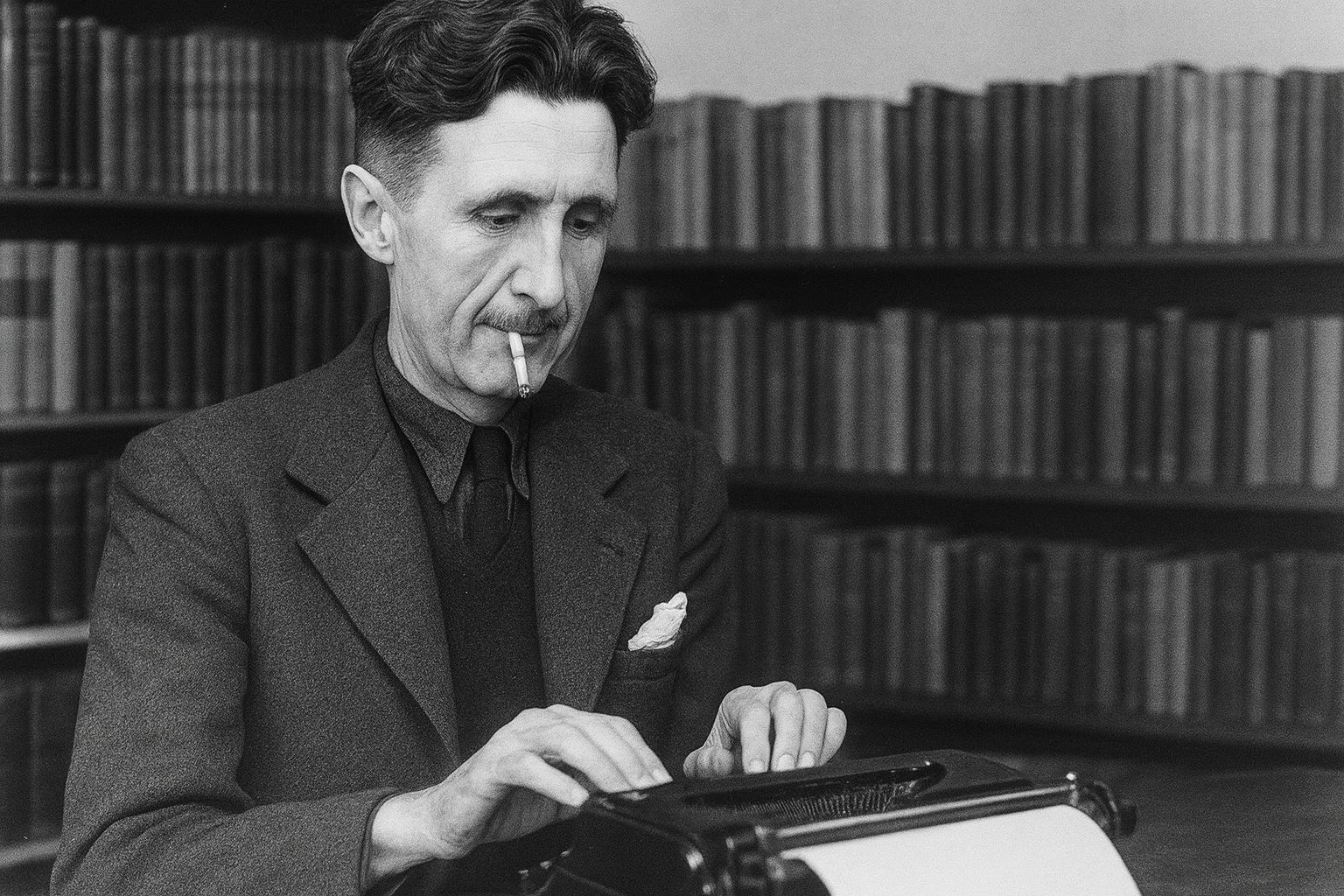
George Orwell was one of the clearest—and most uncomfortable—writers of the 20th century.
Author of 1984, Animal Farm, and a philology teacher. He experienced politics from the inside and understood better than almost anyone that language can either illuminate us or manipulate us. That’s why in 1946 he wrote an essay that remains essential for anyone who writes—especially in the internet age: “Politics and the English Language.”
In it, Orwell distills six essential writing rules for being clear and memorable.
If you write to explain ideas, connect with your audience, or simply think more precisely, these six rules will help you—a lot.
Let’s begin.

Rule 1: Don’t use a metaphor you’ve seen a thousand times
Overused metaphors steal your originality.
When you write “Achilles’ heel” or “time is money,” you sound generic and you don’t make the reader think about your message. Orwell noted that a metaphor only works well if it helps you see something in a new way. A recycled metaphor is just a crutch.
Example 1
Generic: “Time is money, so you must seize every opportunity.”
Original: “Time drips like a leaking faucet: lost opportunity; lost drop.”
Example 2
Generic: “I lived on an emotional roller coaster because of others.”
Original: “My mood swung like an elevator people wouldn’t stop calling.”
Make every image a unique representation.
Rule 2: Choose simple words
Long and complicated words only slow the rhythm of the text.
Orwell observed that writing was more memorable when it was brief and direct, especially at key moments. Avoid long or obscure words if a common one explains the idea just as precisely. Otherwise, you make the reader’s path harder.
George Orwell fully agrees with what Kurt Vonnegut recommended.
Example 1
Complex: “The optimization of resources will enable a significant improvement in the results obtained.”
Simple: “Using resources better will boost results.”
Example 2
Complex: “Artificial intelligence displayed behavioral patterns that evidenced its progressive emancipation.”
Simple: “Artificial intelligence began to act on its own.”
Write so the reader understands the message instantly and never stumbles.
Rule 3: Remove unnecessary words
To be direct, you must drop the ballast.
This relates to the previous rule: using simple words matters, but so does removing everything unnecessary so the valuable parts shine. “Be about to,” “attempt to,” “carry out”—they may sound good, but none says anything that “almost,” “try,” or “do” doesn’t say. That’s just foam: lots of volume, little substance.
Example 1
Long: “Many times we tend to worry in advance about situations that may never happen.”
Short: “We worry about problems that may never exist.”
Example 2
Long: “To create a new habit, it is essential that we begin with a small goal that we can easily maintain.”
Short: “Habits start small—or they don’t start.”
Rules 2 and 3 together: Use accessible language and be direct.
Rule 4: Don’t use the passive voice if you can use the active
Passive voice is an elegant way to hide the culprit.
“Mistakes were made.” By whom? We don’t know. “Decisions were taken.” Who took them? A mystery. Passive voice turns actions into events without an owner. Active voice points a finger. If your sentence sounds stronger in active voice, use it.
Example 1
Passive: “Bad decisions were made.”
Active: “The team made bad decisions.”
Example 2
Passive: “The report was sent late.”
Active: “I sent the report late.”
Use it strategically and only choose the passive voice when it serves the narrative.
Rule 5: Avoid jargon, foreign terms, and technical language
These words are barriers disguised as sophistication.
Academics and experts use them to communicate precisely with other specialists, but for the general audience they add nothing—quite the opposite: they weaken your message. “User-friendly,” “SEO,” “Weltanschauung”—they sound impressive, but they’re usually unnecessary.
Explain it without jargon and your message will connect instantly with everyone.
Example 1
Technical: “Our goal is to optimize the website’s SEO.”
Simple: “We want the website to be easier to find on Google.”
Example 2
Technical: “This concept refers to the author’s Weltanschauung.”
Simple: “This reflects how the author sees the world.”
Rule 6: Break any rule if necessary
Rules exist to help you, not to chain you.
Orwell knew a rigid system can become as harmful as the chaos it tries to avoid. That’s why he left this final door open: if breaking a rule lets you express the truth more clearly, break it without hesitation.
Clarity always wins.
Use a familiar metaphor if it’s the only accurate image: “It was his Achilles’ heel.”
Use a technical term if it’s unavoidable: “Photosynthesis happens like this.”
Use passive voice if the actor doesn’t matter: “The house was built in 1900.”
Remember: you are the reader’s guide through the text—orient them with every word.
If you do that, people won’t just read you to the end this time.
They’ll come back for more.
Want to learn more? Here are 3 related ideas to go deeper:
The 4 rules of Kurt Vonnegut for succeeding as a writer on the internet
The 10 rules of Elmore Leonard for mastering the art of writing
I wrote 300 articles in 500 days: 7 keys to instantly improve your writing
✍️ Your turn: What other rules are essential for better writing?
💭 Quote of the day: “If thought corrupts language, language can also corrupt thought.” — George Orwell, 1984
See you next time! 👋

References 📚
The Orwell Foundation. (Originally published in 1946). Politics and the English Language URL
Lots of writers in Orwell's day wrote for newspapers and learned these principles from stern editors. My old editor often said, 'rite tite.'
Buenos consejos. Y si quieren ver un maestro en esos aspectos, hay que leer a Hemingway.