


Welcome to Mental Garden. The following letter is part of our “Distilling Books” collection, in which we extract the most revealing ideas from literature. For the complete library, click here.
🏷️ Categories: Writing, Creativity, Habits, Motivation.
Some books aren’t just read — they’re lived.
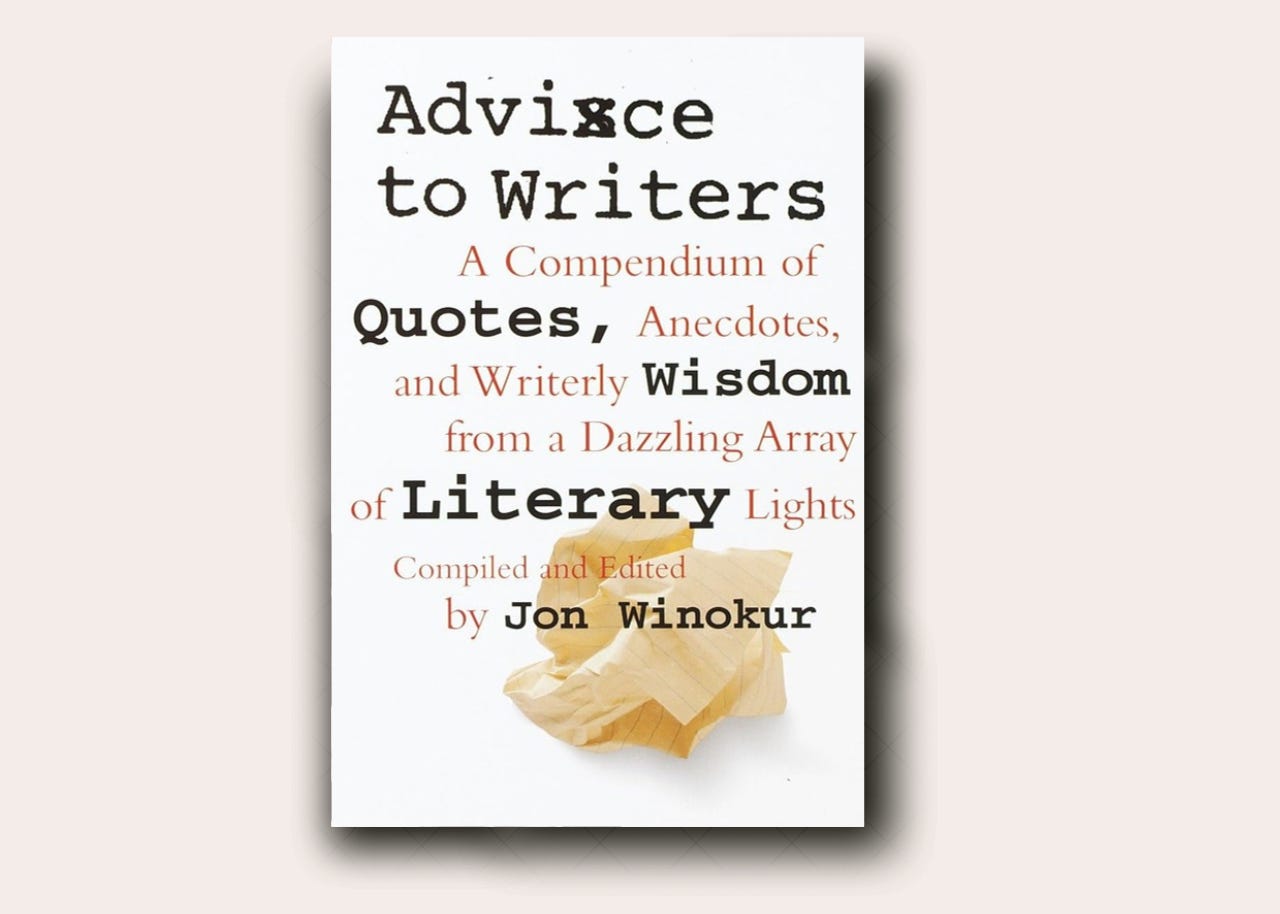
You return to them again and again because you always find a sentence you’d missed before, an idea that now resonates differently, a question you didn’t know you had… Today I want to share such a book with you: “Advice to Writers: A Compendium of Quotes, Anecdotes, and Writerly Wisdom.”
A collection of reflections from some of the greatest writers in history.
These are the kinds of ideas that guide those who write and ask themselves:
“What am I missing? What am I doing wrong? What could I do better?”
This is for you — for creative people, writers in progress, and the innately curious.
Let’s dive in.

1. The Writer’s Routine
“It is by sitting down to write every morning that one becomes a writer. Those who do not do this remain amateurs.” — Gerald Brenan
“It is useful to write at the same time each day. Obligations often pose problems, but one can almost always find an hour or two early in the morning—when the phone never rings and no one knocks at the door. And it is important that you write something, no matter how little, every day. As the Romans said, Nulla dies sine linea (No day without a line).” — B. F. Skinner
“Write even when you don’t want to, don’t like what you’re writing, and aren’t writing particularly well.” — Agatha Christie
“It’s a job. It’s not a hobby. You have to sit down and work, schedule your time, and stick to it.” — Rosellen Brown
“Don’t worry about what others will think, or whether it’s a masterpiece or not. I write one page of masterpiece for every ninety pages of crap.” — Ernest Hemingway
“Cultivate an extreme indifference toward praise and blame, for praise leads to vanity, and blame to self-pity, and both are bad for writers.” — A. E. Housman
“Don’t leave the demands on your time unanswered. Be ruthless and refuse to do what people ask of you.” — Lynne Sharon Schwartz
“If you want to write, write. This is your life. You are responsible for it. You won’t live forever. Don’t wait. Make the time now, even if it’s just ten minutes once a week.” — Natalie Goldberg
2. Finding Inspiration
“You can’t wait for inspiration. You have to go after it with a club.” — Jack London
“Curiosity drives you; it’s the moving force.” — John Dos Passos
“Any writer who finds it hard to write is probably not on their true subject but wasting time on false and trivial goals; as soon as you connect with your real subject, you will write.” — Joyce Carol Oates
“Any life will provide material for writing if you pay attention to it.” — Wallace Stegner
“A writer needs three things: experience, observation, and imagination.” — William Faulkner
“The first secret of good writing: we must look intensely, listen intensely, and taste intensely.” — James J. Kilpatrick
“Too many young writers don’t understand that listening is a key skill in writing.” — Claude Lewis
3. Creating Fictional Characters
“When writing a novel, a writer should create living people; people, not characters. A character is a caricature.” — Ernest Hemingway
“You never know enough about your characters.” — W. Somerset Maugham
“The character who endures is an ordinary guy with some extraordinary qualities.” — Raymond Chandler
“When I used to teach creative writing, I told students to make their characters want something right away, even if it’s only a glass of water. Characters paralyzed by meaninglessness still have to drink water from time to time.” — Kurt Vonnegut
“If you want to know your characters better, ask yourself: ‘How would they behave in an argument?’” — Barnaby Conrad
“The moment comes when a character does or says something you hadn’t planned. That’s when they’re alive.” — Graham Greene
“You should be able to identify each character by what they say. Each must sound different from the others. And not all should sound like you.” — Anne Lamott
4. Building Fictional Plots
“All fiction must be a story. In any story there are three elements: people, a situation, and the fact that by the end something has changed. If nothing has changed, it’s not a story.” — Malcolm Cowley
“Plot grows out of character. If you focus on who the people in your story are, if you sit and write about two people you know and know better every day, something has to happen.” — Anne Lamott
“If the setting is right, the story will arise from the setting.” — E. Annie Proulx
“If in the first act you have a gun hanging on the wall, then it must fire in the last act.” — Anton Chekhov
5. Style
“If the noun is good and the verb is strong, you almost never need an adjective.” — J. Anthony Lukas
“When you catch an adjective, kill it.” — Mark Twain
“The difference between the right word and the almost right word is the difference between lightning and a lightning bug.” — Mark Twain
“If it is possible to cut a word out, always cut it out.” — George Orwell
“The best writing is rewriting.” — E. B. White
“The key is to omit everything except the essential.” — David Mamet
“Read what you’ve written aloud; you’ll learn the rhythms that work for you.” — Nat Hentoff
“Write for yourself and have no audience, rather than write for an audience and have no self.” — Cyril Connolly
“If what you’re writing isn’t for you, it won’t work.” — Stephen King
6. Writing Good Fiction
“What lingers in the reader’s mind is not the sentence, but the effect it created: laughter, tears, pain, joy.” — Isaac Asimov
“People read fiction for emotion, not for information.” — Sinclair Lewis
“Fiction is a lie, and good fiction is the truth inside the lie.” — Stephen King
“Good fiction is made from what is real, and reality is hard to come by.” — Ralph Ellison
“A story should have a single mood, and every sentence should contribute to it.” — Edgar Allan Poe
“Don’t put anything in a story that doesn’t reveal character or advance the action.” — Kurt Vonnegut
7. Writing Good Nonfiction
“You can’t write well without data.” — George V. Higgins
“Facts speak for themselves.” — Norrie Epstein
“A good article doesn’t need an introduction, so don’t start with background, why you became interested in the topic, why the reader should care, or how you gathered your information. Start with a conflict that creates tension, often revealed through a brief example or anecdote and a problem that will be resolved at the end. It’s a good rule to start as close to the end as possible and plunge the reader straight into the central tension. Once you’ve engaged your reader this way, weave in the background facts or context as needed for understanding.” — Donald M. Murray
“A good article builds a bridge to the reader and touches them where they live. The greater the identification, the better the piece. Ask yourself who will want to read your article. If very few, find another idea.” — Louise Boggess
“You can structure an article like a sandwich: two slices of experience, reporting, or data with a manual on the topic in the middle. Find something in your research that you think will interest readers and use it to open the story. When you reach a point that’s likely unknown to them, detour to explain the context, then return to the narrative, and so on throughout the piece.” — Richard Rhodes
8. Inspirational Reflections
“If you want to write, you can. Fear stops most people from writing, not lack of talent—whatever that is. You are a human being, with a unique story to tell, and you have every right. If you speak with passion, many of us will listen. We need stories to live, all of us. We live by stories. Yours expands the circle.” — Richard Rhodes
“Everyone has talent, originality, and something important to say.” — Brenda Ueland
“Keep going. If you are a true writer, you’ll write no matter what.” — Irwin Shaw
“Writing a novel is like driving at night. You can only see as far as your headlights, but you can make the whole trip that way.” — E. L. Doctorow
“Be persistent. Editors change; editorial tastes change; markets change. Too many beginning writers give up too easily.” — John Jakes
“For a true writer, every book must be a new beginning, one where he again tries something beyond his reach. He must always try what has never been done or what others have tried and failed. Then, sometimes, with great luck, he will succeed.” — Ernest Hemingway
“Dream and aim higher than you think you can do. Don’t bother to be better than your contemporaries or predecessors. Try to be better than yourself.” — William Faulkner
“As a writer you are free. You are the freest person who ever lived. Your freedom is what you have bought with your solitude.” — Ursula K. Le Guin
“Ever tried? Ever failed? No matter. Try again. Fail again. Fail better.” — Samuel Beckett
“First, get it down on paper, and then we’ll see what to do about it.” — Maxwell Perkins
“It’s never too late to be what you might have been.” — George Eliot
“Most people quit. If you don’t quit, if you rewrite, if you keep publishing in better places, you’ll realize that the question isn’t ‘What’s the secret?’ but ‘Are you having fun?’” — Robert Lipsyte
“The most essential gift for a good writer is a built-in, shockproof crap detector.” — Ernest Hemingway
“The question of talent is irrelevant. I see perseverance, diligence, will, will, and more will; desire, desire, and more desire to write.” — Gordon Lish
“Write for free until someone offers to pay you.” — Mark Twain
What to Do Next
This is where many stop.
They’ve read quotes that spark something. Maybe they even underlined an idea that hit hard. But then… they freeze. And that’s exactly what I don’t want you to do. After this journey through the wisdom of the greats, it’s natural to have questions and the urge to dig deeper.
We’re not stopping at a handful of quotes — we go further.
If any of these ideas left you hungry for more, here’s a little guide for exploration — articles worth diving into for hours, underlining until your pencil breaks, and emerging with new ideas (and better writing):
Creativity Is a Process, Not an Event: The Key to Creativity
How I Avoid Creative Block and Stop Staring at the Blank Page
4 Ways to Make Your Writing Stand Out: Be Different, Not Better
Inspiration Doesn’t Exist: Discipline Lessons from Camilo José Cela
✍️ Your turn: Which quote resonated with you the most? Personally, I think Richard Rhodes’s advice on nonfiction writing holds the most important key — it’s what separates a dull article from a revealing one.
💭 Quote of the Day: “Learn to write and stop worrying about the damn statistics. If you like statistics, be an accountant.” — Jim Murray
See you next time! 👋

References 📚
Winokur, J. (2000). Advice to Writers: A Compendium of Quotes, Anecdotes, and Writerly Wisdom from a Dazzling Array of Literary Lights.