


Welcome to Mental Garden. The following letter is part of our “Distilling Books” collection, in which we extract the most revealing ideas from literature. For the complete library, click here.
🏷️ Categories: Decision making and biases.
We live in the noisiest era in history.
Every day, thousands of messages compete for your attention: urgent headlines, self-proclaimed experts, tweets with “scientific” facts, reels full of questionable advice, and articles like this one promising to give you “the key.” It’s overwhelming. It’s exhausting. And worst of all: it’s easy to give up and believe that if everyone disagrees, then nothing really matters.
But it does matter.
Because some ideas are better than others. Some facts are stronger than others. And even though we live in a storm of information, distinguishing the signal from the noise is still possible — in fact, it’s more urgent than ever.
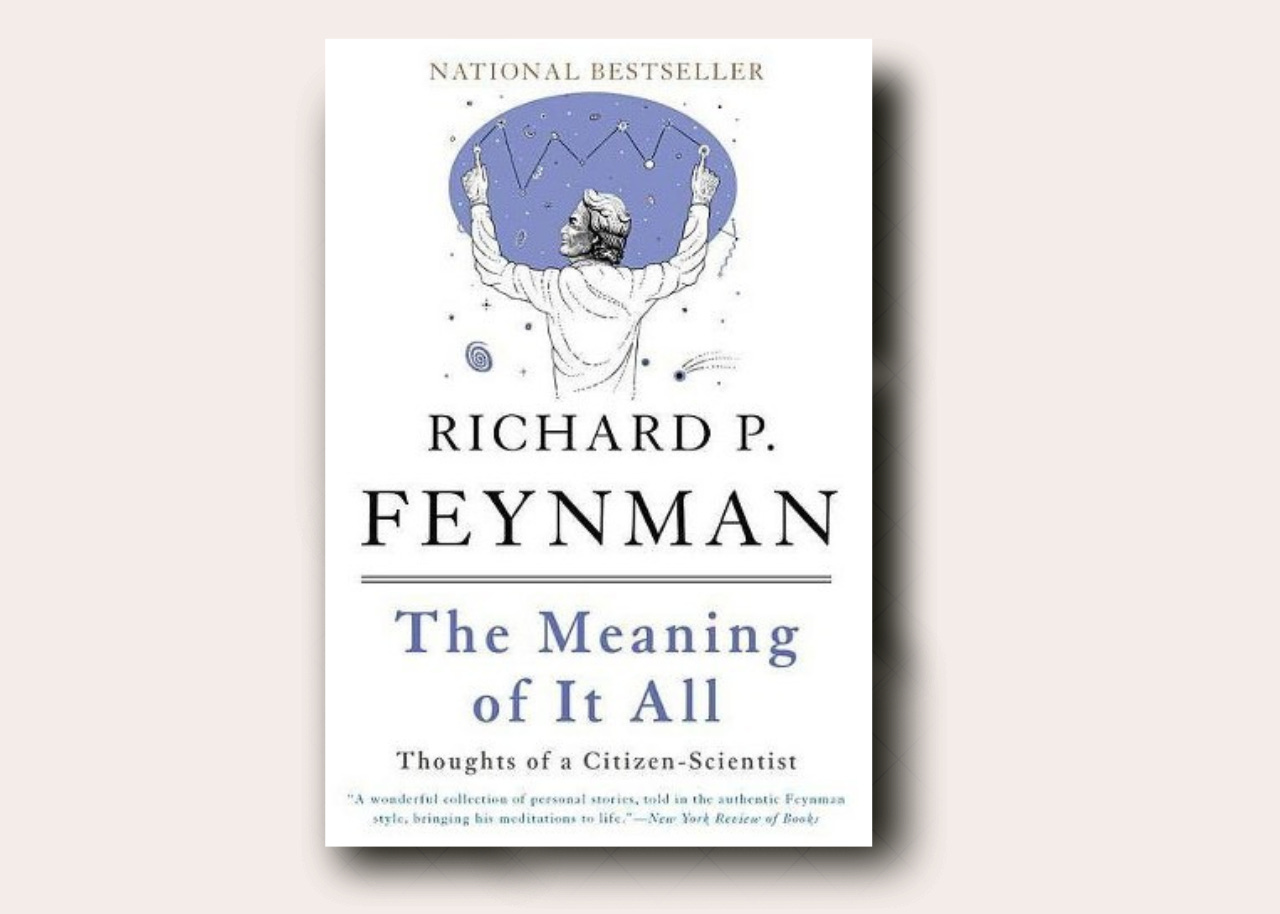
Richard Feynman — yes, the physicist, the Nobel laureate — revolutionized quantum physics, but he also had an obsession: learning and thinking clearly. How not to be fooled. How to know if something is true in a world where everyone claims it is. He wrote a revealing book on this topic: The Meaning of It All.
Today, we’ll step into his mental toolbox.
We’re going to sharpen our thinking so that the next time you read a headline, hear an opinion, or see an impressive claim... you’ll know what to do with it.
Here are Feynman’s 7 principles for finding the signal amid the noise.

1. Does this person really know what they’re talking about?
The message matters — but so does who says it, and how they say it.
To evaluate how deeply someone understands a topic, ask them questions.
“If you ask intelligent, penetrating, honest, frank, direct questions about a subject, and the person instantly runs out of answers, they probably don’t really understand it.”
— Richard Feynman, The Meaning of It All
This trick is based on a simple but powerful technique: asking reflective questions.
A person who truly understands something can explain it clearly, reason from first principles, use helpful analogies, and admit what they don’t know. By contrast, someone merely repeating others’ ideas will quickly run out of arguments when pressed for depth. Test people with the Feynman Technique.
Feynman mentions in his book a great example about an agricultural problem.
Politician A gives quick, confident answers, acting as if he knows everything and holds the solution. Politician B, meanwhile, recognizes the complexity of the issue, proposes gathering experts, and working on a joint solution over a few months. Politician A mocks B for his “incompetence” and wins public attention and media favor. But Feynman valued B’s honesty in admitting he didn’t know everything.
Be wary of those who always have instant answers.
2. Update your knowledge like a scientist
Very few ideas are absolutely true.
We tend to think in absolute terms (true/false) because it’s easier than thinking in probabilities, but the reality is that everything we believe today could change tomorrow with better evidence. Isaac Asimov explained this brilliantly when describing how humanity discovered the Earth’s shape.
What matters is adjusting your beliefs as new evidence appears.
If a theory predicts blue and you see green, be cautious. The theory may not be entirely wrong, but it’s probably less accurate than you thought. Seek more evidence, find similar cases, and compare all possible explanations. The one that best fits the evidence you gather will be the strongest.
No idea is entirely true — but with every new piece of data, it can get closer.
3. Improve your experiments, and your evidence will improve
Have you noticed how spectacular ideas often collapse under rigorous study?
When we investigate something, the evidence should become stronger as we perform better experiments, not weaker. If it weakens, the initial result was probably luck or observational error.
It happens to us all the time.
We take a personal experience as truth without testing it rigorously.
Feynman recounts the case of telepathy: early studies showed surprising results about people guessing others’ cards, but later, more controlled experiments proved it false.
Be careful — an impressive data point can come from a terrible experiment.
4. Don’t confuse possible with probable
The right question isn’t “Could this be true?” but “How likely is it to be true?”
Is there life on other planets? Possible.
Is your horoscope right today? Possible.
Can an alternative medicine cure you? Possible.
It’s easy to be dazzled by what’s possible, but what matters is how probable it is based on the evidence. Feynman mentions UFOs: of course it’s possible that extraterrestrial life exists — even that it visits us — but… how probable is it?
Possibility is binary (yes/no).
Probability is a gradient (0% to 100%).
Many things are possible, but not all are equally probable.
When you hear something surprising, ask: are they talking about what’s possible, or what’s probable?
5. First theorize, then test
You can’t judge the probability of something after it’s already happened.
If you notice a pattern (say, in a chart), you can’t call it a trend yet. You must create a new experiment specifically designed to test your theory — using fresh data — and see if the pattern repeats.
First build your theory, then test it. That’s how you avoid hindsight bias.
Feynman tells the story of a psychologist who observed during an experiment that mice alternated directions when choosing paths (left, right, left...). That observation can’t be confirmed yet. You must design new experiments specifically to test that pattern and repeat them to see if it holds.
For a result to matter, you must predict it first — and then see if it happens.
Always apply this to your opinions and theories so you don’t fool yourself.
Make your prediction.
Check if it holds.
6. One case proves nothing
“My aunt smoked her whole life and lived to 90” doesn’t prove smoking isn’t harmful.
Studies involving thousands of people say otherwise.
To conclude that something is true, you need lots of data — and diverse data. Truth rests on reliable samples. As Feynman said: if you want to know what percentage of people are taller than 1.80 meters, don’t just measure your basketball friends.
Sounds silly, right?
Yet we often believe information based on silly samples without realizing it.
Someone saying, “It worked for me” proves nothing. Choose a solid sample.
7. Seek more information
Many errors come not from thinking badly, but from not knowing enough.
Sometimes we believe things simply because we don’t know enough to see they’re false. A classic example is astrology. Believing that Mercury retrograde affects your mood might sound plausible — until you learn that retrograde motion is just an optical illusion seen from Earth. No force is actually involved.
So why does it seem to make sense to so many people?
Because with the information they have, it seems to make sense. Without knowledge of astronomy, physics, statistics, or experimental design, it’s understandable. It’s the same case Asimov described with the Sumerians, who believed the Earth was flat — because with the information they had, that was the logical conclusion.
Seek information that contradicts your beliefs — avoid confirmation bias.
As Charlie Munger said: “You’re not entitled to an opinion on a subject unless you can argue the other side better than your opponents.”
Richard Feynman wanted you to learn to think for yourself — to observe, to question, to have the humility to change your mind, and the courage to say “I don’t know.”
In a world this noisy, clear thinking is a superpower.
What would happen if you applied these principles the next time you saw a shocking claim, a viral video, or a loud opinion?
What if you applied them even to your deepest beliefs, your opinions, or your theories?
That’s how you’ll find the signal amid all the noise.
✍️ Your turn: Which of these techniques do you already use in your life?
In my case, I use number 2 every day. The more I research, the closer I get to firm conclusions — and sometimes I’m amazed by how much my opinion on the same topic has changed.💭 Quote of the day: “The first principle is that you must not fool yourself — and you are the easiest person to fool.” — Richard Feynman
See you soon! 👋

References 📚
Feynman, R. P. (2009). The Meaning of It All: Thoughts of a Citizen-Scientist.