


Welcome to Mental Garden, a newsletter about creativity, focus, and systems for writing and building projects on the internet. To explore the full library, go here.
The following letter is part of our “Notes on Giants” collection, in which we explore the thoughts and lives of humanity’s greatest minds.
🏷️ Categories: Writing, Creativity
Kurt Vonnegut is a writer who knows how to stay with you.
If you’ve ever read one of his novels, you know what I mean. His writing makes you smile at the absurdity of it all, but a second later, it leaves you staring into the void, wondering what the true meaning of being here really is. He mastered the art of words and was a generous teacher, which is why he used to remind his students that their first job is to grab the reader’s attention and their second is to take care of it so they don’t leave. You have to give them an addictive story.
It doesn’t matter whether you’re writing your next short story, screenplay, novel, or newsletter—you’ve probably faced the same questions that haunt me in the morning: How do I connect this idea with the person on the other side? How do I make them stay?
Today, I want to break down with you the seven writing rules Kurt shared in the preface to his book Bagombo Snuff Box, and tell you how they’ve helped me shape the rhythm of everything I write.
Let’s take it step by step.
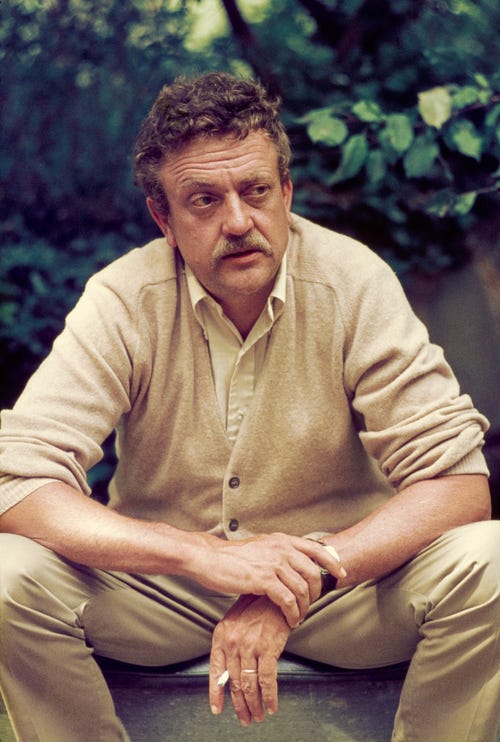


Kurt Vonnegut’s 7 Rules
1. Use people’s time in a way that makes them feel it was time well spent
Time is the scarcest and most valuable resource we have. Deep down, it is our life. Reading is one way of spending that time, perhaps one that is increasingly endangered in an age of endless short-form video content. For this reason, your reader should leave knowing they received something they didn’t have when they arrived.
Don’t think of anything too lofty. It could be something as simple as:
A lesson
An emotion
A practical idea
A new perspective
This applies to both fiction and nonfiction.
Think of movies like Interstellar, which gives you a profound reflection on time, love, and the future of humanity; or Homer’s Odyssey, which connects us with Greek mythology through an epic adventure filled with emotion; or even this article of mine, which aims to give you a practical insight for your writing.
Always write with this value proposition in mind.
If, when you finish your work, you can’t point to the benefit of reading it, revise the work.
2. Give the reader at least one character to root for
It doesn’t matter whether your protagonist is your own audience trying to get through a gray day, a warrior in a distant world, or simply an inanimate object.
We all need someone to accompany us through the fog. Only when we get the reader emotionally invested will they be willing to hold that character’s hand through every stumble along the way. This is also a key principle that the artists at Pixar emphasize when making their successful films.
And yes, this is obvious in fiction, but it remains useful in nonfiction.
When I write an article, or when you examine the successes of the genre, one key to success is weaving it together with a story. We empathize because the author strips themselves bare and tells us about their process from the same mud we’re standing in today, or because they bring forward the experience of someone who has already climbed out of that mud. It’s simple: we don’t fall in love with data; we fall in love with people and stories.
On the most intimate level: We see ourselves in the vulnerability and hope trapped within The Diary of a Young Girl.
In personal development: We see ourselves in the mice from Who Moved My Cheese?, dealing with the fear of change.
In psychology and survival: We see ourselves in Viktor Frankl in Man’s Search for Meaning, looking for purpose in the middle of chaos.
If there’s no “someone” to hold on to, it’s very hard for the reader to stay.
3. Every character should want something, even if it’s only a glass of water
Desire is the heartbeat that keeps a story alive.
Think of The Big Lebowski: an entire movie revolving around a man who simply wants to get his rug back. Now, every time you review your paragraphs, ask yourself: What is this character really looking for? Answering that question gives the plot a clear direction at all times.
In Finding Nemo: Everything boils down to a father who simply wants to find his son.
In Gladiator: The driving force behind an entire empire is a man who only wants to avenge his family and return home.
In The Lord of the Rings: Despite its epic scale, the plot is as simple as two friends who want to throw a ring into a volcano.
You can make things as intricate, profound, and expansive as you want, but at their core, things are quite simple. Have a clear premise and build around it.
4. Every sentence should either reveal character or advance the action
This is one of the best editing principles there is. In short fiction, where Kurt was an expert, if a sentence doesn’t reveal something about a character or move the story forward... simply remove it.
Your reader will thank you.
And in nonfiction, the same rule applies: every sentence should move toward a new idea or develop the value of what you’re explaining. If a paragraph doesn’t deepen the subject or take you to the next step, it’s filler.
The masters of nonfiction get straight to the point and make every line count:
In The 7 Habits of Highly Effective People: Stephen Covey doesn’t waste time; each principle is broken down with clarity and pragmatism.
In Atomic Habits: James Clear cuts out the fluff to give you a manual where every line is a precise instruction for using the method.
Conciseness and clarity don’t take away depth. Quite the opposite: in many works where the reader’s goal is to want to know more, they amplify it. Read with your scissors in hand and cut everything that doesn’t take the reader toward what they want to know.
5. Start as close to the end as possible
This is crucial in short formats such as short stories and newsletter-style nonfiction.
Cut the unnecessary preambles and let your reader fall straight into the heart of the story. Starting in the middle of the action, what narrative calls in medias res, is exciting for you as the writer and transfers that same pull to the person reading.
It’s the key to succeeding in short formats like the short story, and it applies to nonfiction too.
Long introductions are obstacles in the path of a modern reader who lives in a hurry. Your opening should immediately make the value of staying clear. Don’t beat around the bush—present the problem, promise the solution, and get started.
Look at the introduction to this article as an example. In just three paragraphs, I told you:
Kurt Vonnegut was a master at hooking readers.
He taught his students to do the same.
Are you struggling to connect people with your ideas and make them stay?
Stay, because here are his seven expert rules to solve that problem.
If the topic interested you, you were hooked instantly.
6. Be a sadist
No matter how sweet and innocent your characters are, make terrible things happen to them.
This is also the golden rule of Pixar movies: We fall in love with the characters’ struggle, not their easy success. It’s only in the storms that we get to see what they’re made of, and we love them because they reflect our own imperfections—we see people who, deep down, are just like you and me.
It’s what I was saying earlier about nonfiction: connect with stories of people who climbed out of the mud and explain how they did it so they can help you.
7. Write to please just one person
There’s an unfounded idea that publishing on the internet means speaking to an auditorium full of people.
That’s not how it works.
If you try to make the entire world fall in love with your work, your voice will become diluted. Look at the content that goes viral: it tends to be superficial because it needs to appeal to the lowest common denominator to reach everyone. In that process, it loses all its charisma because it has to be capable of touching everyone—and every person is a universe when you go deep enough.
Instead, if you write with one specific person in mind—with their doubts, their fears, what they need to read today—something magical happens. The magic of platforms like Substack is that success isn’t measured in millions of empty clicks. The artist’s value lies in connecting with a small community of souls who resonate with your art, support your work, and take part in the process. The ongoing exchange of comments and events creates a bond between you and your readers, between all of us.
Think about your ideal reader, write only for them, and let the others find their way to you.
Return to the basics when you feel lost
Which of these rules resonates most with your own mental space? I tend to come back here whenever I get stuck halfway through a draft. If these lines manage to accompany you in your own process or spark your curiosity to discover the work of this fascinating author, then the journey will have been worth it.
Thank you for being here with me for another day.
Take care.
— Álvaro
Want to know more? Here are 3 related ideas to explore:
P.S. I also offer 1:1 consulting to help you grow on Substack.
If you’re just starting out and don’t know how it works, or if you’ve been at it for a while but are stuck, this will help you. I’ll help you find your direction, position yourself as a leader in your niche, and build a system tailored to your needs for sustainable growth.
My credentials? Over 100,000 global readers in 2 years, 100% organic growth, with 300,000 monthly visits. All from scratch, writing all by myself in my spare time.
If you’re interested, email me at: jardinmental@proton.me
References
Vonnegut, K. (1999). Bagombo Snuff Box: Uncollected Short Fiction.
A practical and engaging article that reminds writers they must earn and keep the reader’s attention. Vonnegut’s rules are timeless, and the emphasis on clarity, purpose, and respecting the reader’s time is especially valuable. Which of these seven rules do you think is the hardest to consistently follow?
Really nicely presented, Alvaro. Your Mental Garden is a rich plot, indeed!