


Welcome to Mental Garden, a newsletter about creativity, focus, and systems for writing and building projects on the internet. To explore the full library, go here.
🏷️ Categories: Decision-making and biases, Attention.
When I first started writing on the internet, I was fascinated by the idea of breadth.
Substack was an unconventional window onto the whole world. Opposing opinions, distant cultures, ideas I never would have discovered in my immediate surroundings. “How great,” I thought, “a place that doesn’t just give me back what I already think.”
But something has changed.
Today, instead of opening windows, it has become a mirror. A polished mirror, designed by algorithms, that does not show the world, but rather an edited version of what we already think, what we already believe, what we have already clicked on before. Substack Notes is just another Twitter, another TikTok, another mirror.
And what is most unsettling is that this has become the global trend.
Today we are going to look at how algorithms shape your view of reality, impoverish democracy, and ultimately may decide the future of countries.
Yes, just like that…
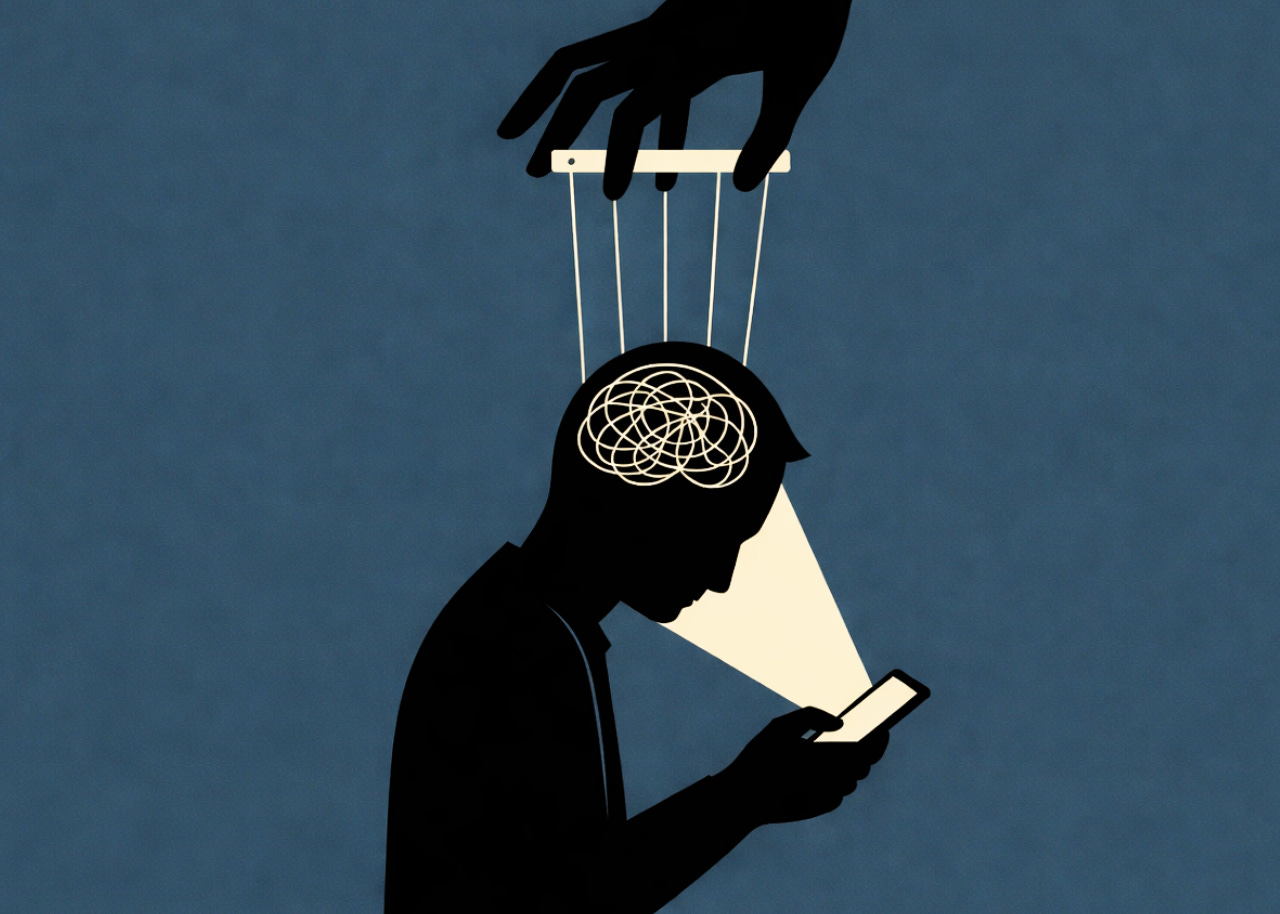

The filter bubble
The first warning came in 2010.
Eli Pariser, an activist for a free and open internet, coined a term we should remember today: “filter bubble.” It refers to that “personal universe of information” that surrounds you every time you go online. It refers to that perfectly trimmed version of reality designed to fit your way of thinking that all apps offer.
Facebook, Google, Instagram, Twitter, TikTok… it is everywhere.
The mechanism is simple: when you use their service, they analyze your behavior, measure it with the data they collect when you accept “cookies,” and then decide what to show you.
Facebook stopped showing Pariser posts from some of his friends because he tended to click on others’, which made those friends effectively invisible.
Google even personalizes results for the exact same search. Two people type “Egypt” at the same time, and one sees tourism as the dominant option while the other sees political protests and economic data.
TikTok took this to the extreme: you do not even have to search for anything anymore. The algorithm decides what you will see. You just passively swipe your finger.
What used to be a mixed “information diet”—a bit of vegetables, a bit of meat, a dessert—is now a single meal: your favorite dish all day long.
And just as that kind of unbalanced diet would throw your body off, the same thing happens to your mind.
The user’s role
It is tempting to blame only the algorithms, but we feed them.
A study by Bakshy et al. (2015), involving 10 million Facebook users, revealed something striking: the algorithm reduced exposure to opposing news by 10%, but users themselves reduced it even more by following accounts that reinforced their worldview and making opposing views invisible.
We see less diversity because the system decides it, and because we prefer it that way.
We prefer to confirm what we already believe because it is more comfortable to be told we are right than to question what we have always thought. Psychology has a name for this: confirmation bias. And technology has turned it into a business.
Nicholas Carr warned about this in his book The Shallows, which we have already analyzed.
“The media we use end up shaping our minds.”
Every click trains the algorithm.
Every like predicts what you will see next.
Every scroll makes you more and more certain of your beliefs.
A world where everything tells you that you are right is a world where no one ever learns.
The power of algorithms
Up to this point, it might seem like an individual problem, but it is collective.
The data show that the impact is political, massive, and silent.
In 2015, Robert Epstein showed, with nearly 5,000 undecided voters, that a simple bias in Google rankings could shift electoral preferences by as much as 80% in vulnerable groups. What the algorithm showed—and hid—in the final days was critical in moving voting intentions.
What is most disturbing is that this kind of manipulation is invisible.
Because we are the ones doing the searching, and there is no one visibly on the other side, we do not realize that what we find online may be biased or that other sources are being hidden from view. If a television network could shape public opinion, imagine what happens when a single company controls 90% of a country’s searches…
That is the great power of algorithms compared with previous forms of mass media.
But the effect does not end there: it creates the illusion of unanimity.
The danger of these echo chambers is that you lose the ability to criticize other points of view, ignore risks, and begin to feel that consensus is the same thing as truth. And the most sinister part is that this happens while we hand over data from our everyday lives in exchange for this “personalization.” What was once an anonymous space is now a machine that knows what you buy, what you read on Kindle, which pages you bookmark, even which intimate doubts you type into a search engine.
A simple trade: entertainment and convenience in exchange for your privacy.
The ethics of algorithms
Eli Pariser sums it up with an idea that is worth reflecting on…
If algorithms have become our new content editors, then who decides what deserves to be seen and what remains hidden? Who determines what is relevant and what is not? Today it is no longer traditional media, the press, or television that play this role. Now it is the big tech companies, which define the “ethics” of algorithms and determine what to prioritize and what to make invisible to your eyes.
In the end, algorithms only understand clicks: the real difference depends on the interests, decisions, and values of the humans behind them.
Getting out of the bubble is not comfortable.
But discomfort is the price of freedom.
Want to learn more? Here are 3 related ideas to go deeper:
Stop Watching the News: Ideas on noise and the search for depth
Are Your Opinions Really Yours? The work involved in having opinions of your own
✍️ Your turn: What concrete steps could you take today to broaden the diversity of the information you consume?
💭 Quote of the day: “There are a great many things in this our world that you have not yet started wondering about.” — Roald Dahl, James and the Giant Peach.
See you next time! 👋

References 📚
Bakshy, E., Messing, S., & Adamic, L. A. (2015). Exposure to ideologically diverse news and opinion on Facebook. Science, 348(6239), 1130-1132. URL
Epstein, R., & Robertson, R. E. (2015). The search engine manipulation effect (SEME) and its possible impact on the outcomes of elections. Proceedings Of The National Academy Of Sciences, 112(33). URL
Pariser, E. (2011). The filter bubble: How the New Personalized Web Is Changing What We Read and How We Think.
This is all so true. What's more, the algorithms have learned to censor those who "argue" in the comments, oftentimes abusively, and that also controls what can be said online. It took this cantanerous old lady quite a while to learn proper manners on Facebook: how to write an opposing opinion in a way that wouldn't trigger both the algorythm to censor me and to give an opposing insight to another commenter. It's quite a steep learning curve sometimes. And of course, Americans don't really know how to behave in a civil manner anymore ... that is, if they ever did. The folks who came to this continent from other countries were usually the misfits, outcasts, and ne-er-do-wells who brought their nasty behaviors with them. Thus, the Wild West occurred and still exists today. The algorythms are one way to sort out that kind of behavior.