


Welcome to Mental Garden, a newsletter about creativity, focus, and systems for writing and building projects on the internet. To explore the full library, go here.
🏷️ Categories: Writing, Mental models, Continuous improvement, Habits.
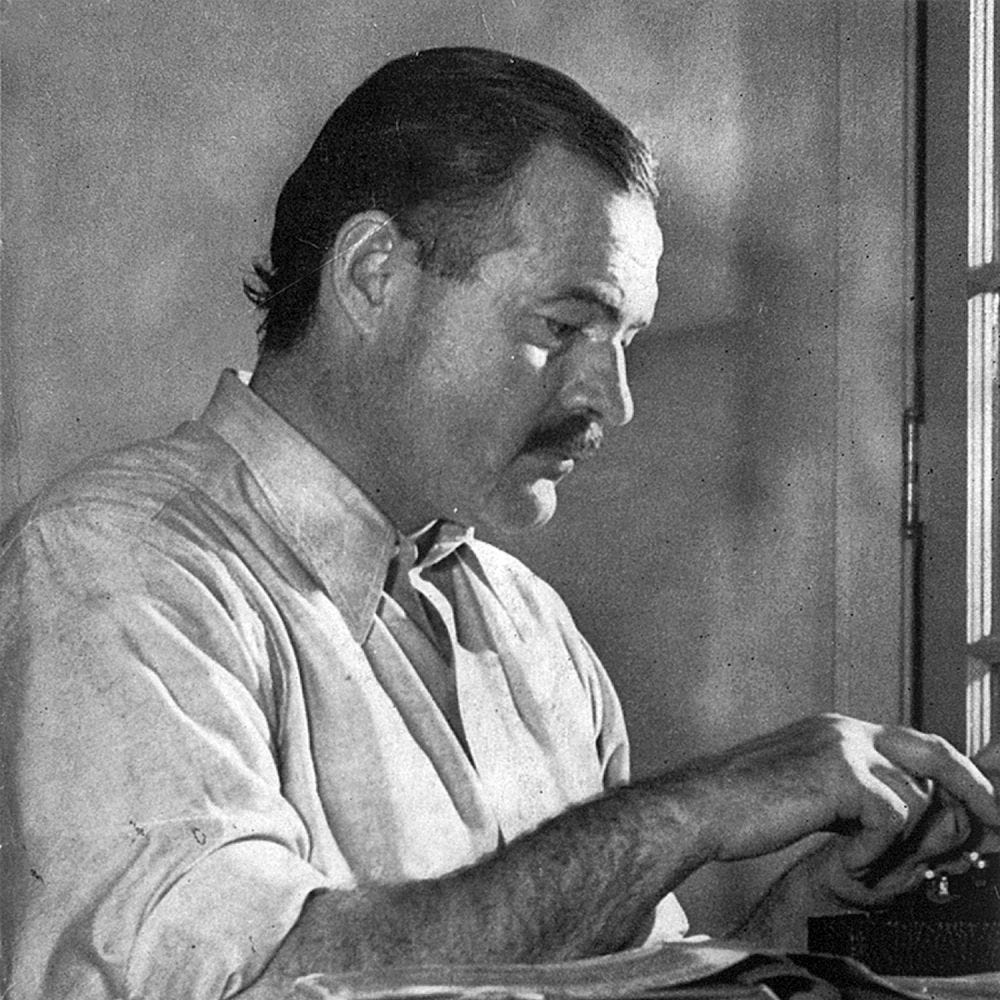
Ernest Hemingway finished some of the most influential works of the 20th century without resorting to epic writing marathons or depending on bursts of inspiration.
How did he do it?
By following a simple strategy.
Hemingway wrote every morning, as soon as the sun rose. Sometimes he started at six and continued until noon. He didn’t seek to write the maximum possible in a single day, he only aimed to write a little, well, and come back the next day. In fact, he kept a detailed record of his daily output. His daily figures were modest: 450, 575, 462, 512 words. On the most intense days, he could reach 1250 words, but those were the exception, not the norm.
Now compare that to the classic idea of the writer who locks himself away to write like a madman.
That writer has a very high maximum speed: perhaps 20 or 30 pages a day. For weeks he writes and writes like a man possessed until he finishes a book. However, after a few weeks at that unsustainable pace, either the book gets finished… or the writer does. Hemingway, on the other hand, rarely hit spectacular peaks. His secret wasn’t in the maximum speed, it was something much more important.
His average speed.
Day after day, year after year, his sustained pace was much higher than that of most people.
This principle goes far beyond literature, think about it.
Anyone can feel a burst of motivation, go to the gym and train like a beast for one day. That’s maximum speed. We spend a lot of time obsessed with it, too much time.
Did you feel motivated?
Did you train hard?
Did you give 110%?
But… what happens if you look at the average?
How many days did you train last month?
And in the last three months?
And last year?
Here a key idea appears that we already explored in Mental Garden: the second failure is what crushes speed. It’s not skipping 1 day. It’s failing… and then failing again. That’s where the average collapses and the habit loses rhythm (Avoid the second failure).
Hemingway knew this, that’s why he stopped while he still knew how to continue tomorrow.
“Write until you reach a point where you still have juice left to squeeze and you know what’s going to happen. Stop there.” (Hemingway, 1954). He always wanted to have ideas in reserve to keep going the next day. He wasn’t looking to squeeze the day to the maximum.
He was looking to secure the next day.
But he was also a fishing enthusiast. That’s why he said his highest word-count days were days when he worked hard in order to spend the next day fishing (Hemingway, 1954). So, the pace was constant, modest, but unstoppable.
When you look at life this way, you notice something uncomfortable: we love maximum speed. Maybe it’s very high, extremely high, but only once in a while. And your average speed is much lower than you’d like. This applies to almost everything in life.
Health
Work
Relationships
Personal projects
Let’s explore this idea in depth.

The power of average speed
Here’s the surprising thing: it doesn’t take much time for a decent average speed to produce extraordinary results.
It’s the mechanism I shared when we talked about the enormous power of exponential growth: small daily increments seem insignificant at first, but over the long term the performance skyrockets.
Writing 500 words a day isn’t impressive.
Reading 10 pages seems like very little.
Training 30 minutes, the same.
But when you look at your trajectory over the long term, the progress is huge.
Hemingway did it this way. Writing between 400 and 600 words a day has nothing attractive about it. However, sustained over months and years, that average builds novels, Nobel Prizes, and a literary legacy. Hemingway didn’t work very hard.
He was just more consistent than most.
And here comes a great lesson…
Do things you can sustain
This is perhaps the most valuable lesson in life.
Hemingway didn’t write until exhaustion. He stopped before that, he said so himself. He made it very clear that he preferred to maintain the pace rather than squeeze out maximum performance in a single session. Which connects exactly with a central idea of Mental Garden: do sustainable things.
The long-term progress that yields results happens in the sustainable range.
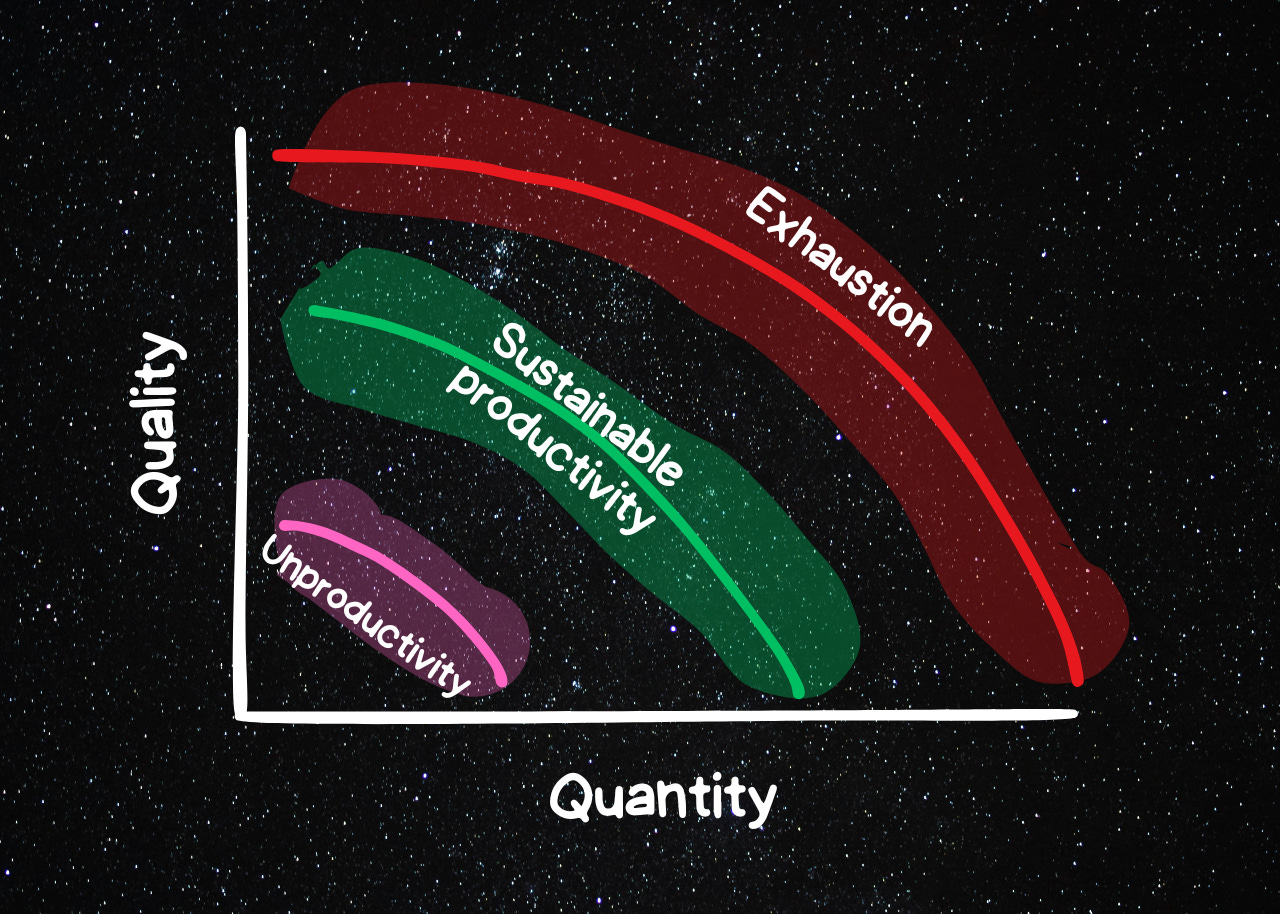
The lower limit protects us from laziness, and the upper limit protects us from burnout.
I’ve been writing for 2 years. I started at a low frequency, my lower limit was 1 article per week. As I developed the writing habit, I increased the frequency until I found my sustainable range, which in my case is 1 article every 2 days.
Could I write more? Yes.
Is it worth it? No.
I’d be exhausted and would neglect rest time, exercise, family and friends. Think about your daily habits, calibrate their intensity so it’s sustainable. Just as Hemingway did when he spoke about his two passions: writing and fishing.
Now think about yourself.
How to increase your average speed without burning out
The sustainable productivity range isn’t static, keep that in mind.
Once you’ve formed the habit and calibrated its optimal intensity, you can go further. To do this, you must eliminate what drags you down and boost what drives you forward. Here’s an example.
Don’t write more hours, study writing techniques and you’ll write better.
Don’t write more hours, have a plan B if you have creative blocks.
Don’t write more hours, just reduce distractions.
By eliminating those small losses and boosting the key skills, you achieve more with equal or less effort. Start your habit incredibly small and increase it until you find your sustainable speed. From there, analyze what drags you down and what drives you forward.
In the long term, this mindset changes everything.
Anyone can push themselves at 200% for one day. Very few come back consistently week after week. Hemingway went back to writing the next day and didn’t rush to go faster. The key is to be aware of your average speed and understand that a small constant change can multiply your results.
In writing (and in life) titanic efforts aren’t necessary.
Constant speed is necessary.
— Álvaro
Want to know more? Here are 3 related ideas to go deeper:
P.S. I also offer 1:1 consulting to help you grow on Substack.
If you’re just starting out and don’t know how it works, or if you’ve been at it for a while but are stuck, this will help you. I’ll help you find your direction, position yourself as a leader in your niche, and build a system tailored to your needs for sustainable growth.
My credentials? Over 100,000 global readers in 2 years, 100% organic growth, with 500,000 monthly visits. All from scratch, writing all by myself in my spare time.
If you’re interested, email me at: jardinmental@proton.me
✍️ Your turn: What’s your average speed in your daily habits? What small change could you make today to expand your sustainable limit through less drag and more drive?
💭 Quote of the day: “Write and then read what you have written until you reach a point where you still have juice left to squeeze. Stop there.” — Ernest Hemingway in 1958, interview for The Paris Review.
References
Ernest Hemingway, The Art of Fiction. (1958). The Paris Review. URL
You've just made me feel better about my attitude toward practicing my piano tunes. I've built a repertoire of 24 pieces that I want to keep in my memory. It's difficult to play the entire catalog in one swoop, but I do it now and then ... to my frustration. Some pieces get lost and I have to recover them. That's because the onus of doing the entire thing creates days where I don't practice at all. That's when things get lost. But, I've discovered that if I get the urge to play a piece or two without distractions, and I get through them in a way that's pleasureable, I'm more apt to practice more. Doing this daily, just short bursts of inspired time devoted to my music and even my writing produces better results. But I feel guilty about not putting in hours of perfect practice time. BOSH! You've helped me understand that it's not the volume of time spent at maximum output. It's the brief sessions when perfection melds with inspiration and pleasure that creates the product as well as the buzz. Hemingway worked until the inspiration and energy waned. He was satisfied with the day's output. And your article points out that bliss so well. Thank you, Alvaro.
and where or from whom can I learn writing techniques? do you have some essays about it —yours or others’?