


Welcome to Mental Garden, a newsletter about creativity, focus, and systems for writing and building projects on the internet. To explore the full library, go here.
🏷️ Categories: Deliberate practice, Writing, Continuous improvement.
Some time ago (as life would have it) I went to Paris and visited the Louvre…
I walked in eager to get lost among masterpieces. What struck me were the hallways, not the artworks. There were entire rooms almost empty next to a single hallway packed with people waiting to plant themselves for two seconds in front of a single painting: the Mona Lisa.
What’s going on with them?
People ignored work after work, just to reach one. Always the same one. It didn’t matter where they came from or what they knew about art. So I started researching the psychological and mathematical mechanisms behind this phenomenon… If we put it in numbers: the Louvre has about 35,000 works, but the Mona Lisa alone easily accounts for 80% of the photos taken in the museum. One work. Out of 35,000.
The issue goes beyond the Mona Lisa.
The pattern is everywhere once you learn it, and it all started in the 17th century, when a mathematician named Jacob Bernoulli ran a statistical test you could do at home on a boring afternoon: What can you say about the result of flipping a coin? A single flip tells you nothing (it can land heads or tails). If you flip that coin a hundred times, the pattern starts to emerge, right?
The result will be roughly 50% heads and 50% tails, correct?
That experiment, where there are only two possible outcomes and the probability of each attempt is always the same, is called a “Bernoulli trial.” Every time you publish something on Substack, you’re running a trial, like flipping coins.
The formula goes like this: if your probability of success per attempt is p, your probability of getting at least one success in “n” attempts is 1 − (1 − p)^n.
Okay, that might be too abstract. Let me show you with an example:
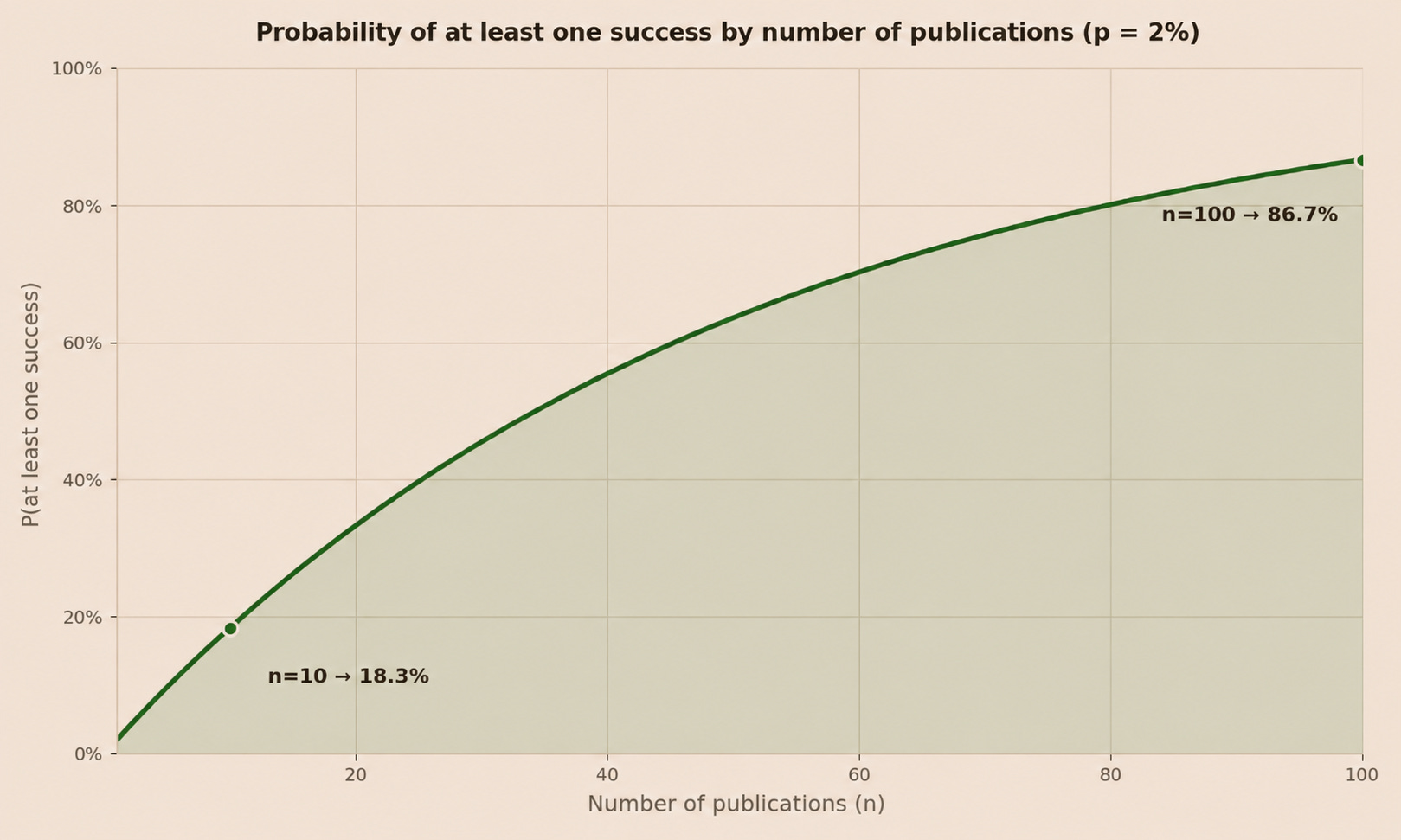
With a 2% hit rate (2% of texts go viral) and 10 articles, your probability of hitting (something going viral) at least once is 18.3%
With that same hit rate and 100 publications, your probability is 86.7%
From 18.3% to 86.7%. Your talent didn’t change, but you gave your talent many more chances to show up. If you write on Substack or have any creative project underway, you’d better master this formula to play with an edge.
Let’s see how to make the most of it, and I’ll give you a practical guide at the end.

Formula for artistic successes
We call “p” the probability that an individual work becomes a viral success. To me, “viral” means a very big win relative to what I normally achieve. If “p” is the probability of success, then the probability of failure is what’s left over. Think about it: if you have a 2% “p” (success), then you have a 98% “not p,” meaning failure.
1 − p
Following me?
If you make “n” attempts (works of art), the probability that every single one of those n attempts fails is this:
(1 − p)^n
Let me explain. It’s the same logic as asking what the probability is that it rains all seven days of a trip. You multiply the probability of no rain, day after day. The more days you add, the smaller that number gets, because each new day is another chance for rain. Think about it: rain on 1 of 7 days is likely, rain on 3 of 7 is unusual. Rain on all 7 of your 7 days… extremely rare.
Now let’s take this one step further.
If you know the probability that all of them fail (say, 7 works, 7 failures), you can calculate the probability that at least one succeeds.
P(at least one success) = 1 − (1 − p)^n
Let’s use your numbers as a writer.
Suppose your hit rate is 2%. So, p = 0.02. A number that sounds pitiful when you look at it that way, but it means that if you publish 10 times, the probability that all 10 fail is 0.98 raised to the 10th power, about 0.817.
Here’s how I filled in the formula: P(at least one success) = 1 − (1 − p)^n
With p = 0.02 and n = 10:
P(at least one success) = 1 − (1 − 0.02)^10 = 1 − (0.98)^10 = 1 − 0.817 ≈ 0.183
In other words, if you publish 10 times you have an 18.3% probability that at least one of those pieces is a viral hit. Not bad, but not a sure bet either — expect plenty of misses along the way. Publish 100 times with that same 2% rate. The probability of total failure drops to a tiny number. Your probability of landing at least one success is 86.7%.
With p = 0.02 and n = 100:
P(at least one success) = 1 − (1 − 0.02)^100 = 1 − (0.98)^100 = 1 − 0.133 ≈ 0.867
In other words, if you publish 100 times you have an 86.7% probability that at least one of those pieces is a viral hit. The probability of total failure (none of them working) drops to 13.3%, a much smaller number than 81.7%.
See where I’m going with this?
Your talent stays the same, p is still 0.02, you didn’t become a better writer, but you did change how many times you gave that talent a chance to show up. What matters for an artist, more than talent, is consistency.
Writing a lot makes it more likely that the piece that actually works will show up.
Expected success rate
There’s a second formula, which I developed after analyzing dozens of the most successful newsletters in Spanish and English. It’s related to the one you just saw.
E[H] = n × p
H is the number of hits. Sticking with your numbers: if you publish 100 pieces with a 2% hit rate, the expected number of hits is 100 × 0.02 = 2. Two hits on average per hundred pieces. This matters because if you know going in that after a hundred pieces you should only expect two clear hits, when you reach piece number 47 with none yet, you won’t read that as a sign of personal failure.
You already knew where you were headed. You’re within the normal range of the process.
I’m not saying you’ll get exactly two out of every hundred pieces; you could get zero, one, three, or five. The value two is the average you’ll land on if you repeat the process many times. This means that if you write 200, 300, 400, or even 500 articles — which is my current count of published works — you’ll trend toward that value.
This formula gives you the peace of mind of knowing what level of success to expect.
Let me use my own case as an example so it’s clearer. If p = 0.02 and n = 500 (my current number of works created): E[H] = n × p = 500 × 0.02 = 10
In other words, with my volume of 500 published works, the expected number of hits is 10. Not that I’ve had exactly 10 — in fact, I’ve had quite a few more — but that’s roughly where it should land if my “p” were 2%. If I currently had fewer than 10, it could mean my “p” is lower than 2%, meaning my skill as a writer needs improvement.
Only 2 paths exist
Look at the formula again: E[H] = n × p.
Only two variables control the hits you’re going to get in your life as an artist: “n” and “p.” There are no other secrets, sorry to say.
Quantity (n): publish more notes, articles, and books…
Quality (p): improve your stories, editing, style, distribution of your work…
The reason so many writers get stuck is that they only focus on one. In my experience, they focus on the second and obsessively try to perfect things without ever generating enough “n” (works) to know what “better” even means. If you don’t publish tons of work, you won’t know what works — you can’t see a pattern without having made the attempts that reveal the pattern.
Could you fine-tune your aim at a dartboard without ever having thrown darts? Same thing here.
For you, as an artist, the crucial thing is knowing how to raise “p” through “n.”
In other words, how to make quality emerge from quantity.
Raising “p” through “n”
This isn’t about just publishing and calling it done — if you do that, things won’t go well.
Every attempt gives you data. More data, more learning. More learning, higher quality. And better quality, better attempts. Better attempts, more success.
My cycle is: attempts → data → learning → quality → attempts → (repeat).
When you launch your first piece, you have no data, but by the time you hit number 50, you start seeing your own patterns: which topics generate comments, which don’t, which format captures attention, which style hooks people... If you collect that information, you gain quality. Your p, which might start at 2%, keeps rising: to 4%, to 6%, to 10%…
To find your p, you just need to look at your track record.
Calculate the median number of likes, shares, comments, and saves across all your pieces. Then, filter the top 10% of your most successful articles by each variable.
That’s your “p.”
Technical note: How to calculate your median (not your average).
The average, the good old everyday one, is calculated by adding up all the data and dividing by the total number of published articles. The problem is that if a single article goes very popular, the average gets skewed. That gives a false sense of success, because that one data point “pulls” your values upward, making you believe things are generally going much better than they are. It’s not real. Watch out.
The median is the balance point.
To calculate it for your metrics (likes, shares, comments, and saves), follow these three steps:
Gather data: Pick a metric (for example, likes) and make a list of the results from all your articles.
Sort them: Line up the numbers in order, from the article with the fewest likes to the one with the most. You can do this with any measure that’s useful.
Find the center:
If your number of articles is odd, the median will be the middle number. For example, if you have 51 articles, it will be number 26.
If your number of articles is even, the median will be the 25th and 26th numbers, added together and divided by two.
Why does this matter to you? The result is your baseline. Anything above this median performed better than half of everything you’ve done. Then, analyze that top 10% to see what patterns show up in your success and start improving your performance from there.
From here, you already have the answer for how to raise your quality.
The 3 phases for raising “p” (quality)
Exploration phase: you have little data. Your priority is raising n (publishing and testing). You need to generate enough information for patterns to start appearing. Many people get discouraged here, thinking being an artist was supposed to be easy. It’s not. Right now you’re producing the raw material you’ll later use to build your artistic judgment.
Identification phase: you now have 50 or 100 published works. Congratulations, you’ve outlasted 99% of artists who give up when they don’t see easy results. Now you can compare. What did the works that worked have in common? What earned them likes, shares, visits, saves…? In this phase you use the data from your n to better understand your p.
My own experience: with my first 10 texts I had no idea what I was doing. After 30 texts, I roughly knew the direction I wanted to take. By 50 texts I started taking this seriously. Be patient.
Exploitation phase: you no longer spread your energy in every direction, like in those first 50 texts. You know what you want and have a clear idea of what works. Now you focus, with judgment, on the areas where you found the patterns. You raise p.
The mistake many people make (and it needs to be said plainly, because that’s where the most time and hope get lost) is jumping straight to the exploitation phase without having done the exploration. That’s the quality filter where 99% of writers give up because they see no future in their work.
Don’t stress about it.
Don’t decide your niche, don’t decide your format, don’t decide your tone. Forget about that. If you haven’t published three articles yet, how would you know what works for you? Studying others who’ve succeeded can guide you, but it won’t give you the exact answers.
Want to see it clearly?
Studying the best dart throwers might improve your accuracy a little.
Studying your own performance from actually throwing darts will skyrocket your accuracy.
How to make success inevitable
We’ve covered a lot of formulas and text. Let’s organize it.
Here’s the protocol for applying the formula to your writing and your Substack.
Define your unit of attempt: decide your “Bernoulli trial.” A Substack note, a Substack article, a podcast episode, a painting, a photo — it depends on what you do, so think about yours. Each published unit adds 1 to your “n.”
Define your success criteria: once you’ve published at least 20 units, you’ll know your median for likes, visits, shares, saves, comments, etc. After publishing and waiting a bit, add that new unit to your database and check whether it beats the median.
Record every attempt: you need your “n” in order to calculate your “p.” Most writers don’t do this. They remember something like “I published quite a bit this year.” That’s almost the same as not having published at all.
Set a minimum threshold before judging your talent: if your goal is one hit (one viral piece), and your estimated “p” is between 2% and 5%, you need between 20 and 50 attempts before drawing conclusions about yourself, because until you have that volume published, you won’t really know your “p.”
Once you have 50 or more recorded attempts, move to the identification phase: split your pieces into two columns — those that met your success criteria from the start with the first 20 pieces (that median we mentioned) and your few standout viral pieces. Look for what the standouts have in common: topic, format, length, type of opening, publishing time, thumbnail, title… there can be many factors. Be patient.
Raise your “p” using the keys you’ve identified: pick 1 or 2 key variables (the intro, the length, the topic) and deliberately repeat them in your next batch of work. Measure whether your hit rate rises a few months later.
Repeat the cycle forever: exploration, identification, exploitation, then exploration again with a higher “p,” and start over. This cycle never ends.
Your “n” and “p” matter more than the algorithm
Some people blame social media algorithms.
If you understand the formula that defines your creative success, the algorithm stops mattering. You just need to focus on your pace of attempts, learn from each one, and trust that “n” and “p” will do their job.
The only secret is consistency — sorry, but there’s nothing more to it.
Fact: 99% of people have a consistency problem, not a talent problem.
The algorithm matters far less than you think, and the competition is an illusion, because after your first cycle of exploration, identification, and exploitation, you’ll already have outpaced most artists who never took their craft seriously. That’s how blunt and simple the reality is.
Publish again.

— Álvaro
Want to know more? Here are 3 related ideas to explore:
The metamorphosis of getting good at something: The gap from beginner to expert
Threshold Theory: Intelligence doesn’t predict success (and what does)
Consistency: the advantage nobody romanticizes (and that you need to cultivate)
P.S. I also offer 1:1 consulting to help you grow on Substack.
If you’re just starting out and don’t know how it works, or if you’ve been at it for a while but are stuck, this will help you. I’ll help you find your direction, position yourself as a leader in your niche, and build a system tailored to your needs for sustainable growth.
My credentials? Over 100,000 global readers in 2 years, 100% organic growth, with 500,000 monthly visits. All from scratch, writing all by myself in my spare time.
If you’re interested, email me at: jardinmental@proton.me