

Henry Ford: Education is not about filling yourself with facts
Notes on giants - Number 33

Welcome to Mental Garden. The following letter is part of our “Notes on giants“ collection, in which we explore the thoughts of humanity’s greatest minds.
To see the full library, click here.
🏷️ Categories: Learning, Life lessons.
Henry Ford said something a century ago that we still urgently need to remember.
“Education is not filling your mind with data; it is teaching you how to think.”
Although the world remembers him for his factories, Ford understood something we keep forgetting: educating is not about delivering data, it’s about awakening the mind. In the classroom, we were led to believe that being “educated” meant accumulating information. Ford saw it coming: a head full of data is not the same as a brilliant mind.
You can store thousands of ideas and still understand nothing.
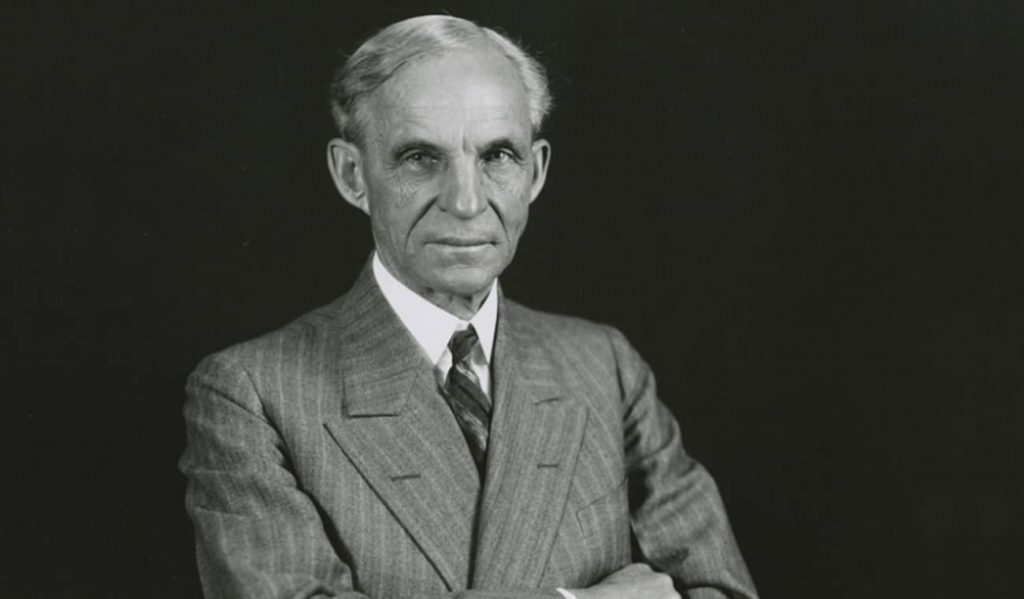

1. Knowing is not the same as understanding
Ford said:
“Being educated today means simply being familiar with a hundred theories, and not knowing those theories is considered ‘uneducated.’ A mass of knowledge in the head is not the same as mental activity.”
For centuries, knowledge was scarce, and those who possessed it held power. Today we live at the opposite extreme: everything is available, all the time. Courses, tutorials, videos, articles, podcasts, books. Infinite information… but without clear structure.
The value is no longer in accessing data.
The value is in filtering it, connecting it, and giving it meaning within your own context. What creates value is thinking holistically. This idea applies to every field, including writing. Think of this very newsletter as an example.
Gresham’s Law: Why Mediocrity Dominates Social Media (It blends an old economic law with digital content creation in the 21st century.)
Zhuang Zi’s Lesson for Mastering Any Skill in Life (It combines an ancient Chinese story with the psychology of learning.)
Are You Underestimating Your Long-Term Potential? (It mixes an ancient Indian story with mathematics and the value of consistency.)
The data I reference was available to anyone.
The value is not in repeating it, but in weaving connections that didn’t exist before.
This principle applies to everything in life.
2. Taking action
For Ford, education should be a mental gym, not a data warehouse.
“The best service a university can render is to serve as an intellectual gymnasium, where the student’s mental muscles are developed. However, real education will begin when they leave school. True education is obtained in the discipline of life.”
Only when you apply what you know do you truly understand what you’ve learned.
Accumulating knowledge without using it is like filling a toolbox you never open—everything rusts and eventually becomes useless. You may know a lot, but if you do nothing with it, you stagnate just like someone who never learned at all.
Accumulating is not progressing.
Knowledge only becomes powerful when it is put into action.
That’s why Ford said: “One’s mind is more satisfied by discovering things for oneself than by accumulating what others have discovered.” Thinking and doing go hand in hand. And while learning from others is essential, if you don’t connect ideas and work through the data yourself, knowledge creates no value—it doesn’t improve your reality.
In his time, Ford observed what we now experience on a massive scale.
Everyone “knows” what they should do: eat better, read more, rest, learn that new skill—but few actually do it. Everyone has the internet on their phone, the largest university in the world, free and in their pocket. And still, few take advantage of it.
Why?
Because thinking and acting require effort.
As Ford said: “Thinking is the hardest work there is, which is probably the reason why so few engage in it.”
Filtering data, connecting it, and applying it takes effort—and almost no one is willing to do that. Ford called it “accumulating data”; today we call it “consuming content.” It’s the same thing. Consuming content without direction is not learning. You educate yourself when you absorb theory (inside and outside school) and change your reality (and the world’s) through practice.
Ford created a production system that changed the world: the assembly line.
Thanks to it, millions of people were able to own a vehicle for the first time.
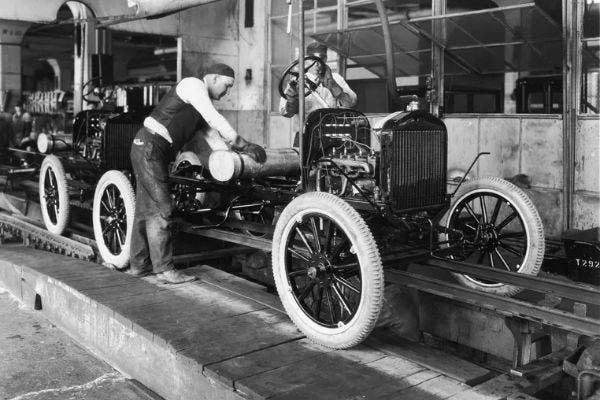
Educated minds are those that act with judgment and improve reality.
That was Ford’s message—and it remains the most urgent lesson of the 21st century.
Want to go deeper? Here are 3 related ideas to explore:
Double-Loop Learning: Breaking Out of Autopilot and Learning for Real
The Legend of Genghis Khan: The Rider Who Never Stopped Learning
✍️ Your turn: How much of the information you consume each day do you actually retain and turn into something you apply? How could you improve your information diet?
💭 Quote of the day: “Education is not filling your mind with data; it is teaching you how to think.” — Henry Ford
See you in the next letter! 👋

References 📚
Ford, H., & Crowther, S. (1922). My Life and Work.
thank you, Alvaro.
Strong piece on Ford's distinction between information and understanding. The assembly line analogy works well here, just as Ford revolutionized production by breaking down complex processes into manageable steps, education should focus on building thinking systems rather than stockpiling facts. I've noticed this same tension in tech where people obssess over learning every new framework but struggle to apply first principles thinking when actual problems arise.