


Welcome to Mental Garden, a newsletter about creativity, focus, and systems for writing and building projects on the internet. To explore the full library, go here.
🏷️ Categories: Deliberate practice, Writing, Learning.
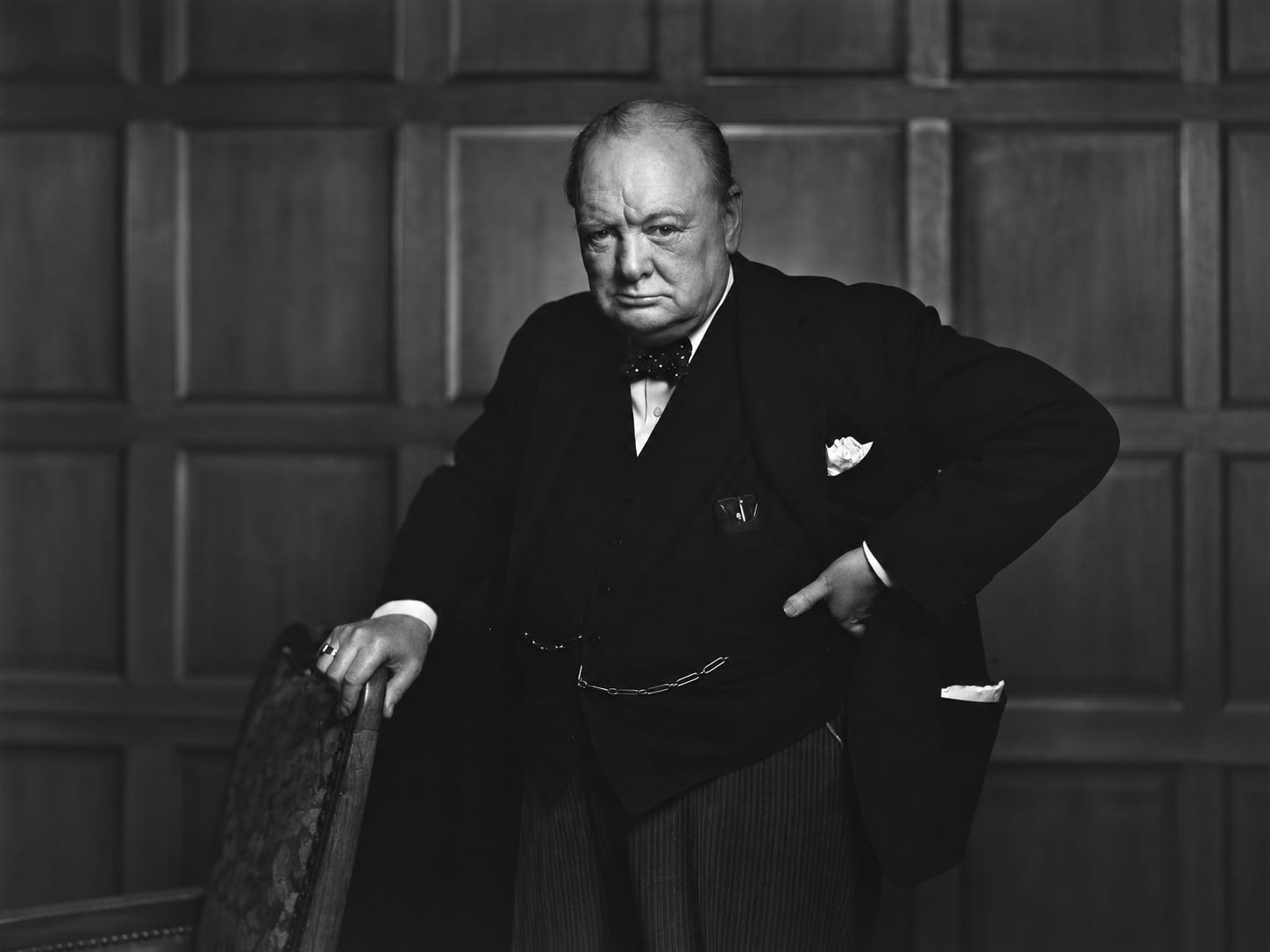

It was June 1940. France had just fallen in the Second World War, and Britain’s days seemed numbered against Hitler. Churchill wrote his famous speech, “Their Finest Hour,” between Monday afternoon, the 17th, and Tuesday noon, the 18th. He wrote the speech that made him a legend in two quick afternoons. Anyone reading it without knowing this would assume it had been polished over long days of writing and revision.
No.
His best friend, F. E. Smith, used to say that Winston had “wasted” the best years of his life writing speeches. Years later, his private secretary told Churchill’s grandson that his grandfather spent an average of one hour of preparation for every minute of speech. Do the math: roughly 30 hours of work for 30 minutes of speaking. After the war, Churchill also admitted that he had been able to handle the job at such a critical moment in history because his entire life had been training for a challenge of that magnitude.
The improvisation was the visible part of a very long, invisible preparation.

I felt about Isaac Asimov the way the world felt about Winston Churchill.
Asimov wrote more than 500 books, and his work appears in 9 of the 10 categories of the Dewey Decimal library system. In other words, if you walk into a large library, his name will show up in almost any section you visit... As if that weren’t enough, he laid much of the groundwork for modern science fiction, my genre.
What fascinated me most was the pace.
Asimov wrote original ideas at an insane speed, truly. He was one of the most prolific authors ever and kept an extremely high standard of originality, with fictional worlds that have become references for later authors and for cinema.
When I started writing, reality hit me hard.
It took me about 3 months to be able to finish an article in less than a week. And I was working hard, believe me.
Turtle steps.
Every day I’d lock myself in my room to read and write. I gave it everything, and writing was hard, it almost seemed to hurt. I wanted to put down ideas I hadn’t yet internalized (I was reading, studying, and writing about topics that were new to me, all at once, on Substack, with the added fear of getting it wrong in front of an audience). Nothing I wrote made me feel sure of myself. I had never expressed an opinion of my own beyond a WhatsApp message. The clumsiness was obvious.
I came to the conclusion that it had no future.
Today I have more than 500 published pieces and more than 100,000 readers in 2 years.
I’m still very far from Asimov. However, I now know what he and Churchill had that I didn’t. I know because I’ve lived it from the inside, and science has measured it. The answer had been written down since 1897, but I didn’t know it.
Let me tell you.
At 23, Churchill wrote an essay he never published: “The Scaffolding of Rhetoric.” In it, he asked whether a great orator’s charisma is something you’re born with. He had reason to doubt it (he had a lisp that he worked on with tongue twisters and pronunciation drills). Despite not being the most gifted speaker, he went down in history partly because of it.
His life’s conclusion was this: “The power of rhetoric is neither wholly bestowed nor wholly acquired, but cultivated.” — Winston Churchill, The Scaffolding of Rhetoric (1897)
Cultivated.
Beautiful, isn’t it? Fitting for a place called Mental Garden.
The myth of talent
There are two ways to understand the articulation of ideas.
Many people believe that articulating means having something new or brilliant to say; that’s the reason to open your mouth. That belief condemns you to the blank page, I promise you. Every article or conversation feels like an exam where you have to deliver value from scratch. Which is absurd. Science, contrary to popular belief, starts from the premise that people who articulate well have a handful of ideas they’ve said hundreds of times and now deliver masterfully, like a musician who has rehearsed a piece 1,000 times.
Churchill was a master at this.
You, like me back then, may still think you have to say something brilliant.
I often use the metaphor of a warehouse. Imagine you run a warehouse full of products. Where will you place the most in-demand products? Three seconds from the entrance, because they’re the ones everyone wants to buy when they come to your warehouse. Right? When people think of your products, 90% of them remember that small handful of products they want so badly.
Your ideas work the same way.
The question is how you find the star items in your warehouse of ideas.
I recently wrote about this in my essay on Bernoulli’s formula. Everything you publish is a “Bernoulli trial,” like flipping a coin with two possible outcomes (hit or miss). If we do some quick math...
With a hit rate (of going viral) of 2%, publishing 10 pieces gives you an 18.3% chance of getting at least one success.
With that same viral rate and 100 publications, the probability rises to 86.7%.
Your talent stays the same; I didn’t even mention it. What changes is the number of opportunities you give your talent to show itself. The number of hits you can expect is n × p (quantity times quality). With my 500 pieces and a 2% hit rate, the formula predicts 10 successes. I’ve had quite a few more, and you could too.
Why am I telling you this?
Because volume reveals the quality you already had inside your warehouse of ideas.
Your warehouse might hold 500 ideas, but 80% of customers may come for a single product. The audience decides that with their feet; they walk toward what interests them. You won’t know which item is a star until your warehouse of ideas is packed with items. You don’t decide; your readers decide it together with you.
That process has 3 stages, and we’re going to look at them in depth.
The 3 stages of articulation
To express yourself with astonishing clarity and develop brilliant ideas, follow this.
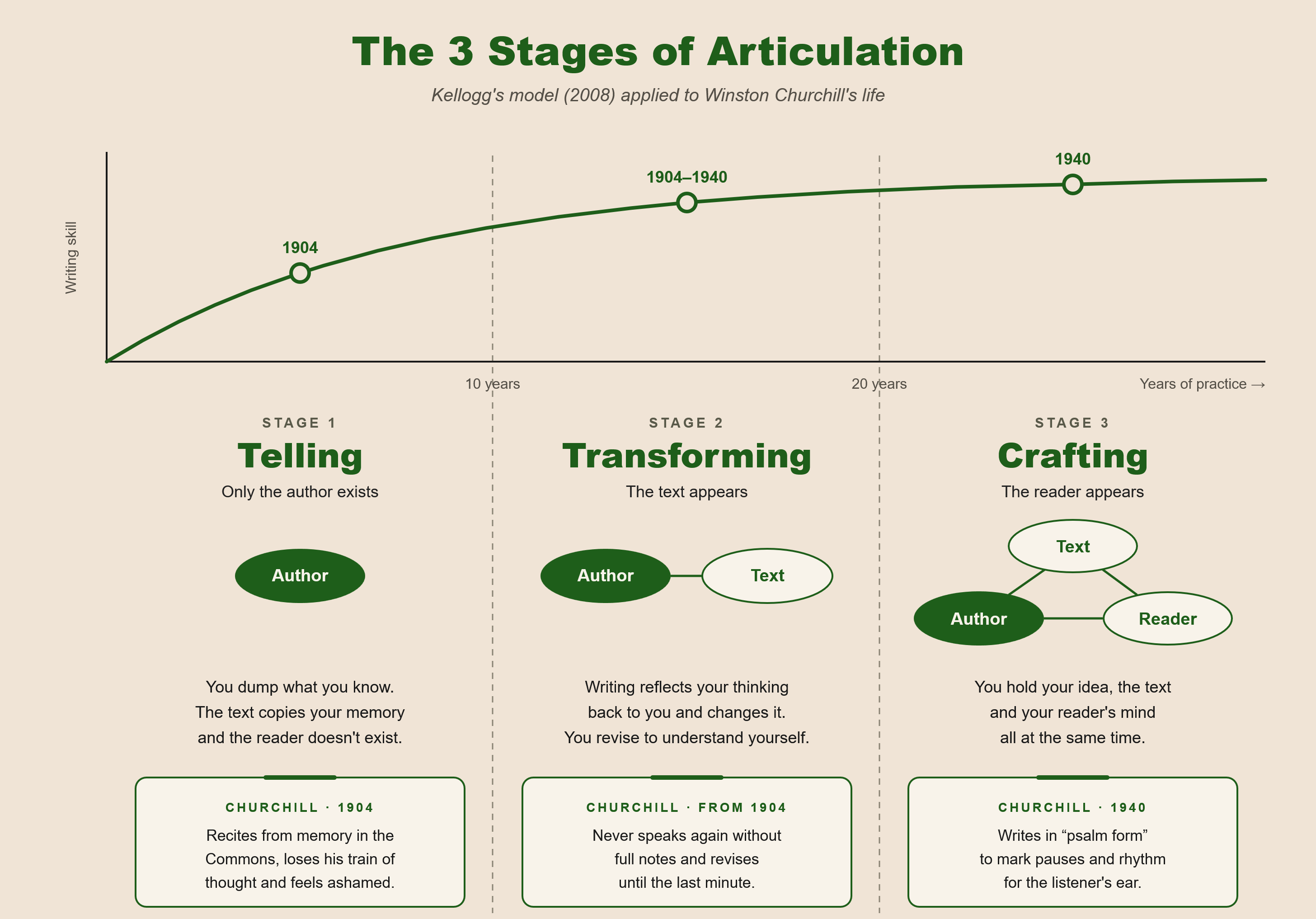
Kellogg (2008) describes a writer’s development as a progression from the novice who simply tells what they know, to the adult who transforms what they know, to the professional who crafts what they know with the reader in mind. By his calculations, that path takes at least two decades of maturation. Each stage adds a new character to your mind while you write. First, it’s just you (the author). Then the text appears, and finally, the reader.
Churchill’s life moves through the 3 stages in order.
Stage 1: Telling (the one who recites)
April 1904.
Churchill is 30 and already a Member of Parliament in the House of Commons. His method is to memorize every speech. If he loses his train of thought midway, he goes blank and feels ashamed. This happened to him quite a few times, and it hurt his self-confidence (McMenamin, 2013).
Churchill’s strategy was failing him.
He recited what he knew, but nothing more. Kellogg calls this first stage “knowledge telling.” Only the author’s representation exists. You dump what’s in your head, and the text (or speech) works as a copy of your thoughts; you can’t express yourself without the paper in front of you. It doesn’t matter how much you know if you can’t retrieve it at the right moment. Churchill in 1904 depended on a fragile memory.
That’s how I felt, back in my room.
The ideas weren’t mine yet. I was trying to tell knowledge I had read in scientific analyses two days earlier. That’s why I moved at a turtle’s pace (my brain was trying to learn and express at the same time on a tiny mental desk).
The way out of this stage is a matter of volume.
How to get out of the telling stage
Increase your volume: publish often, even if you feel you’re not ready. Each piece is one more attempt and one more data point about what works.
Use a minimal structure: problem, consequence of not solving it, and solution. Don’t aim for complicated, deeply layered essays.
Write about what you’ve already digested: the more an idea is your own, the less working memory it consumes. Reflect on what is highly familiar to you.
Log every attempt: note what you published and how it performed (without a record, nothing can be improved). As I often say: what isn’t measured doesn’t exist.
Stage 2: Transforming (the one who thinks by writing)
After 1904, Churchill changed his method.
From then on, he made sure he always had notes for every speech. He had the habit of revising the text until the very last moment. Writing became his way of thinking, and by expressing himself on paper, what was fuzzy in his head became sharp on the page. Churchill had, in essence, leveled up to the second stage of Kellogg’s model.
Kellogg calls it “knowledge transforming.”
What you write reflects your thinking back to you and changes it (you read your draft, discover that it isn’t clear enough and that there are gaps, which forces you to think again). Writing becomes a tool for building knowledge, and that’s exactly what I urgently needed too.
From here, you climb to the highest (and rarest) level. Few people get there.
Stage 3: Crafting (the one who writes for you)
The third stage turned Churchill into a legend.
In his wartime speeches, he laid out the text on the page in what he called “psalm form” (arranged like a poem) to mark the emphasis, the pauses, and the exact cadence he wanted. Every line break was a pause. The rhythm of the text set the speaker’s breathing. Every line was designed for the ear of the listener. Notice that. The listener is part of the process.
It’s written for them.
Kellogg calls this stage “knowledge crafting.”
The writer holds three representations in mind at once: what they want to say, what the text says, and what the reader will understand. A lovely study by Nancy Sommers (1980) demonstrates this. Professional writers revise the entire structure with their reader in mind. College students limit themselves to changing words so it sounds better.
The professional crafts for someone.
If you reach this level of skill, the most effective move is to start crossing fields.
Mental Garden is built on that crossing of fields. For years I’ve been crossing sciences like psychology, physics, and mathematics with writing, creativity, and productivity.
Examples?
The “F-effect,” which comes from neuroscience research, explains that on the internet nobody reads full articles (we read the beginning, skip to the middle, and quit before the end). That’s where the structure you’re reading right now comes from: a short sentence that captures your attention, a block that develops the idea, and a conclusion that stays with you.
Why this crossing of neuroscience and writing?
This article of mine explains the eye movements the central nervous system makes while reading, in order to show you the scientifically proven way to write on the internet so that it’s engaging.
See?
If you can take your reader into account to that degree, you can surprise them with unexpected ideas that cross domains. This will let you express yourself with astonishing clarity and make your (already original) ideas impossible to forget. A concept from another field teaches the reader something they didn’t expect, and doing it with maximum clarity makes you 100x more memorable.
Science confirmed it.
In 2013, Uzzi and his team analyzed 17.9 million scientific papers and found that the highest-impact ones were built on conventional ideas with an unusual addition. Those were twice as likely to be widely read. Translated to your case: 90% familiar ground and 10% unexpected surprises from distant domains.
You can only develop a truly unusual crossover if you’ve reached level 3 of clarity.
Only at that point, when you’re thinking about the reader, can you be memorable and original.
The fine print (20 years)
The bad part.
Kellogg estimates at least two decades to reach level 3.
Kellogg also cites a fact that made me smile: Asimov’s annual book output grew over the decades, the result of pure practice. My hero of speed became fast with the years. His overwhelming pace came at the end of the road. The Asimov I looked up to was in his third stage while I was in my first.
Comparing your chapter 1 with someone else’s chapter 20 of their 400th book is disastrous.
It will demotivate you, and you’ll quit.
The good news is that the training fits into your day. Writers who write a few hours a day, consistently, get results in the long run, and it’s mathematically proven. Consistency matters more than intensity. A beautiful example is Ernest Hemingway.
A little, every day, for years.
Protocol: how to build your warehouse of best ideas
Increase your volume: decide what counts as an attempt (a note, an article, a video) and publish without waiting to feel 100% ready. 80% is enough.
Find your top 10%: once you have 20 pieces, calculate your median likes, comments, and saves. Filter the 10% that beat it and look for what those pieces have in common. More in this article: Here.
Name your greatest hits: summarize 4 to 10 ideas that keep repeating in that top 10%. Those are the star items in your warehouse.
Refine each idea in your own words: write it and rewrite it again and again, each time polishing its gaps, adding better examples and data, detailing whatever was left unclear, etc. Repeat the same idea from 1,000 different angles, alternating depth, story, more technical, closer to the reader...
Write it for one reader: imagine a real person reading it. You need to make it so that even the person who knows the least about the topic can finish reading with every idea clear. So clear that this same person could explain the ideas to their best friend, who also knows nothing about it.
Cross it with another domain: for your ideas to sink in, you need maximum clarity. If you also bring in a concept from another discipline that illuminates it, your message will rise above 99% of generic writers.
Deliver it again: when you’re asked in a meeting or a comment, answer with your best idea on that topic, refine it again, and explain it that way out loud. Speaking is writing with your voice. To speak with astonishing clarity, you first have to write with that same level of clarity.
In 1953, Churchill received the Nobel Prize.
In Literature. That doesn’t surprise you by now. His “improvised” speeches were writing distilled over decades. You can start your journey as a writer, speaker, and thinker today. Open a blank document. Write, in one sentence, the idea you repeat most when you talk about your work, refine it, remember who your message is for, and then publish again next week (and the next, and the next).
Think, write, and publish.
And start again.
— Álvaro
Want to know more? Here are 3 related ideas to explore:
Threshold Theory: intelligence doesn’t predict success (and what does)
Consistency: the advantage nobody romanticizes (and that you need to cultivate)
P.S. I also offer 1:1 consulting to help you grow on Substack.
If you’re just starting out and don’t know how it works, or if you’ve been at it for a while but are stuck, this will help you. I’ll help you find your direction, position yourself as a leader in your niche, and build a system tailored to your needs for sustainable growth.
My credentials? Over 100,000 global readers in 2 years, 100% organic growth, with 500,000 monthly visits. All from scratch, writing all by myself in my spare time.
If you’re interested, email me at: jardinmental@proton.me
References
Churchill, W. S. (1997). The scaffolding of rhetoric. Finest Hour, 94. URL
Kellogg, R. T. (2008). Training writing skills: A cognitive developmental perspective. Journal of Writing Research, 1(1), 1–26. URL
McMenamin, B. (2013). The Finest Hour URL
Uzzi, B., Mukherjee, S., Stringer, M., & Jones, B. (2013). Atypical combinations and scientific impact. Science, 342(6157), 468–472. URL
Me pregunto por qué me tiene que leer el artículo en inglés. Si está en español escrito. Dónde puedo cambiarlo?
Thank you for this information. At 80 years of age I will probably never master the craft, but it will nevertheless improve my communication skills.