


Welcome to Mental Garden, a newsletter about creativity, focus, and systems for writing and building projects on the internet. To explore the full library, go here.
The following letter is part of our “Notes on Giants” collection, in which we explore the thoughts and lives of humanity’s greatest minds.
🏷️ Categories: Literature, Writing, Creativity.
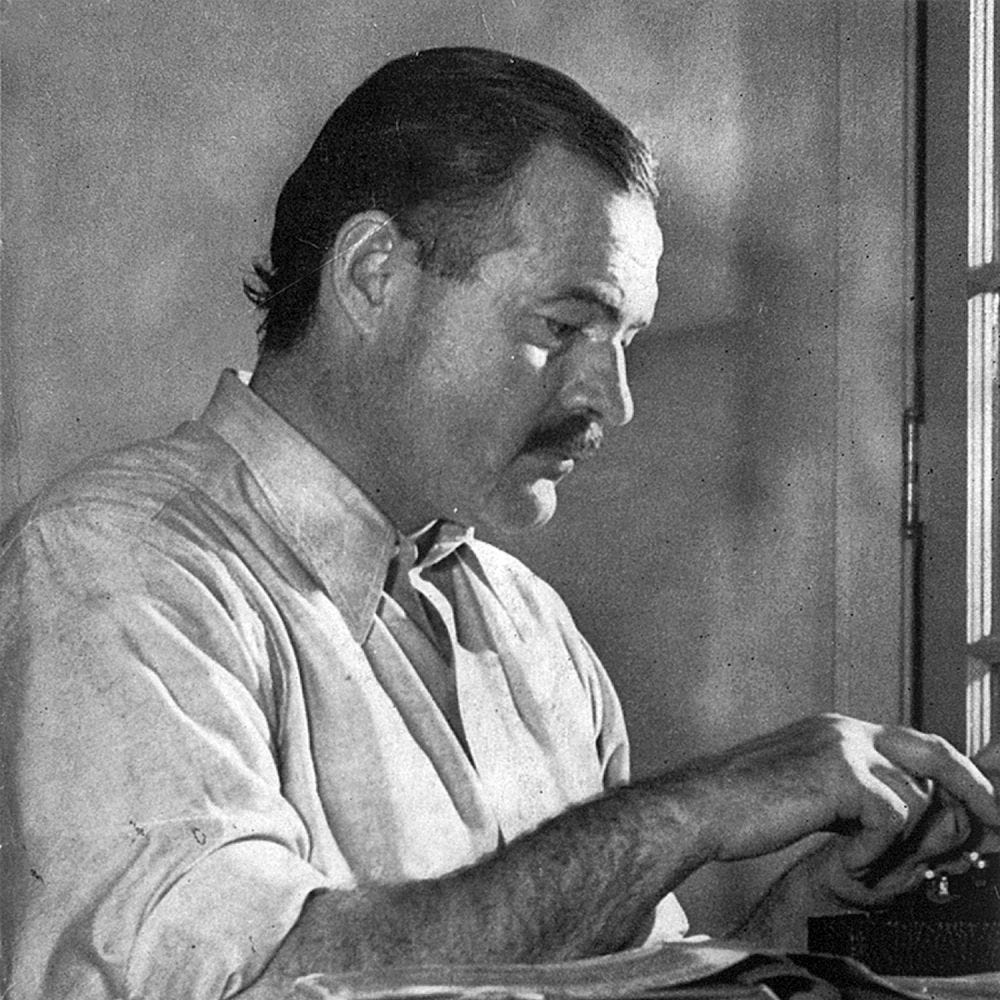
Ernest Hemingway was one of the most influential writers of the 20th century.
As a journalist and novelist, he developed a style that broke with the literary traditions of his time. While other authors tried to demonstrate depth through long and detailed descriptions, Hemingway did exactly the opposite: he stripped away until he found the essence of the scene. His prose seemed simple on the surface, but it hid layers of psychological meaning beneath every sentence.
How was it possible for him to say so little and manage to convey so much?
Hemingway believed that a writer should not hand over all the meaning to the reader. Depth lies in knowing the subject matter so well that it is possible to omit the obvious; yet, between the lines, the reader can feel that which is not written.
He called this principle the Iceberg Theory.
The Hemingway Iceberg Theory consists of 3 pillars:
Deep knowledge
Omitting the non-essential
Letting the reader discover
Let’s dive deeper.

The need for the void
Most creators today suffer from compulsive over-explanation.
They are trapped in the game of delegating their intellectual work to AI in the name of “productivity.” The result: the internet is flooded with superficial, repetitive texts, videos, and scripts, lacking voice or character—nothing distinguishes them. They all sound the same and speak too much to say very little.
The Iceberg Theory postulates the opposite.
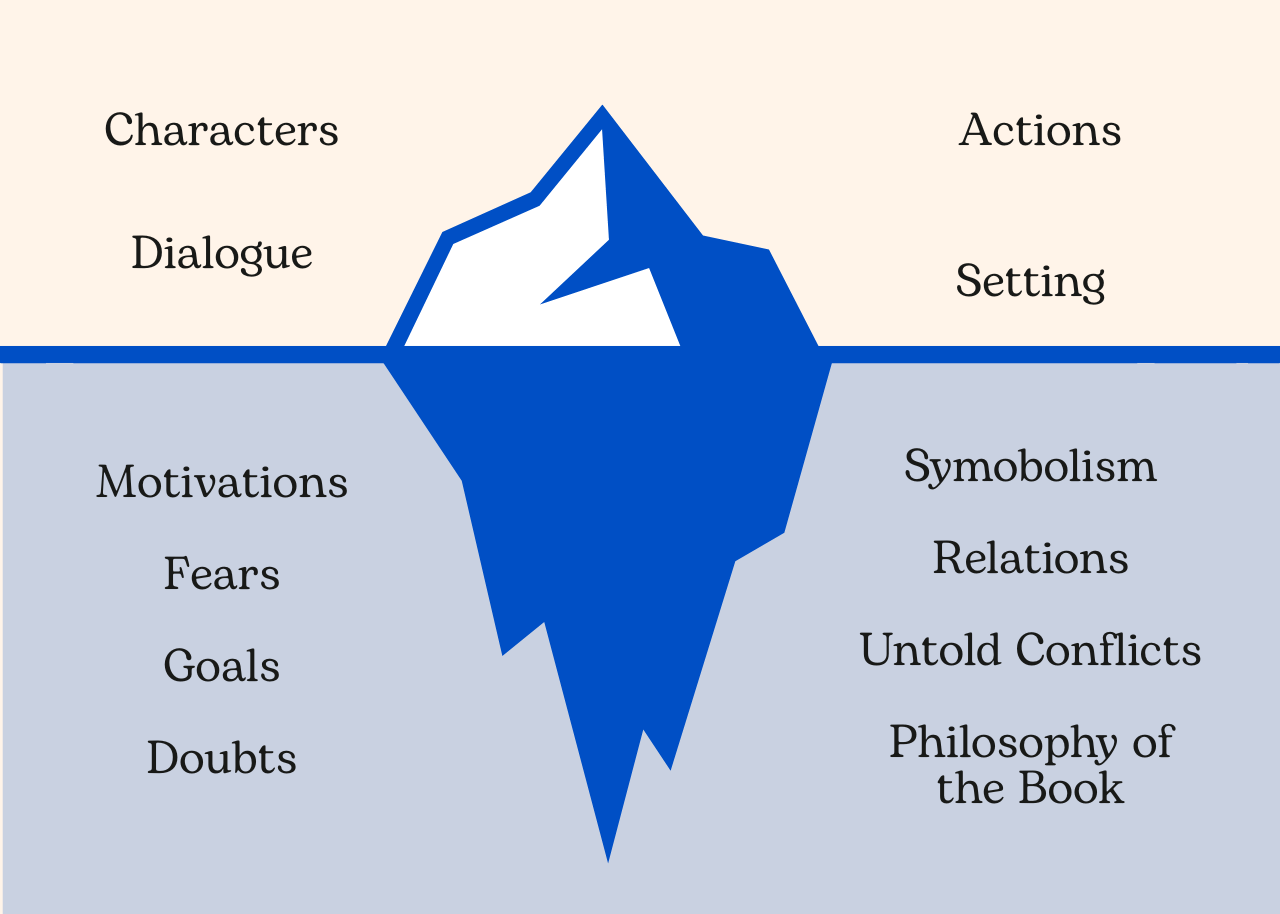
The irreplaceable meaning of a work lives below, like an iceberg, whose largest part is under the water’s surface. Only a small fraction of what the work conveys is done through dialogue, description, and action.
But for that depth to exist, there must first be something underneath, obviously.
1. Deep Knowledge
As Hemingway put it…
“If a writer of prose knows enough about what he is writing about he may omit things that he knows and the reader, if the writer is writing truly enough, will have a feeling of those things as strongly as though the writer had stated them. The dignity of movement of an iceberg is due to only one-eighth of it being above water.” — Hemingway, Death in the Afternoon (1932).
The larger the iceberg, the larger the amount that is submerged. Hold onto that.
A writer who knows the iceberg writes: “Maria opened her father’s closet to look for an old shirt. She found three, but only pulled out one. She looked at it. She smelled it. Then she folded it carefully and put it back where it was.”
Do you notice it?
It is never stated here that Maria is sad, but the reader feels the loss because her behavior reveals something deeper. The scene works because the writer knows what that gesture means. The shirt is more than a shirt. It represents the relationship; it shows the absence she feels and the inability to let go of her past.
This is the invisible work of the artist. Building a deep reality from a small part.
Another example:
Without depth: “Carlos was nervous before the meeting because he was afraid of failing; he couldn’t stop checking every detail.”
With depth: “Carlos checked the meeting presentation for the fifth time. He changed a word, changed it back, and closed his laptop again.”
The second version works because the author knows the character’s psychology and knows how fear manifests in someone trying to maintain control. The visible part works because it is supported by an invisible structure.
2. Omitting the non-essential
Hemingway’s text is brief and clear, but it didn’t start that way.
He admitted the chaos of his process: “I write one page of masterpiece to ninety pages of shit. I try to put the shit in the wastebasket.” — Hemingway (Winokur, J. 2000).
You cannot write perfectly on the first try; like a sculptor, you must remove everything that is left over to turn the marble into a work of art. You must remove all those unnecessary explanations and details that only make your work ugly.
When you omit the unnecessary, the silence between the lines becomes magnetic.
A common mistake here is thinking that editing only means making a text shorter, but it doesn’t have to be that way. When I talk about eliminating, I meant “explanations” and “details,” not words. You can eliminate those explanations and find something of value to add—giving the reader the essential and leaving the deep meaning between the lines.
A writer who doesn’t edit writes: “Juan was very angry after reading the message. He couldn’t believe it. He slammed his phone shut and left the room.” The reader receives a complete explanation; they have no space to feel the emotion.
A writer who understands the iceberg writes: “Juan read the message twice. He locked his phone. He left the room without answering, after slamming the door.”
The anger is never mentioned, but the lack of response and the door say it all.
The silence is part of the scene.
3. Letting the reader discover
The human brain is a prediction machine. This matters to writers.
Humans tend to look for patterns, relationships between elements; we feel an impulse to discover what is behind what we see in the world. This is why the best works make the reader feel intelligent—that they have outpaced the author and found the key long before someone told them.
That is why you must be quiet; silence is part of the music.
Design the scene, place the pieces on the board, and step back—let the reader explore and interpret. In Hills Like White Elephants, Hemingway narrates the conversation of two characters discussing the unbearable weight of a decision without mentioning the key word even once.
Hemingway doesn’t tell you what to think, but he gives you the coordinates to get there.
A writer who leaves no space writes: “Pedro realized he had lost his friend because of pride and regretted it deeply afterward.”
A writer who lets you discover writes: “Pedro opened the conversation he had been avoiding for months. He wrote three paragraphs, then deleted two. In the end, he only sent: ‘Sorry’.”
Regret is never explained. The reader arrives at it.
That is the power of the iceberg.
Fast content and over-information have turned us into passive data processors. The average person has such a low attention span that, increasingly, the narrative level is becoming too obvious. This is an insult to those who do pay attention to detail and stay until the last page with an attentive gaze.
Quality writing is the antidote.
Your only mission as a creator is to keep the reader inside the universe you have designed. Keep them hooked through a narrative that is simple to the inattentive eye, but deep to those who read with care. Let the reader read what is not told. This is the reason why Hemingway’s work is extraordinary.
Speak less to say more.
— Álvaro
Want to know more? Here are 3 related ideas to go deeper:
Hemingway’s brutal letter to Fitzgerald on how to write better
Ernest Hemingway’s inspiring Nobel Prize acceptance speech

✍️ Your turn: How much of what you express in your writing or creative work is visible... and how much really remains supporting what is left unsaid?
💭 Quote of the day: “Prose is architecture, not interior decoration, and the Baroque is over.” — Ernest Hemingway, Death in the Afternoon.
P.S. I also offer 1:1 consulting to help you grow on Substack.
If you’re just starting out and don’t know how it works, or if you’ve been at it for a while but are stuck, this will help you. I’ll help you find your direction, position yourself as a leader in your niche, and build a system tailored to your needs for sustainable growth.
My credentials? Over 94,000 global readers in 2 years, 100% organic growth, with 250,000 monthly visits. All from scratch, writing all by myself in my spare time.
If you’re interested, email me at: jardinmental@proton.me
See you next time! 👋
References 📚
Winokur, J. (2000). Advice to Writers: A Compendium of Quotes, Anecdotes, and Writerly Wisdom from a Dazzling Array of Literary Lights.
Hemingway, E. (1932). Death in the Afternoon.
Thank you for this! I'm a mixed media artist, and it helps me understand why I have the desire to strike a balance of simplicity and activity. I only reveal what is necessary, and am getting more comfortable leaving negative space. Appreciate this breakdown and analogy!