


Welcome to Mental Garden, a newsletter about creativity, focus, and systems for writing and building projects on the internet. To explore the full library, go here.
🏷️ Categories: Creativity, Behavior, Decision-making and biases.
The interpretation we make of social silence kills brilliant ideas.
Human beings learn by observing what others do, but we also infer what is worth doing based on what nobody does. The lack of evidence makes us feel that something is impossible. If nobody has built that project, written that book, defended that idea, or left that secure job to pursue something uncertain, we assume there must be a reason we don’t yet understand.
And yes, sometimes there is…
and sometimes there isn’t.
The first conclusion contains a very human error, and it’s the same error that keeps thousands of artists and people trapped in the same dynamic as always.
In systems where everyone observes everyone else, like on social media, inaction spreads. In psychology it’s called the Bystander Effect: the phenomenon that explains why nobody helps when everyone expects someone else to intervene first. You’ve seen it in countless places in your life.
A person falls on a crowded sidewalk and pedestrians walk past. Nobody acts until the rest act. Everyone just stares or ignores it.
A musician playing in the street who nobody gives money to, but if a few people do, others begin to take the same initiative.
A column of smoke in the forest that nobody reports to firefighters because they assume someone else already has.
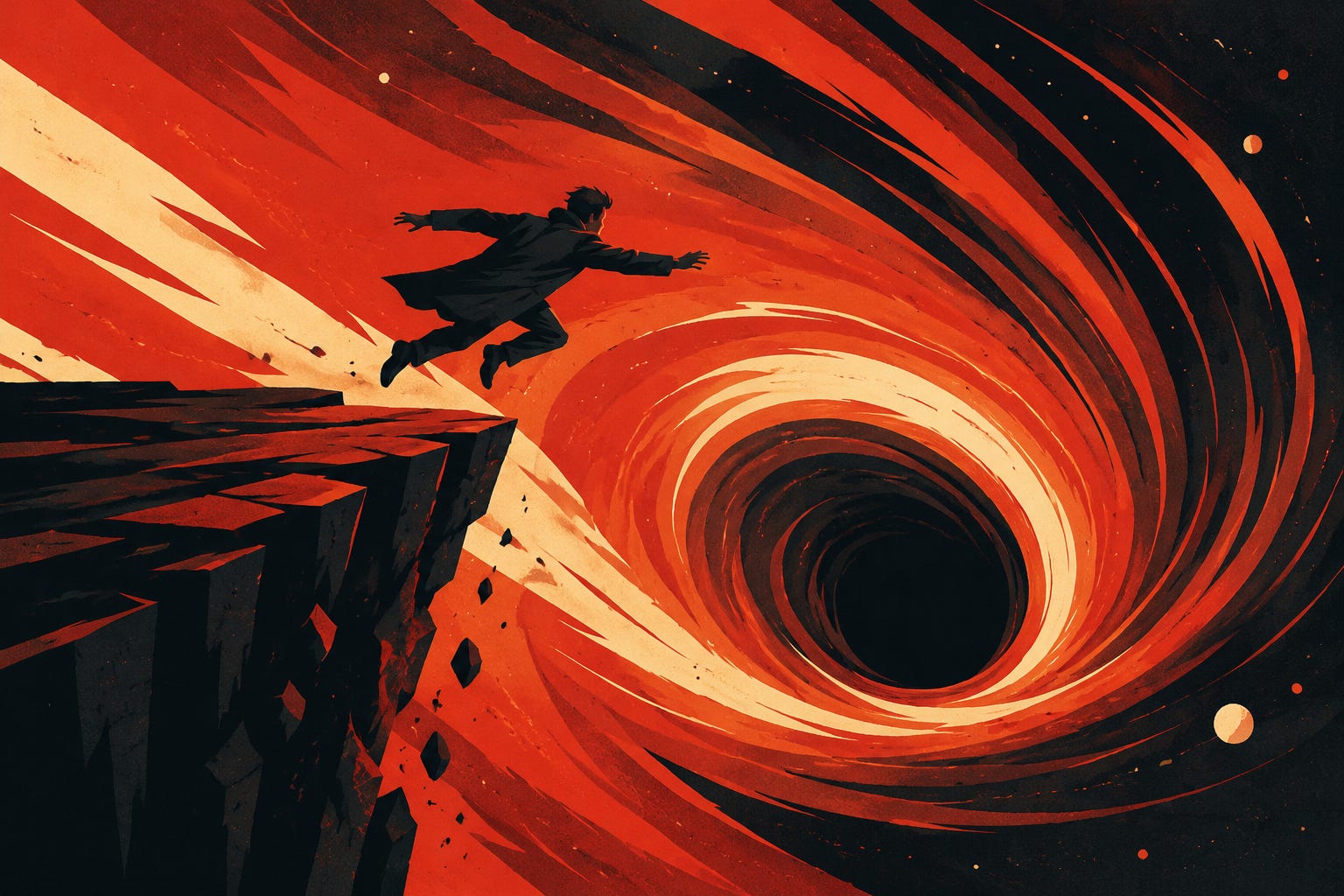
Creativity and ambition are blocked by an identical phenomenon. Everyone waits for someone else to validate an idea first before investing time, reputation, or effort in it. Nobody wants to be the one who takes the risk. Nobody wants to be the first to jump into the void without knowing if there’s a net below. However, it is those capable of distinguishing between what is impossible and what has simply not yet been attempted who make history.
They are two different things.
The inability to tell them apart cruelly holds back people of great potential.
You have to know how to jump into the void…

I. The easier path
We follow paths because the brain prefers what is easy and safe.
It’s an evolutionary adaptation by which the brain is always deciding which ideas deserve your attention and which to discard as too risky or difficult.
The Bystander Effect is the manifestation of a basic principle of human behavior: when we don’t know how to act, we watch others (Bandura, 1977). For millions of years, this strategy boosted survival odds. Copying was cheaper than experimenting. If the rest of the tribe avoided a certain plant, a certain territory, or a certain behavior, imitating that avoidance cost you far less than discovering why they avoided it — especially when the price of discovering it on your own could be death…
Solomon Asch demonstrated this in his conformity experiments: people who knew the correct answer to a simple question ended up giving the incorrect answer rather than contradict the group.
Cialdini would later call this “social proof”: we use the behavior of others as a cognitive shortcut to decide what is correct or true, saving ourselves the costly process of thinking for ourselves.
Our brain still operates under that logic, but today, the greatest value is rarely found by traveling existing paths. It’s found on the ones yet to be discovered. And yet, you keep consulting the collective map before taking any important step, asking yourself what people would do in your situation, when reasonable people, by definition, have never done what you wish to do.
If they were “reasonable,” they would follow the group.
Think of your brain as a GPS constantly trying to recalculate to bring you back to the main road. Every time you go off course it alerts you, and that inner voice you have suggests you return to safety, to familiar ground. The harsh reality is that humanity’s great advances, those artists we call geniuses, began as people who left the GPS’s route.
And they didn’t go back to the marked route no matter how much the GPS warned them…
II. Today it seems obvious, yesterday it seemed absurd…
“Any sufficiently advanced technology is indistinguishable from magic” — Arthur C. Clarke, 1962. Clarke’s Third Law
Here are two of my favorite “insanities” that are reality today.
Before the airplane, the idea that a human being could fly was considered, at best, a fantasy, and at worst, a dangerous madness, until the Wright brothers came along and showed the world it was possible.
Before the internet, the idea that millions of people could communicate instantly without intermediaries and without physical borders sounded like delirious science fiction. Look at it today.
Once demonstrated, all these ideas stop seeming revolutionary.
Everyone will say: “Ah of course, this is how it is and it works for this reason, blah, blah, blah.” Our brain reconstructs the past as if it had been obvious from the start, as if anyone could have seen it coming. Nothing could be further from the truth. This is called hindsight bias, and it’s the trap that always makes you underestimate the courage that each great advance or original idea required.
We confuse familiarity with truth.
The philosopher Thomas Kuhn documented this pattern in scientific revolutions. Science advances through violent paradigm shifts, where the previous framework collapses because it can no longer explain observed reality, and a new generation of thinkers (ridiculed or ignored) builds a new framework from scratch that explains everything previous and everything new.
Nassim Taleb would later add that these events, which he calls “black swans,” are statistically impossible to predict from within the previous paradigm, because the previous paradigm was designed without accounting for their existence.
The ideas that change the world first need to change the worldview.
Read that last sentence. That’s the key. It’s about being willing to build, write, launch, or defend something while it sounds absurd to everyone else, because by the time it stops sounding absurd, the window of opportunity will already have closed and will be occupied by whoever dared before you.
When it stops sounding absurd and they want to copy you… you’ve already gone from crazy to genius.
You need to be like a star, giving all your energy to shine while everything around you is dark… and keep shining regardless of whether anyone is watching or ignoring you.
Hold onto that.
III. The first madman changes the rules of the game
An idea, however brilliant, moves no one while it remains only an idea.
What moves people is seeing another human being who already tried it and succeeded. Precedent eliminates perceived risk without eliminating real risk, and that, however absurd it sounds, is enough to unleash a cascade of imitators.
The first to act bears a mental cost that no one else will have to pay.
Uncertainty.
They carry all the uncertainty, all the potential ridicule, all the weight of being completely alone in their conviction, with no data confirming they aren’t making a monumental mistake. Those who come after only need to verify that someone already survived the attempt. That’s enough for them. From that moment on, it rewrites what the rest of the tribe considers possible.
Malcolm Gladwell described how these social cascades work (Gladwell, 2009).
A small number of initial actions, taken by the wrong people (from the perspective of the established system), can unleash massive change because the majority only needed to see that it was safe to move. And this, however unsettling it may seem, applies to creating.
But also to how we live.
Without realizing it, many end up following the path that others told them to, directly or indirectly. We choose careers because they’re “safe,” understanding safety as whatever millions of people have already traveled without dying in the attempt. We choose relationships, cities, routines, and even political opinions following the same mechanism that stops you from helping someone lying on the street or calling firefighters if you see a column of smoke in the distance.
“Someone else will do it.”
Imagine opening a trail in freshly fallen snow.
The first person sinks to their knees with every step, not knowing if there’s firm ice underneath or a void that will swallow them whole. They move slowly, hesitating, carrying the full weight of the unknown, freezing, soaked, and shivering.
The rest simply follow their footprints. How comfortable.
Their comfort exists only because someone else paid the price of opening the path.
It applies to everything in life.
IV. Don’t follow paths, open them
History proves it.
Memorable people built their own path, which is precisely why they exist: there are, in essence, two ways of living. One is to travel illuminated trails, precisely mapped by previous generations, with clear signs at every crossing telling you exactly what to do, when to do it, and how to avoid any unpleasant surprise. The other consists of exploring places where no maps yet exist, where every step involves a degree of uncertainty that most people find directly intolerable, all full of thorny bushes and disgusting mud that stains everything.
The first option offers safety, but it’s a life indistinguishable from thousands of other lives following, in essence, the same course.
The second option demands uncertainty and enduring the stares of those who don’t understand why you’re “wasting” your time there, as so many people tell me when they discover I want to be a writer. The good thing is that this impassable path ends up building a genuine identity, forged through real choice and a body of work that only that specific person could have created, with that unrepeatable combination of experiences, obsessions, and mistakes.
Most people will spend their entire life wondering which is the best path…
They consult their parents, mentors, ChatGPT, any external source that might save them the work of deciding for themselves. In the endless search for certainty, they end up traveling no path at all. They spend their life in the hallway without opening a single door. Or you can choose the opposite and leap into the void.
Start that crazy project.
Start that radical life change.
Start writing that pointless book.
Start doing all that which seems absurd… until it becomes reality.
No explorer in search of new lands brings the map already solved from home.
You have to go out and explore, get lost, and find yourself in the process…
— Álvaro
Want to know more? Here are 3 related ideas to explore:
The Paradox of Creativity: You love creativity, but you hate creative ideas
How to create an irreplaceable artistic vision: A practical guide for artists
First they’ll make fun of you, then they’ll want to be like you
P.S. I also offer 1:1 consulting to help you grow on Substack.
If you’re just starting out and don’t know how it works, or if you’ve been at it for a while but are stuck, this will help you. I’ll help you find your direction, position yourself as a leader in your niche, and build a system tailored to your needs for sustainable growth.
My credentials? Over 100,000 global readers in 2 years, 100% organic growth, with 300,000 monthly visits. All from scratch, writing all by myself in my spare time.
If you’re interested, email me at: jardinmental@proton.me
References
Darley, J. M., & Latané, B. (1968). Bystander intervention in emergencies: Diffusion of responsibility. Journal of Personality and Social Psychology, 8(4, Pt.1), 377–383. URL
Flynn, F. J., & Lake, A. M. B. (2008). If you need help, just ask: Underestimating compliance with direct requests for help. Journal of Personality and Social Psychology, 95(1), 128–143. URL
Bandura, A. (1977). Social learning theory.
Asch, S. E. (1956). Studies of independence and conformity: I. A minority of one against a unanimous majority. Psychological Monographs: General and Applied, 70(9), 1–70. URL
Cialdini, R. B. (1984). Influence: The psychology of persuasion.
Clarke, A. C. (1962). Profiles of the future: An inquiry into the limits of the possible.
Kuhn, T. S. (1962). The structure of scientific revolutions.
Taleb, N. N. (2007). The black swan: The impact of the highly improbable.
Gladwell, M. (2000). The tipping point: How little things can make a big difference.
This is an OUTSTANDING SHARE.
Everyone-especially creatives (which each of us can be)should read it 5-10 times.
I created every career position I had in 47 years of work-especially Disney-by observation and need.
Walt Disney said: “ If you can dream it, you can do it.”
At Disney, ‘we start from impossible and go from there.’
Ben May
Orlando