


Welcome to Mental Garden, a newsletter about creativity, focus, and systems for writing and building projects on the internet. To explore the full library, go here.
🏷️ Categories: Mental models, Creativity
Maybe you’ve spent years feeling guilty about wasting time.
I’m talking about opening a tab about something that has nothing to do with your work (that nobody asked you to do) and something inside you says you should be putting those hours toward your tasks, toward doing something productive with your life. Sometimes the discomfort is so great that you close the tab, other times… you lose yourself for hours down a rabbit hole of the internet, falling deeper and deeper from one link to another, losing track of time while you dive to the bottom of a topic that, suddenly, has become the center of the universe.
Multiply that by all the days you did it and you have thousands of hours that you call “distraction.” Right?
I’m going to take away that guilt.
I’m going to give you the numbers that prove why you’re wrong and why that’s exactly where the potential of multipotentialite people lies. Let’s jump into the rabbit hole.

Let’s go to 1440, to Mainz, a German town.
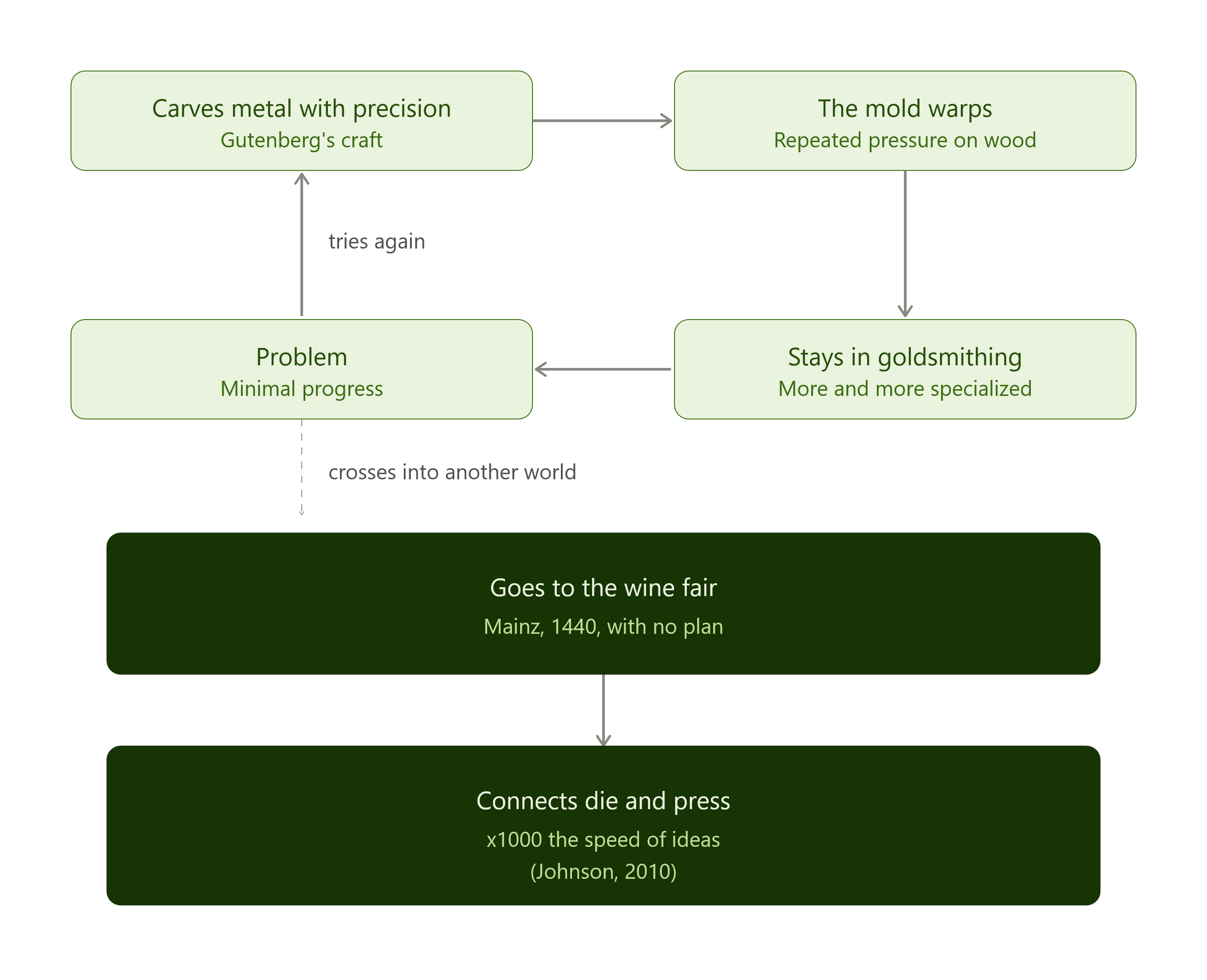
There lives a goldsmith named Johannes Gutenberg, who has spent years turning over a problem typical of his trade. He knows how to carve metal, but he can’t get the wooden molds to withstand the pressure over and over without warping. Each print run wears down a bit of the mold he uses as a template.
One day, Johannes went to a wine fair, with no intentional plan.
And what does he see there? A wine press working.
He noticed that this mechanism crushes the grape with the same force every time, and from there came the great revelation. Johannes connects two worlds that no one had connected before: the goldsmith’s die and the wine press. From that comes the Gutenberg printing press, an invention that multiplied the speed of reproducing written works by a thousand. Without knowing it, he multiplied by x1000 the speed at which ideas could travel in his era (Johnson, 2010).
Gutenberg was not the most skilled goldsmith, and he certainly didn’t know about wine.
What made him unique was being the first person to connect those two worlds.
Now look at what usually happens to us. Almost all of us understand “advancing” in a career as digging deeper into one skill until we’re the best in the world at it. Hyper-specializing in a single topic and going deeper into it than anyone else.
Hmm, that doesn’t convince me.
This strategy (followed by a good part of society) has the problem that your only way to differentiate yourself is by digging deeper than the rest. You compete against everyone else going down the same path as you, and the more you specialize in a topic, the more and more you resemble everyone else.
Fortunately, there’s another way to play.
That way is what happened to Gutenberg by chance. Instead of digging deeper into the same topic (which would be improving his goldsmithing techniques more and more), he went with his shovel to dig wells where no goldsmith dug. You open several wells and draw your advantage precisely from having crossed both explorations.
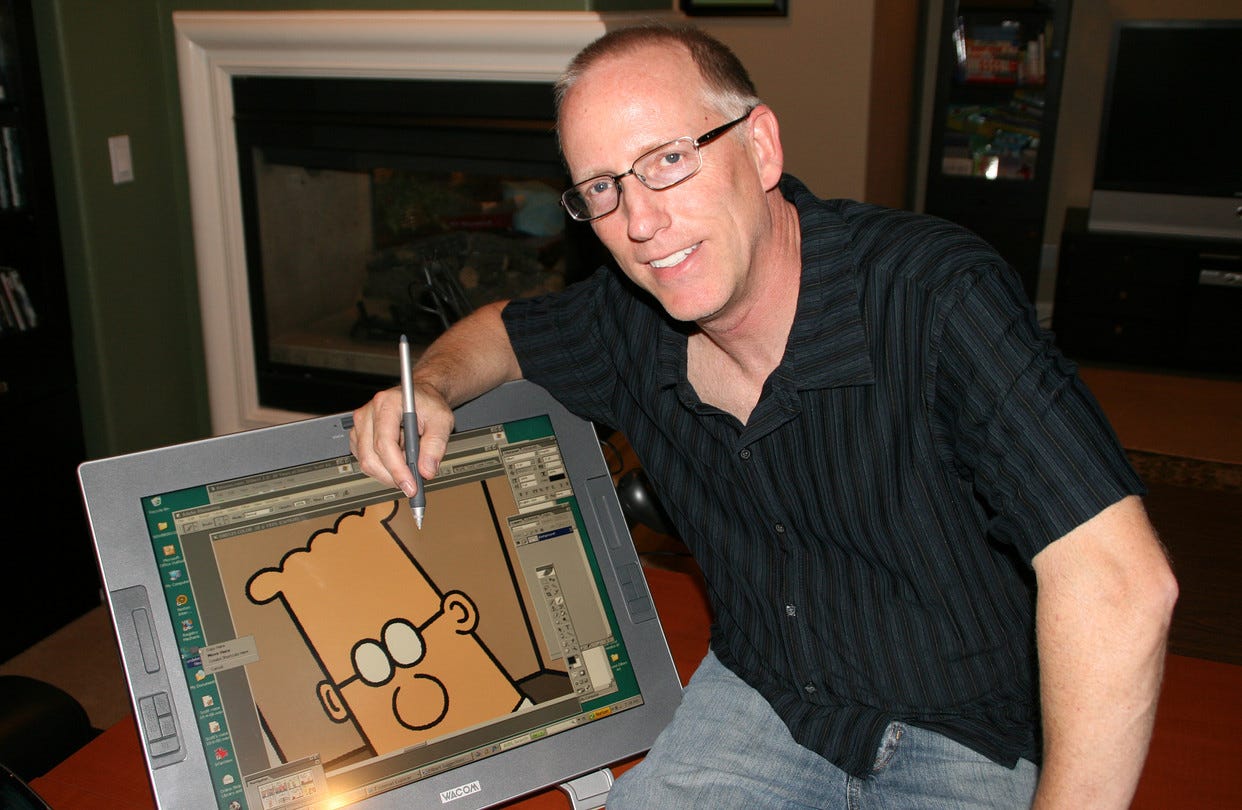
Scott Adams, a famous cartoonist, gave this a name in his book How to Fail at Almost Everything and Still Win Big, a very curious book that I recommend you read.
His idea comes down to this: you don’t need to be #1 at something, almost nobody achieves that.
What you urgently need is to get into the top 25% at several things that obsess you and that you can, in some way, connect with each other (Adams, 2013). This idea is more powerful than you think. Look at the case of the author himself, Scott Adams, he built his career because he drew daily and told jokes with wit. He had studied business, something almost no other cartoonist did.
Business + humor + drawing: Scott Adams’s successful model.
No single piece on its own made the difference; together, it made him stand out.
The psychology of creativity calls this combinatorial creativity (Boden, 1990). No idea arises from nothing. Everything is born from taking ideas that normally live each on its own and putting them together. You don’t need to be a genius for that. What you do need is to have been in both places at once.
Think about it in numbers.
Imagine that getting into the top 10% in one field gives you a 0.1 probability of running into another person who also got there. With just one field, 1 out of 10 is at your level, this is what happens to the vast majority of people. It’s an advantage that anyone with time and effort can reach; it just takes striving to be the best.
Play differently, dig in different holes in search of gold.
Combine two fields where you’re in that top 10%. The probabilities multiply: 0.1 times 0.1 is 0.01. It’s no longer 1 in 10. It’s 1 in 100 probability of finding someone who resembles you. Add a third field, 0.1 times 0.1 times 0.1, and you drop to 0.001. 1 in 1,000 has your same combination.
Notice what happens there.
You don’t become 1,000 times better at anything, but your differentiation grew x1000.
That distance between doing it well and being irreplaceable is achieved by adding a field that almost no one else has along with you, just as Gutenberg added by mixing something as varied as wine technology with goldsmithing. Combining fields is exploration of better combinations. Staying in one topic and wanting to be the best is just exploitation of what already works…
but everyone already does that.
All of this sounds very abstract, but this is exactly why the guilt I mentioned at the start doesn’t make sense here. You are not wasting time when you get into that topic that had nothing to do with your work. If you do it with intention and not just aimless scrolling, you’re trying your luck in new excavations. Most of the time you won’t find much, but that’s no reason to worry.
Once, by digging deep, you’ll strike the gold mine that pays for all the rest of the attempts.
Alright, now you have the theory. How is this done in practice?
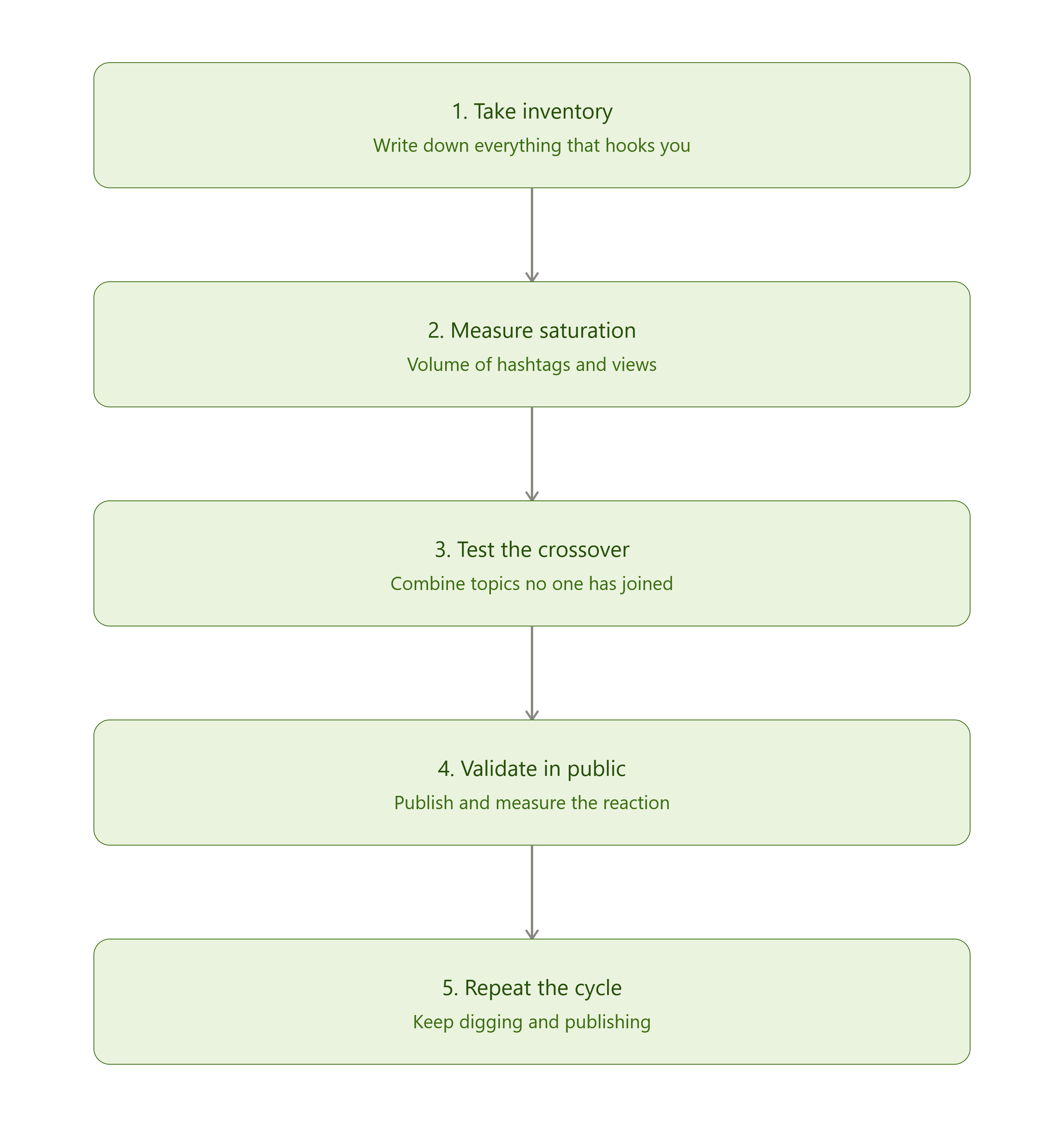
Five steps.
One: make an inventory of all the topics you can talk about for hours and are always watching content about online. When you do this with a new topic, remember to write it down. Note everything that has hooked you. That’s your raw material to get started.
Two: measure the saturation. Look at the volume of each topic on social media using the number of posts under each hashtag or the average number of views that content gets. High volume is telling you there’s no advantage there anymore, it’s usually not fresh ground. Low volume indicates fresh territory.
Three: test the crossover. Bring together 2 or 3 of those topics that no one has put together in front of you before. The less alike the communities of each topic are, the lower the probability that someone else is there too, and the higher your crossover advantage.
Four: validate in public. Publish, create, build, launch a project. Do something in public based on that crossover and measure the reaction. If it works, you now have a combination with potential to exploit. If not, back to digging.
Five: repeat the cycle. Keep looking for topics you didn’t know about, with no pressure that they need to be useful today, and keep publishing on the crossovers you already validated yesterday. One feeds the other, don’t be afraid to learn about “weird” topics.
To make it more obvious, if you’re an artist, here I’ll leave you some examples of how I applied this concept to write some of my most famous articles.
Mushin, the Japanese concept for concentrating without effort, came from an obsessive afternoon of crazy reading about samurai history, mixed with the topic I’ve worked on for years: focus.
Gresham’s Law, on why mediocrity wins on social media, came from another unexpected afternoon reading about economic crises since the Middle Ages. There I stumbled onto that law, and crossed it with how content is created today in the 21st century.
Why do these kinds of articles have such a huge impact?
Because they’re unusual. A unique combination of concepts never seen before.
Once you already have an artistic vision (the ideas with which you explain the world), what you’re missing is digging in distant lands. Getting into the algorithm’s rabbit hole, and, for once, scrolling with a purpose, jumping between links and recommendations, gathering data, stories, curiosities, and key ideas. Then, do what 99% don’t do. Sit down to think calmly about all of it in search of the connection.
Most people stop at the step of scrolling aimlessly.
The advantage of doing it with purpose to gather ideas feels almost illegal.
If you move between different topics, if you never settle for just one, if you already have a project in mind, or already underway, you already have the key. Dig in distant lands. Find something useful. Mix it with your topic and set yourself apart.
Here’s the summary of what we’ve covered.
I’m not asking you to give up your specialty. I’m asking you to stop treating those scrolling sessions as something purposeless and start using them as exploration time.
Your combination doesn’t have a name yet.
Go find it.
— Álvaro
Want to know more? Here are 3 related ideas to explore:
The Wine Glass Technique: How to write deep ideas and still go viral
How to create an irreplaceable artistic vision in the age of AI
The two types of creators who will dominate the internet: Cartographer and alchemist
P.S. I also offer 1:1 consulting to help you grow on Substack.
If you’re just starting out and don’t know how it works, or if you’ve been at it for a while but are stuck, this will help you. I’ll help you find your direction, position yourself as a leader in your niche, and build a system tailored to your needs for sustainable growth.
My credentials? Over 100,000 global readers in 2 years, 100% organic growth, with 500,000 monthly visits. All from scratch, writing all by myself in my spare time.
If you’re interested, email me at: jardinmental@proton.me
References
Adams, S. (2013). How to fail at almost everything and still win big: Kind of the story of my life. Portfolio/Penguin.
Boden, M. A. (1990). The creative mind: Myths and mechanisms.
Johnson, S. (2010). Where good ideas come from: The natural history of innovation.