


Welcome to Mental Garden. The following letter is part of our “Notes on giants“ collection, in which we explore the thoughts of humanity’s greatest minds.
To see the full library, click here.
🏷️ Categories: Creativity, Deliberate practice, Mental models, Art.
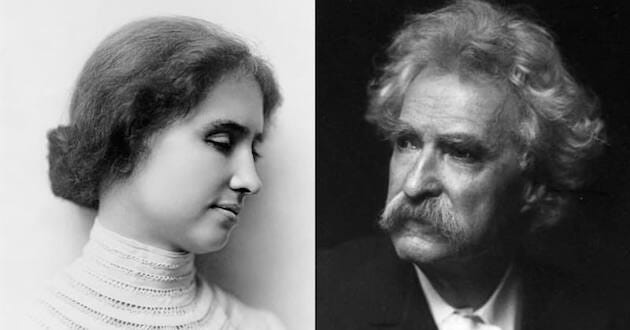
In 1903, Mark Twain wrote a letter to his friend Helen Keller.
Her short story The Frost King bore too much resemblance to Frost Fairies, a story published by Margaret Canby. Although she was acquitted, the damage had already been done. That episode of humiliation marked her for life.
Twain, who saw creativity in a different way, dedicated a few lines to his friend.
He told her, bluntly, that the idea of “plagiarism” was absurd. That all human thought is a variation of previous thoughts. Nothing can be original.
This letter leaves us with a key insight: if you want to be creative, you’d better start by imitating others.

Letter from Mark Twain to Helen Keller (1903)
My God, what an indescribably comic spectacle that solemn and grotesque farce of “plagiarism” was! As if there existed anything, in any human utterance—oral or written—that was not plagiarism.
The kernel, the soul—let us go further: the substance, the essence, the real and valuable material of all human utterance—is plagiarism. Practically all ideas are second-hand, consciously or unconsciously drawn from a million outside sources, and daily used by the gatherer with a pride and satisfaction born of the superstition that he originated them; whereas there is not a rag of originality about them except the little discoloration they get from his mental and moral calibre, his temperament, and his method of expression.
When a great orator makes a great speech, what do we hear? Ten centuries and ten thousand men speaking through him. But we call it his speech, notwithstanding the fact that it is only a small part of it that belongs to him.
Not enough to signify.
It is simply a Waterloo: we credit the battle to Wellington, but there were many who contributed. It takes a thousand men to invent a telegraph, or a steam engine, or a phonograph, or a telephone, or any other important thing—and the last man gets the credit, while the others are forgotten. He added his little grain of sand; that is all he did.
These lessons should teach us that ninety-nine parts of all things that proceed from the intellect are plagiarisms, pure and simple; and that the true lesson should be to make us modest.
But nothing does that.
Twain was defending Keller while revealing the most uncomfortable truth of art: human creativity is simple, raw combinatorics.
What no one tells you about creativity
Originality is the result, not the starting point.
And accepting this truth is liberating: the obsession with being unique stops weighing on you, and you finally begin to create for yourself.
We love the idea of a “unique voice,” the singular artist, the unrepeatable singer. We hate imitation—and with the arrival of artificial intelligence, even more so. Little by little, culture has made us believe that copying is fraud. In reality, it is learning.
No one is born with style: style is trained.
The real creative process is this:
Analyze what you admire.
Practice until you master it.
Repeat with multiple influences.
Mix it and improve it in your own way.
Share it with the world and refine it.
Only then does a personal voice emerge. Those who dare to imitate end up learning how to create. Those who fear resembling someone else never become anyone.
Let’s see step by step how to achieve the originality everyone longs for.
5 steps to be creative
1. Analyze what you admire
Everything begins with admiration—but admire with a hunger to understand.
When you discover something that inspires you (a phrase, melody, design, photograph, landscape, conversation…), your first impulse should be to analyze it. Why does that song move you? What hidden structure supports that text? What visual decisions make that design so clear? What makes this painting impact me so deeply?
Little by little, you train your eye to recognize patterns you didn’t see before. That is the difference between seeing the world and understanding it.
Take notes on the patterns you see in art.
When you have many patterns, classify them into groups.
Over time, you’ll have a valuable toolbox for creating.
What you understand deeply, you’ll be able to transform into your own art.
2. Practice until you master it
Understanding patterns isn’t enough—you have to learn to execute them yourself.
Repeat techniques, structures, styles, forms… Great composers begin by studying and playing the works of others. Good writers are first great readers who then put what they’ve learned into practice.
Copy other styles until you master them.
If you write, imitate the tone, rhythm, atmosphere, and structure of authors you admire.
If you paint, copy the color palette and use of light from an artist who inspires you.
If you do photography, work on framing, shadows, and color from your references.
Practice helps you master technique and expand through it.
3. Repeat with multiple influences
Once you master one style, don’t stay there. Change subjects within your discipline and step outside your usual territory. Look for other references inside your field and beyond it. The Japanese call this idea “shuhari”: learn from the master, break with the master.
If you write mystery novels: analyze and practice science fiction authors. Study how they build worlds and manage the pacing of key information, then apply those techniques to suspense to find new ideas.
If you do photography: study classical painters. Learn how they organize space and use color palettes, then apply those compositions to your frames to create novel photography.
If you compose electronic music: listen to jazz. Observe harmonies, rhythms, and instruments, then apply them to your tracks to create an innovative blend.
The more often you do this, the better your artistic toolbox becomes.
It’s time to create.
4. Mix it and improve it your way
This is the moment for alchemy.
Take elements you learned from all your masters.
Change the rules: different proportions, styles, contexts, tones, colors, rhythms…
Your style appears when something new and satisfying emerges from the mix.
That longed-for “originality” is nothing more than your way of combining elements—everything influenced by your history, your obsessions, your personality, your values, by you.
And now comes the best part…
5. Share and refine
The creative process ends when you share your work and refine it based on feedback.
Showing your work to the world requires courage, but you must understand that creativity matures in public. Listen to reactions and comments; observe what works and what doesn’t. The audience will see your flaws—then it’s your turn to fix them.
After sharing, return to the beginning: analyze, practice, mix again, and remember the feedback.
It’s a cycle that makes you better with every turn.
That’s how you move from imitation to creation.
That’s how you build a personal style.
Want to know more? Here are 3 related ideas to explore further:
The mistake that kills the most creative careers (and how to avoid it)
7 techniques proven by science and artists to boost creativity
✍️ Your turn: What patterns could you start observing today in what you admire?
💭 Quote of the day: “Those who do not want to imitate anything produce nothing.” — Salvador Dalí, Dalí by Dalí (1980).
See you next time! 👋

References 📚
Twain, M. Mark Twain’s Letters, Volume 2: 1867–1868.
I have been saying this for years, but not in Spanish. Well done Alvaro
Good advice, especially the critique of the public or fellow creatives. While I've read a lot of books of various genres, I haven't made an effort of imitate their styles. Some writing programs actually assign their students to do this. I don't know if I'm that estute, but I'll give it a go.