


🏷️ Categories: Happiness, Life lessons, Minimalism, Time.
Can cinema change your life?
One characteristic of art is its ability to generate emotions in the viewer. Emotions that, depending on their impact on us, can bring about changes in our lives or push us to make decisions we once felt incapable of making.
Today we’ll talk about Perfect Days, the movie that changed my life.
In a world that is increasingly fast-paced and superficial, with an impatient society and shrinking attention spans, this work reminds us of the natural rhythm of life. With its calmness, it is an act of resistance against the dehumanization in which we live.
We meet Hirayama, a Tokyo toilet cleaner who will change your perspective.
We enter his rituals: making the bed, watering the plants, morning coffee, choosing a cassette to listen to while driving to work, his reading breaks at the laundromat, his daily bath, and reading before sleep.
Small gestures that reveal a meticulous, calm, and… very happy man.
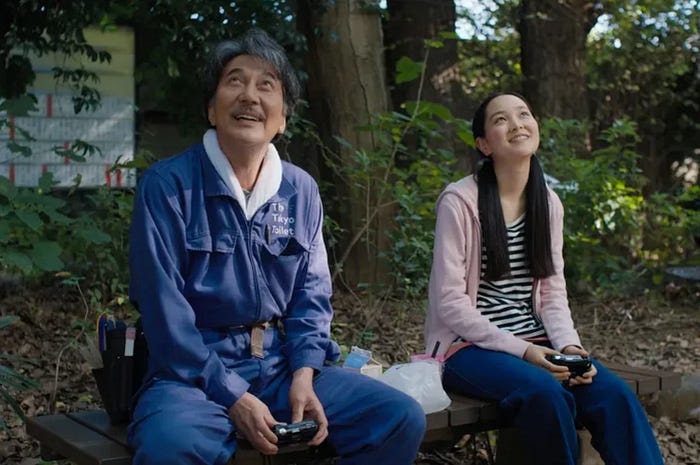
“Now is now. Next time is next time.”
In the film, Hirayama says these words to his niece Niko.
They repeat them while pedaling across a bridge at sunset and, if I had to reduce Perfect Days to a single idea, it would be precisely that. Every instant deserves to be lived; every moment is valuable. In Japanese, this concept is called ichi-go ichi-e, and while it sounds beautiful, it requires something hard to achieve in this frantic world: presence.
It happens when you accept that your life unfolds here and now.
Not yesterday, with regrets about what could have been.
Not tomorrow, with anxiety about what might come.
Life happens now.
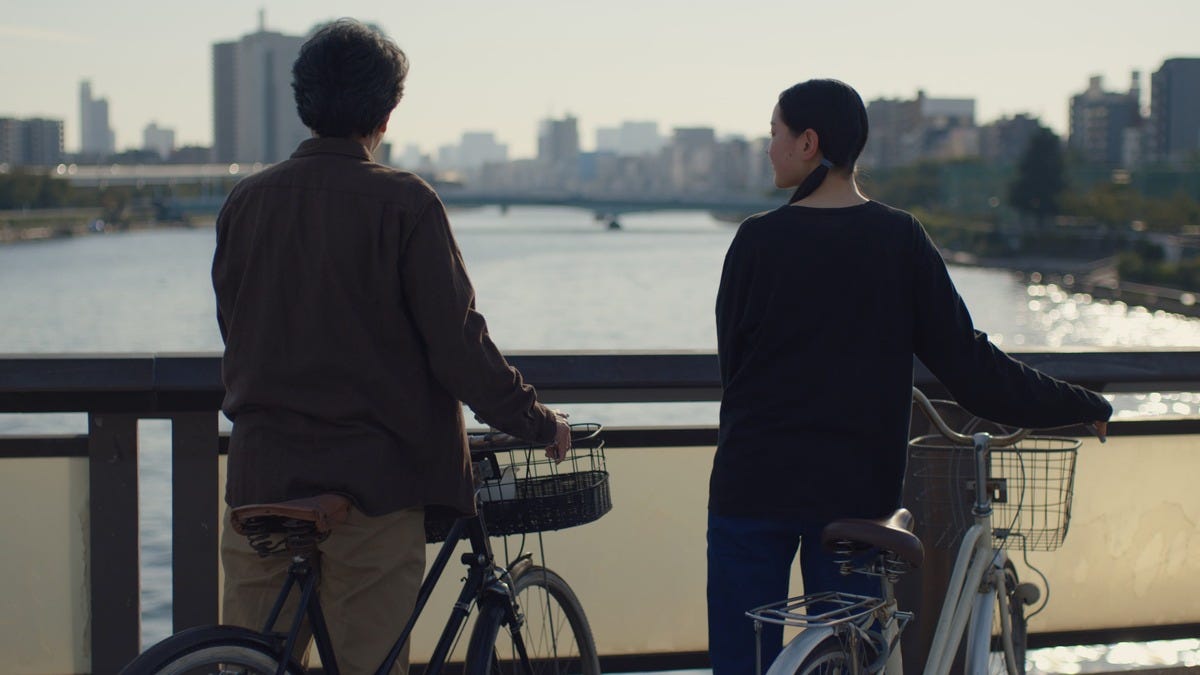
Hirayama never rushes.
He doesn’t listen to podcasts while multitasking or play voice messages at 1.5x speed. He hardly depends on technology at all. He wakes up to the sound of a street sweeper’s broom, folds his futon, waters his plants, buys the same coffee as always, chooses a cassette (Lou Reed, Nina Simone, The Velvet Underground), drives his van, and cleans toilets across Tokyo. He comes home, reads a few pages of a book, turns off the light. Repeat.
And yet, he doesn’t repeat.
That’s what shifted my mindset.
Hirayama is the opposite of the myth of Sisyphus. Sisyphus repeats his routine as punishment, endlessly pushing the same rock. Hirayama is the reverse: he loves routine because he discovered the secret—appreciating every detail that makes each day unique while turning routines into pleasurable rituals that give his life meaning and order.
He does the same things, and yet no day is the same. There are always new details to discover.
A bird singing from a tree branch.
An unexpected, pleasant conversation.
A beautiful sunset.
By living slowly, he can savor each detail. But don’t be fooled…
Hirayama is not always happy; life has ups and downs. Yet his order, modesty, and attention to detail make him deeply happy overall. His life contrasts with that of most people, who long for vacations to escape their routines, who turn to excessive consumerism in search of novelty, but who never find true satisfaction no matter what they buy.
Hirayama owns little, and therefore he enjoys more.
Hirayama lives slowly, and therefore he lives more.
How much do you resemble him?
That was the question I kept asking myself throughout the film.
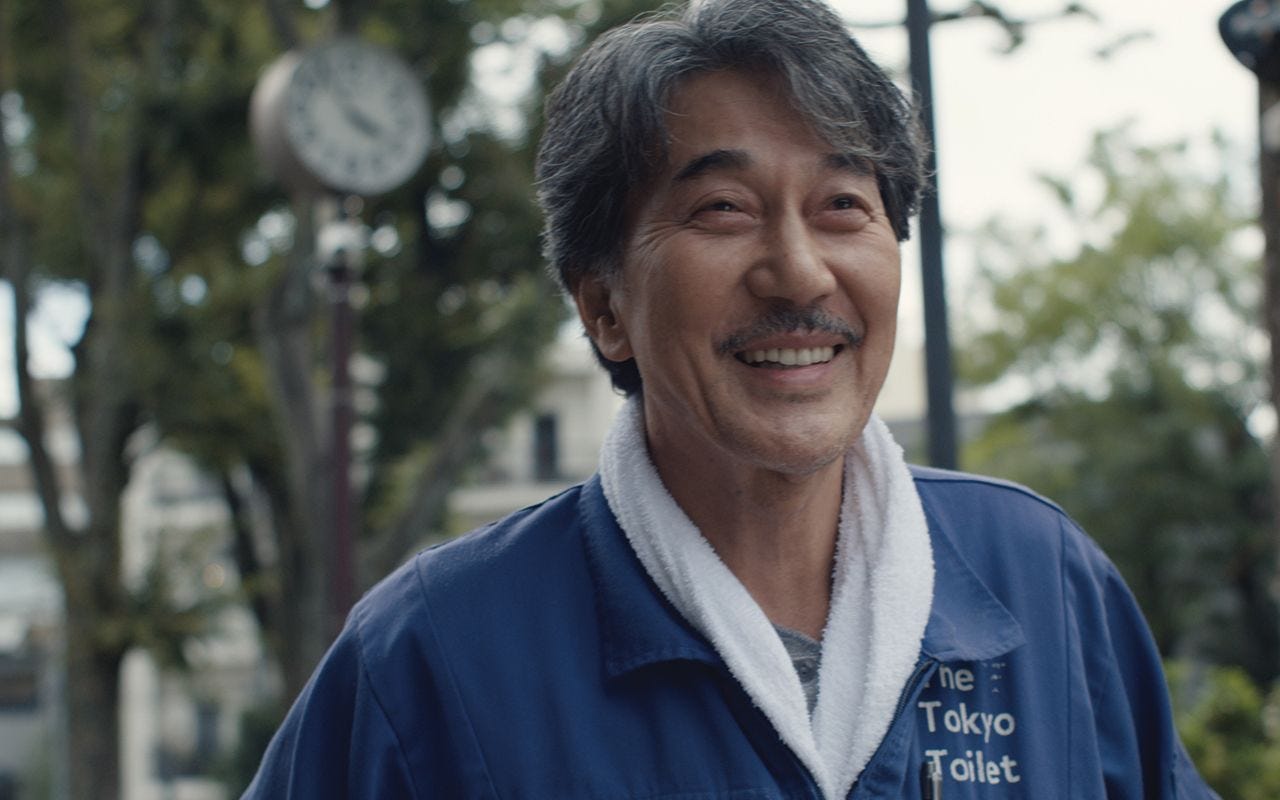
Komorebi
This Japanese idea floats throughout the movie, infusing it with magic.
Komorebi (木漏れ日) is a Japanese word that describes sunlight filtering through tree leaves, creating a play of light and shadow.
Dancing shadows. A pattern you can only notice if you pause and remain present. It will never be appreciated by someone rushing across the city, stressed out, staring at their phone screen instead of the park they walk through.
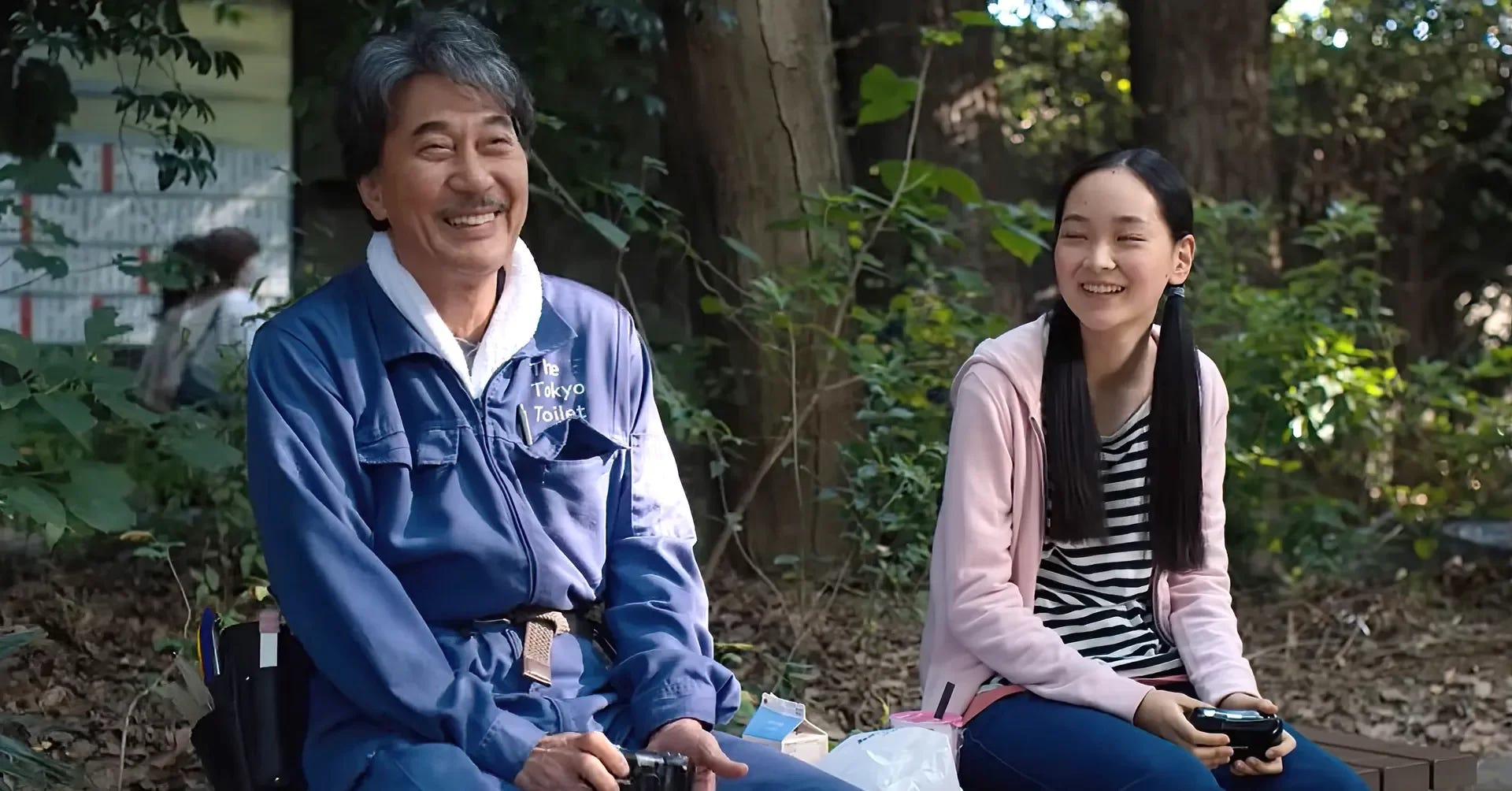
Hirayama always eats lunch on the same park bench and looks up.
He takes out his analog camera and gazes at the trees. Click. Another snapshot of komorebi. He doesn’t collect “content” for Instagram; he keeps beautiful fragments for his photo diary. He develops them at a photo shop and stores them on paper—no need to display, no need to prove.
His niece Niko asks if the trees are his friends. He says yes.
His diary has witnessed the trees’ growth over the years.
His slowness has even allowed him to savor the growth of trees.
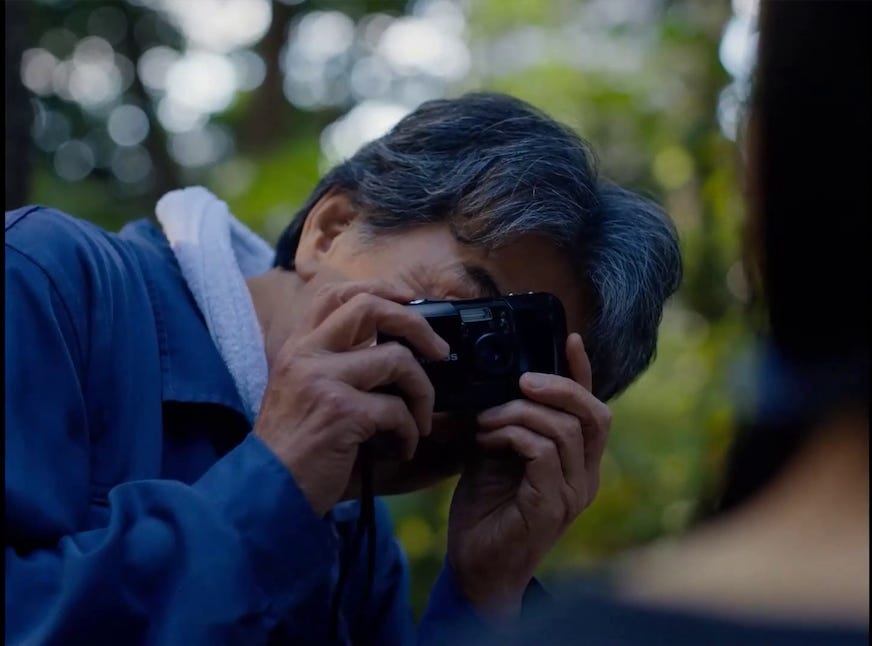
The trees are his journal, his way of contemplating the subtle movement of the immobile.
The Praise of the Ordinary
What an uncomfortable expression in societies obsessed with the extraordinary.
Hirayama performs with love actions most people would despise: cleaning a toilet, folding a sheet, scrubbing the floor. The everyday becomes, for him, an intimate moment to show his love for detail. Hirayama does each daily action with mindfulness, striving to make the outcome the best it can be.
His coworker, Takashi, doesn’t understand.
A young man who spends his shift glued to his phone while cleaning toilets, he marvels at Hirayama’s devotion, even asking how he can be so committed when the bathrooms will soon be dirty again. Hirayama doesn’t waste time. He tells him to get back to cleaning and continues scrubbing with care.
His philosophy can be summed up as: “Whatever you do, do it the best you can.”
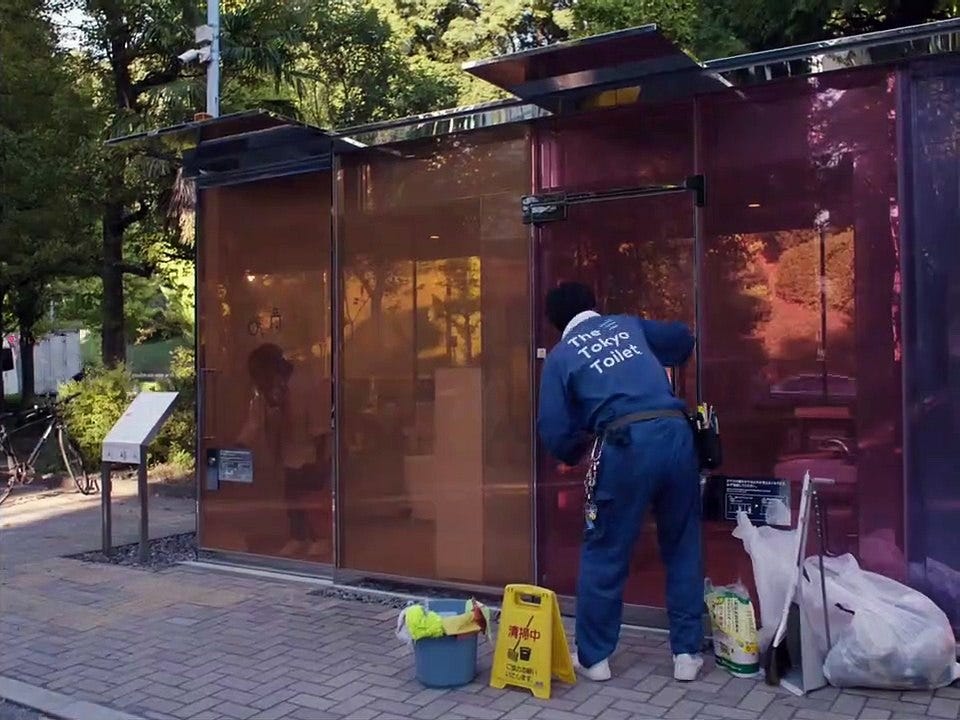
But don’t mistake him for being obsessed with productivity.
He doesn’t compete to clean the fastest or the best. He only cares about honoring each action and moment. Whatever he does, he never does halfway, never multitasks, never rushes.
If he talks to you, he looks you in the eyes—not at his phone.
If he scrubs, he scrubs with attention to detail—not to finish quickly and go home.
Everything in its time, everything with respect.
And the most striking part: in a world that measures people’s worth by their titles and possessions, Hirayama takes pride in a job most would never notice. Still, he doesn’t let himself be stepped on. He’s not naive.
He’s not gullible and knows his limits.
When his coworker quits and the boss expects him to do double the work, Hirayama stands his ground. With respect, but firmly, he warns his boss he won’t do two jobs no matter the pay. The brief, sober scene reordered something inside me: you can live slowly, be contemplative, humble… and still know how to assert yourself.
After the workday and another komorebi captured, we return to his home.
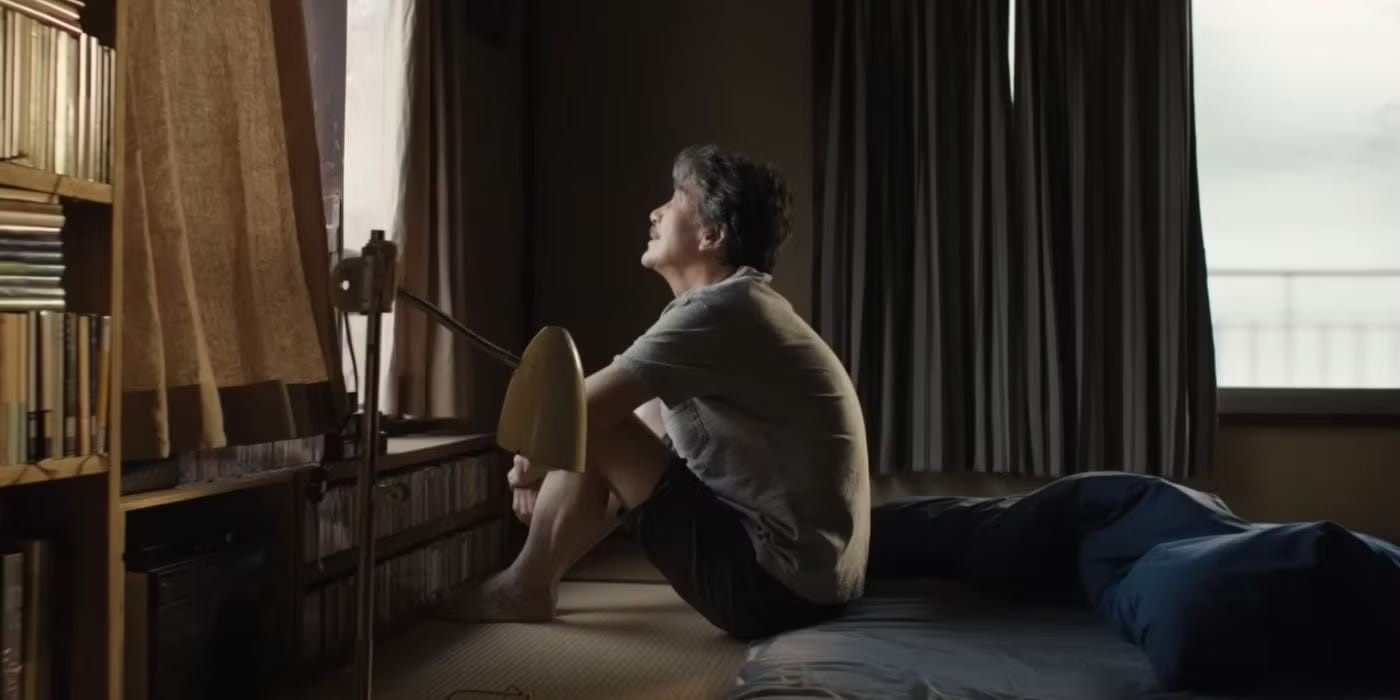
No TV. No computer. No smartphone. Not even a bed—he sleeps on a futon. What he does have: secondhand books, plant cuttings he rescues from parks to grow, and a shelf of cassettes. There is space to listen, to think. A simple space with only the essentials.
When was the last time you asked yourself if “more” was truly better?
His home made me reorder mine.
One day, he goes with Takashi to a retro shop.
The owner offers him a huge sum of money for his pristine collection of original cassettes. Hirayama doesn’t flinch. No deal. It’s not contempt for money—it’s simply that he doesn’t need more to live the way he wants. And that, in a society obsessed with accumulating more and more, makes you reflect on what you prioritize in your life and why.
A simple lifestyle, chosen by him, is what makes Hirayama’s life full.
It’s a lesson in surviving the 21st century.
The inevitable question is: what does it mean to live a full life?
For many, success is synonymous with visibility, accumulation, and speed.
Hirayama offers a radically different answer.
The key is whether you own your attention—or gave it away to haste and technology like his coworker Takashi. Whether you savor each moment and those habits that have become rituals you repeat daily, shaping you into who you want to be.
I don’t think the film tells you to “give up your ambitions” or “go clean toilets.”
That would be missing the point.
What it proposes is more demanding: asking yourself what you prioritize and at what pace you live.
Perhaps the key to enjoying the passing of days is to live a little more like Hirayama. A little more pause. A little less constant stimulation. A small, pleasurable ritual to rekindle the joy of routine: watering a plant, choosing a song and listening to it in full without skipping, going for a walk and standing still when sunlight pierces through a tree so you don’t miss the komorebi…
Since watching Perfect Days, I haven’t forgotten: now is now; next time is next time.
I don’t know if cinema can change your life.
I know this film changed mine.
Now is now.
✍️ Your turn: How will you protect your attention from noise (rush, screens) and use that time to create rituals that give direction to your life?
💭 Quote of the day: “Next time is next time. Now is now.” — Hirayama
See you next time! 👋

References 📚
Wenders, W. (2023). Perfect Days.
So many worthwhile ideas here, thank you. After your description, I really must see the movie. From one garden to another:
past, present, future
so much movement back and forth--
now is all there is
On your suggestion I watched Perfect Days. First, thank you for the suggestion and your take on it. It was an excellent movie crafted with great care and attention to detail--a true work of art.
The movie generated a lot of thoughts for me. Here are a few of them.
The first half of the movie seems to show the ways in which Hirayama honored his work and philosophy as you mentioned. But something happened in the 2nd half of the movie after his niece shows up. Her arrival means different sleeping arrangements. She sleeps on his futon, he sleeps in a room stuff with supplies. This room isn't part of what we see in the first half. It's not neat and orderly, it is overstuffed and feels cluttered.
The room seems to symbolize that there are things hidden away or below the surface. We see glimpses of what that could be when his sister shows up to retrieve her daughter and asks Hirayama to visit their father who is demented and not the same man. And when they hug before she leaves. It's obvious they don't agree but they care for each other.
I think his niece's visit also opened up a glimpse into the struggle we may all be familiar with between taking care of ourselves and connecting with others. Others interrupt our routines, AND they add essential elements that being alone, tending to our work, and doing our hobbies can't add. I see that he is happiest during his niece's visit, his connection with the bar owner's ex-husband, and the possibility of more connection with the bar owner.
We initially see him as a solitary person, but later see that he is connected to others often in small but meaningful ways. The young woman in the park eating her lunch who stares at him, the restaurant owners he sees regularly, the young boy who lost his mother, his co-worker's girlfriend, and his niece all appreciate and connect him in different ways. That seems to be the result of him meeting each moment and bringing his best, but not his ego.
Thank you for recommending the movie and sharing your thoughts. I found it delightful and have enjoyed it for much longer than its 2-hour length. It's also making me think about how cluttered my days are and how I can make my life simpler.