

The Irish Mistake: Why You Need a Plan B
Ireland had the perfect Plan A... and that was the problem

🏷️ Categories: Mental models, Life lessons, Creativity, Decision making and biases.
In 1845, Ireland bet its entire future on a single plant.
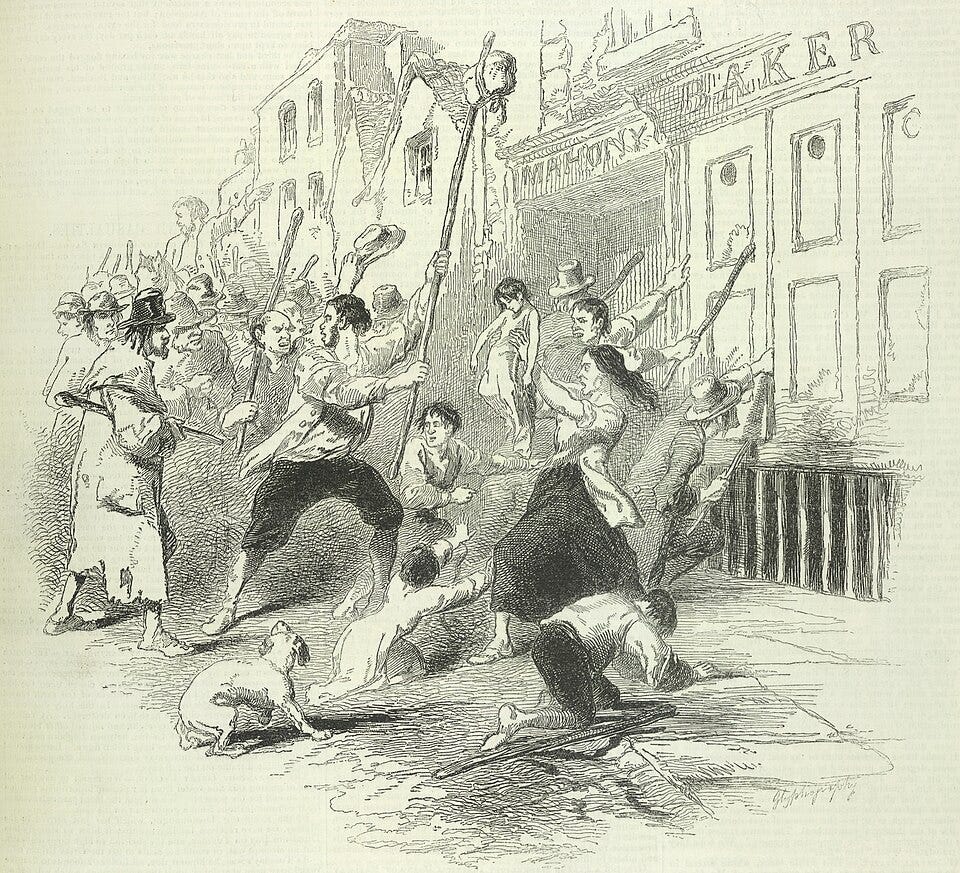
Solanum tuberosum, the Irish potato. It grew quickly, resisted the cold, and filled the stomachs of millions. For poor families, it was the difference between eating and going hungry. For the country, it was a perfect system. So perfect that for years no one saw any reason to change anything…
And that’s exactly where tragedy began.
In just a few weeks, a fungus called Phytophthora infestans blackened the fields. The plants rotted. The crops vanished. What had seemed like the safest solution in the world became a deadly trap. More than a million people died and another million had to emigrate. And the most painful part is that the tragedy wasn’t caused by the fungus.
It was caused by the lack of variation.
When you depend too much on a single thing (a crop, idea, plan, or person), you become so fragile that the first unexpected “fungus” wipes everything out. And this isn’t just about agriculture: it reflects how we live. Because all of us, in some part of our life, bet everything on one thing without realizing it.
And like the monoculture in Ireland, it will fail.

Vital Monoculture
Vital monoculture occurs when your life, decisions, ideas, or relationships rely on a single element.
A single way of creating.
A single way of working.
A single way of solving problems.
We do it out of comfort: if something works, why change it? The problem is that life always changes before we do. And if we haven’t broadened the options in our methods, relationships, or strategies, when something fails (and it will), we’ll find ourselves with no alternatives.
Nature, wiser than we are, has been warning us for centuries.
Without variation, there is no adaptation.
Without adaptation, there is no future.
Species mix and change generation after generation to adapt to their environment. Yet this lesson is ignored in many teams, companies, and decisions, where we repeat the Irish mistake over and over.
Monoculture works.
But it’s fragile.
Very fragile.
1. Creativity
Creativity is the ability to combine elements in a new way.
If you always consume the same things, think the same things, and draw inspiration from the same things, your brain can’t combine new elements and soon you’ll exhaust your resources.
If everyone in a room shares the same education, references, experiences, books… then everyone is combining the same with the same. And we won’t get anything new. Soon we’ll run out of ideas and won’t understand why they’re no longer coming despite having a brilliant team.
The problem, as in Ireland, lies in the lack of variety.
How to sow creative variety:
Consume diverse media: books, magazines, films, interviews, videos, podcasts.
Explore diverse arts: music, poetry, painting, sculpture, writing, photography.
Explore unusual topics for you: medieval history, Japanese architecture…
Surround yourself with diverse people: go to new events and make new connections.
This takes you from medieval economics books to talks from NASA physicists.
Here are 3 examples from Mental Garden where ideas came from diversity:
Gresham’s Law: why mediocrity dominates social media (the history of an ancient economic law + its relation to digital content creation).
The mathematical formula that predicts your creative success (the incredible story behind the formula + its application to consistency in creative projects).
Feynman Technique: Master the Art of Learning (the method used by physicist Richard Feynman to teach + its application as a learning technique).
Notice this: an economic law, a statistical rule, and a physicist’s technique.
When you sow variety, you harvest originality.
2. Productivity
Vital monoculture also appears in the way you work.
When your productivity depends on a single plan, system, or condition, any unexpected event knocks you down. A traffic jam, a meeting that drags on, a bad night, an unexpected call… and you spend the whole day running late and stressed.
It’s the day-to-day equivalent of the Irish potato: a perfect plan, but fragile.
How to avoid productivity monoculture:
1. Buffer spaces in your schedule
If your schedule is 100% packed, you have a serious problem. Use 10–15 minute buffer blocks between tasks to absorb surprises.
If nothing unexpected happens, they serve as rest.
If everything goes wrong, they soften the blow.
2. Multiple ways to make progress
Always have alternatives to move your projects forward. Don’t stop.
Writer:
Can’t write today? → revise previous drafts.
Can’t revise? → read to gather new ideas.
Can’t read? → save new sources of inspiration for later.
Training:
Can’t go to the gym? → work out at home.
Can’t work out? → go for a run or walk.
Can’t move? → review your diet and routine to improve them.
There’s always an alternative plan that keeps you moving.
3. Backups
People only learn this after losing everything once.
Digital monoculture is having everything in a single device or folder (and that can have fatal consequences…). Make monthly backups and store your data in the cloud. This keeps you safe from any mishap and allows you to access your files from anywhere—home, outside, phone, or computer.
Diversity also protects your work.
3. Decision-Making
Your way of deciding can also become a monoculture.
If you only follow one perspective, one person, or one single media source, your mental map narrows and your decisions become dangerous. Also consider the biases you never question that distort your plans: anchoring, confirmation, availability…
The lack of variety in decision-making leaves us vulnerable.
We need to open the field:
Read opposing opinions on purpose and study their pros and cons.
Ask yourself: “What am I leaving out?”, “What if my plan weren’t possible?”
Contrast perspectives to find flaws in your own reasoning.
Listen to different people to expand what you consider possible.
I myself fell into that monoculture.
When I decided to start writing, I believed that to be an online writer you had to be on Twitter. Not because it was the best platform—it was simply because I didn’t know anything else. My world was so small that Substack didn’t even exist to me.
Everything changed when I spoke with other writers and saw ideas outside my plot of land.
Your life changes when you stop looking at the same field and discover that the seeds others have been planting for years may be exactly the ones you were looking for.
Add variety to what you do, who you are, and how you decide.
The more types of seeds you plant, the more harvests you can save.
Want to learn more? Here are 3 related ideas to go deeper:
The danger of playing it safe: How fear of risk slows your progress
The trap of the perfect plan: Nothing will go the way you think
✍️ Your turn: In which areas are you betting everything on one thing? What small change could you make today to expand your options and be better prepared?
💭 Quote of the day: “Everything I ever thought has turned out to be different.” — Cormac McCarthy, No Country for Old Men.
See you next time! 👋

References 📚
Sadurní, J. M. (2020, September 21). The Irish Great Famine, a humanitarian disaster. Historia National Geographic. URL