
Homeostasis: The reason you always start over
Every system resists change

Welcome to Mental Garden, a newsletter about creativity, focus, and systems for writing and building projects on the internet. To explore the full library, go here.
🏷️ Categories: Habits, Mental models.
In the 1930s, the physiologist Walter Cannon gave a name to a fundamental idea in modern biology: homeostasis (Cannon, 1932).
Walter noticed that the human body is in continuous adjustment to keep itself stable. If something drifts out of balance, a series of mechanisms kicks in to restore equilibrium.
If blood pressure drops too low, heart rate speeds up.
If blood pressure rises too high, the kidneys reduce the amount of fluid in the body through urine. At the same time, blood vessels help maintain balance by constricting or expanding as needed.
The human body uses hundreds of these feedback loops to stabilize blood pressure, body temperature, glucose levels, calcium levels, and many other processes. And it does all of this without you noticing.
Something similar happens in our daily lives.
Our routines, schedules, and habits also tend to organize themselves around a state of equilibrium. And when we try to change that equilibrium, a strong resistance appears and pulls us back to the original point. That is why so many people relapse into bad habits, throw themselves into drastic changes, and then, a few months later, end up right back where they started.
The reason is simple: the homeostasis of daily life.
And understanding this will permanently change the way you approach life changes.

The myth of radical change
The myth of overnight transformation is everywhere.
We are constantly told that many people’s mistake is not being ambitious enough. That if we want big results, we have to go big. That we need to aim high. On paper, these ideas sound good. In practice, they are usually a poor strategy.
That is why so many people relapse after trying to make a major life change.
It happens because they try to install, in just a few days, a behavior that their life still cannot sustain. They want to run too far, too soon. And in doing so, they trigger a resistance proportional to the size of the change: fatigue, friction, obligations, social relationships, temptations, wear and tear... everything pulls you back.
The more abrupt the change, the stronger the rebound usually is.
They suddenly change their entire diet.
They suddenly change their lifestyle.
They want a radical transformation.
And after a few weeks, they end up right where they began. This is exactly why 90% of New Year’s resolutions fail. People who try to change this way are fighting against homeostasis... and that rarely works.
The question is how to change in a way that allows the change to stay.
Shifting the point of equilibrium
Change is possible, but it only works within a narrow margin.
If an athlete overtrains, they end up sick or injured.
If a company changes too quickly, the team becomes disoriented.
If a leader pushes their group to the limit, people eventually burn out and quit.
Systems are in equilibrium, and they do not tolerate extreme changes well.
The problem is not change.
The problem is the speed of change.
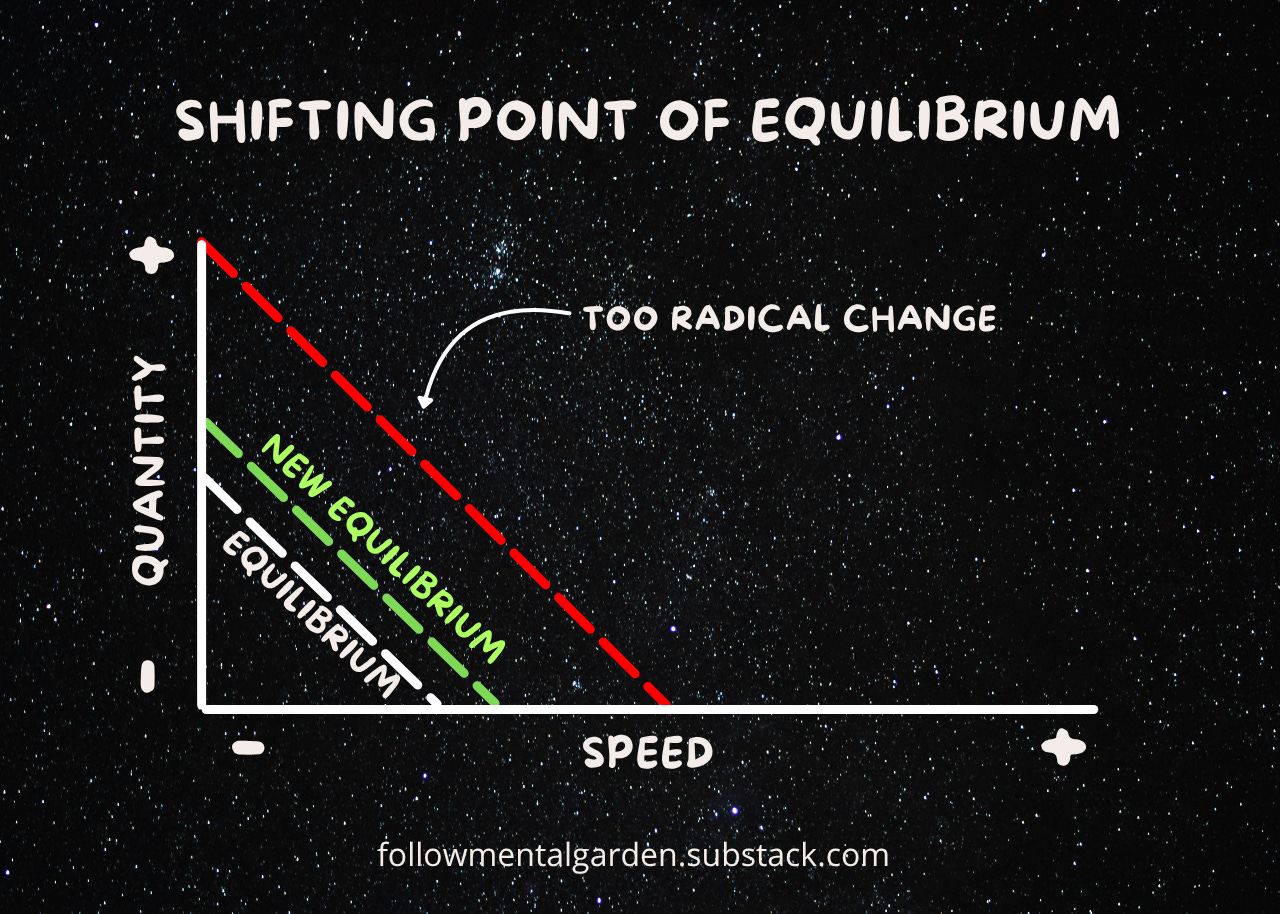
Fortunately, there is a solution: shift the point of equilibrium slightly. In other words, operate at a point very close to equilibrium—so close that the change is almost imperceptible to the system. Let’s look at a few examples.
Nutrition: If you go from eating poorly to following a perfect diet overnight, your body and mind resist, and you end up quitting. But if you add one extra vegetable to your plate each week, your palate and your life adapt without you even noticing the effort.
Writing: Trying to write a thousand words a day from day one is unrealistic. By contrast, starting by writing three sentences every morning creates a rhythm the brain accepts. Over time, those three sentences turn into paragraphs without any violent rupture with the previous habit.
Finances: Wanting to save 20% of your income immediately is unrealistic. Daily life requires flexibility. Saving 2.5% more each month gradually adjusts your spending level and allows your life to readjust without collapsing.
Shift the point of equilibrium so slowly that the system does not collapse.
The homeostasis of routines
For change to last, you have to work with the forces, not against them.
Everything has a natural equilibrium: a rhythm, a pace of development. If you push too hard, the system sends you back to the original equilibrium. Only if you move forward just enough to stimulate adaptation without triggering rejection does the equilibrium begin to shift.
It is not about breaking with your entire lifestyle.
It is about shifting your normal.
The best way to reach a new state of equilibrium is through small accumulated changes. On their own, they seem insignificant, but they have one enormous advantage: they produce major sustainable change over the long term.
That is the key to homeostasis.
Change your day-to-day life slightly.
And your life will end up changing on its own, completely.
Want to learn more? Here are 3 related ideas to go deeper:
Why 90% of New Year’s resolutions fail (and what to do to actually succeed)
How to create an environment that pushes you forward (and stop depending on motivation)
The psychological technique that doubles your chances of achieving your goals
✍️ Your turn: How many times have you tried to change too quickly and ended up exactly where you started? It happened to me when I tried to study a new language. I was so ambitious that I ended up discouraged. Then I gradually moved my point of equilibrium until I found the right balance, and it worked.
💭 Quote of the day: “Perhaps the greatest tragedy of our lives is that freedom is possible, and yet we may spend years trapped in the same old patterns.” — Tara Brach, Radical Acceptance.
See you next time! 👋

References 📚
Cannon, W.B. (1932) Physiological Regulation of Normal States: Some Tentative Postulates Concerning Biological Homeostatics. In: Pettit, A., Ed., A Charles Richet: Ses amis, ses colléges, ses eléves, Les Editions Medicales, Paris, 91-93. URL