

The internet shattered your view of reality
As long as the extraordinary is your benchmark, your life will always be insufficient

Welcome to Mental Garden, a newsletter about creativity, focus, and systems for writing and building projects on the internet. To explore the full library, go here.
🏷️ Categories: Attention, Decision-making and biases, Social relationships.
We live surrounded by too many exceptions.
For almost all of history, your brain learned what a “normal” life was by observing a few dozen people. That was the map used to interpret reality. Today that map is different. Now you spend hours consuming an endless succession of people at their best moment: the perfect trip, the perfect body, the perfect business, the perfect relationship, success before turning 30.
The environment changed, not the brain.
The brain simply does what it has always done: it takes what it sees repeated and turns it into the reference point from which it judges its own reality. Maybe that’s why you feel like you’re making less progress than you should. Maybe that’s why what would have looked like good progress a few years ago now feels miserable to you. You may have even come to think that you are the problem.
What if you weren’t?
What if that feeling of falling behind is a distorted perception of reality?
If the reference point is broken, so is the judgment you make about yourself. That changes your self-esteem, the decisions you make, the goals you chase, and the life you end up building in the long run. This is the great challenge of the 21st century: understanding how digital reality warps our vision, and achieving a focused mind.
Let’s take apart, piece by piece, how our view of life has changed.

I. The inflation of the extraordinary
The exception is now the norm.
Before, the reference point was the neighborhood, at most, the city. Today you find yourself comparing your life to the best moments of millions of people online.
Think about it.
When you open any platform, you’re not seeing anyone’s life — you’re only seeing the 0.001% best moments of thousands of different people, edited and selected to capture your attention for the next three deceptive seconds. That content doesn’t represent those people; it only shows the highest peak they reached, over months, maybe years, compressed into a few seconds of video with background music.
A brain flooded with those stimuli starts to believe “this is normal.”
Psychologists Amos Tversky and Daniel Kahneman discovered this (Tversky & Kahneman, 1973). Humans don’t judge the frequency of an event by how often it actually happens in reality — that would be statistics. The brain judges frequency by how easy something is to recall.
In other words: the easier you can recall it, the more frequent and important you consider it.
It’s called the availability heuristic, and it’s devastating at a mental level.

If you watch a hundred videos of people making a million dollars in a month, your mind irrationally starts calculating that making a million dollars in a month is common. It isn’t. Statistically, it’s unlikely — but the availability of that information in your feed rewrites your view of reality, and you don’t even notice it happening, because it’s unconscious.
That’s why it’s so dangerous.
On top of this you can add the effect of hedonic adaptation (Brickman & Campbell, 1971): the brain’s tendency to normalize any repeated stimulus until it stops noticing it. The first time you saw someone do something impossible, it left you speechless. The hundredth time, you barely stopped to look. Your threshold for amazement skyrockets, because the doses you’re accustoming your brain to are enormous.
That’s why it seems like nothing is enough anymore to make you watch a TikTok video all the way through.
I like to call this the “Louvre effect”: imagine walking through the Louvre for months without ever leaving. On day one, every painting takes your breath away. On day one hundred, you walk among masterpieces staring at your feet, counting flies. The paintings haven’t changed, but your capacity for wonder has been exhausted from constant exposure to something designed to be exceptional, not everyday.
The internet has turned all of reality into an infinite Louvre.
And you walk through it, every day, for hours, without noticing that you’re slowly killing your ability to value anything that isn’t spectacular. Everything that doesn’t appear on screen feels colorless, dull, tasteless, and boring.
You start to change who you think you are, and you devalue your own surroundings.
II. Identity needs the everyday
Your identity answers a question your brain asks itself 24/7.
What kind of person am I compared to my environment?
For almost all of human history, the answer was your immediate environment. As I’ve been telling you: your range of comparison was narrow, and therefore attainable.
Today, your perceived environment is made up almost exclusively of statistical anomalies: 23-year-old CEOs, Olympic athletes, writers who sell millions of copies, creators with audiences the size of entire countries. You compare an entire mountain range (which is your life, with its valleys, its hills, and its moderate peaks) against Everest, which is the only thing shown on social media.
When the reference point is the top 1% of the planet in their top 1% moment…
Your identity is always a tiny misery.
It doesn’t matter what you achieve. There will always be someone, somewhere on the internet, who did it faster, younger, with more money, with more followers, and better-looking. Imagine Cristiano Ronaldo watching Lamine Yamal win a World Cup at such a young age, when he himself, despite all his achievements, never did.
Even he ends up looking like not much.
Psychiatrist Alfred Adler called this the inferiority feeling (Adler, 1927): that chronic sense of not measuring up, which in small doses can motivate you to improve, but in massive doses, will crush you.
This anxiety of “being nobody” ends up altering how you make decisions about your life.
III. If everything seems possible, nothing is enough
Extreme abundance produces a dangerous illusion.
If infinite possible lives exist, any life is a renunciation.
Before the internet, your life options were limited by geography, by social class, by the information available. That was painful in many ways, but it had the positive side effect of forcing you to commit, because there was no visible alternative. Today it’s the opposite. Now you can watch, in real time, someone living in Bali, someone building an e-commerce empire, someone living off farming in the mountains, someone retired at thirty on cryptocurrency…
The internet is a circus of rare animals. It has them all.
And then you, in your ordinary home, after leaving your ordinary job, start to feel the crushing weight of all the lives you’re not living.
Barry Schwartz is the leading expert on this. He called it the paradox of choice (Schwartz, 2004). More options don’t create more happiness; there’s a point where they create paralysis, and when you finally choose, they create regret, because now you’re aware of everything you left on the table. Before you gave up 3 lives, now you give up 3,000 (Iyengar & Lepper, 2000).
You see the opportunity cost directly in the palm of your hand, every day.
Everything you didn’t choose, someone else is living, and they show it to you on social media.
This explains why it’s so hard for you to commit to anything. Sociologist Zygmunt Bauman was the first to warn about this phenomenon in newer generations. He called it “liquid modernity” (Bauman, 2000): now people “flow” through life. A person can change homes, jobs, ideals, and even partners and friendships without any commitment or friction.
Everything is taken casually, as convenient, and without commitments.
Sound familiar?
It does to me, a lot.
You feel that constant FOMO, that background hum whispering that maybe you should be doing something else that would work out better for you. Why not quit that project? What if that city is better? Is this the right person?
An explorer with infinite maps never reaches any destination.
IV. The easiest (and most boring) path
If you truly want to live an extraordinary life, you must first be boring.
And when I say boring, I mean very boring. Really boring. This culture, addicted to appearing extraordinary, lacks what it actually takes to truly be so.
Henry David Thoreau retreated to the woods to answer this very question many years ago — long before the internet existed, long before the problem became massive. He wanted to discover what was left of a life once you stripped away all the social noise, all that comparison and that anxiety to keep up appearances. What he found was simplicity — a boring life to many, but one of maximum clarity and deep focus.
There, he produced the results that made him go down in history.
There, he wrote Walden (Thoreau, 1854).
I ask you. I beg you, even, to live slowly and focused.
The tree never tries to pretend it’s tall; it simply keeps growing. Be a tree.
Don’t compete with the forest. Don’t check how many centimeters the tree next to you grew this week. Don’t compare yourself to the tallest redwood on the planet if you’re a pine tree. Simply, day after day, continue the process that turns you into what you chose to be. When you finally reach a notable height, no one will see the decades of slow growth that made it possible.
They’ll only see the tree.
That’s the lesson the internet made us forget, and one we must relearn.
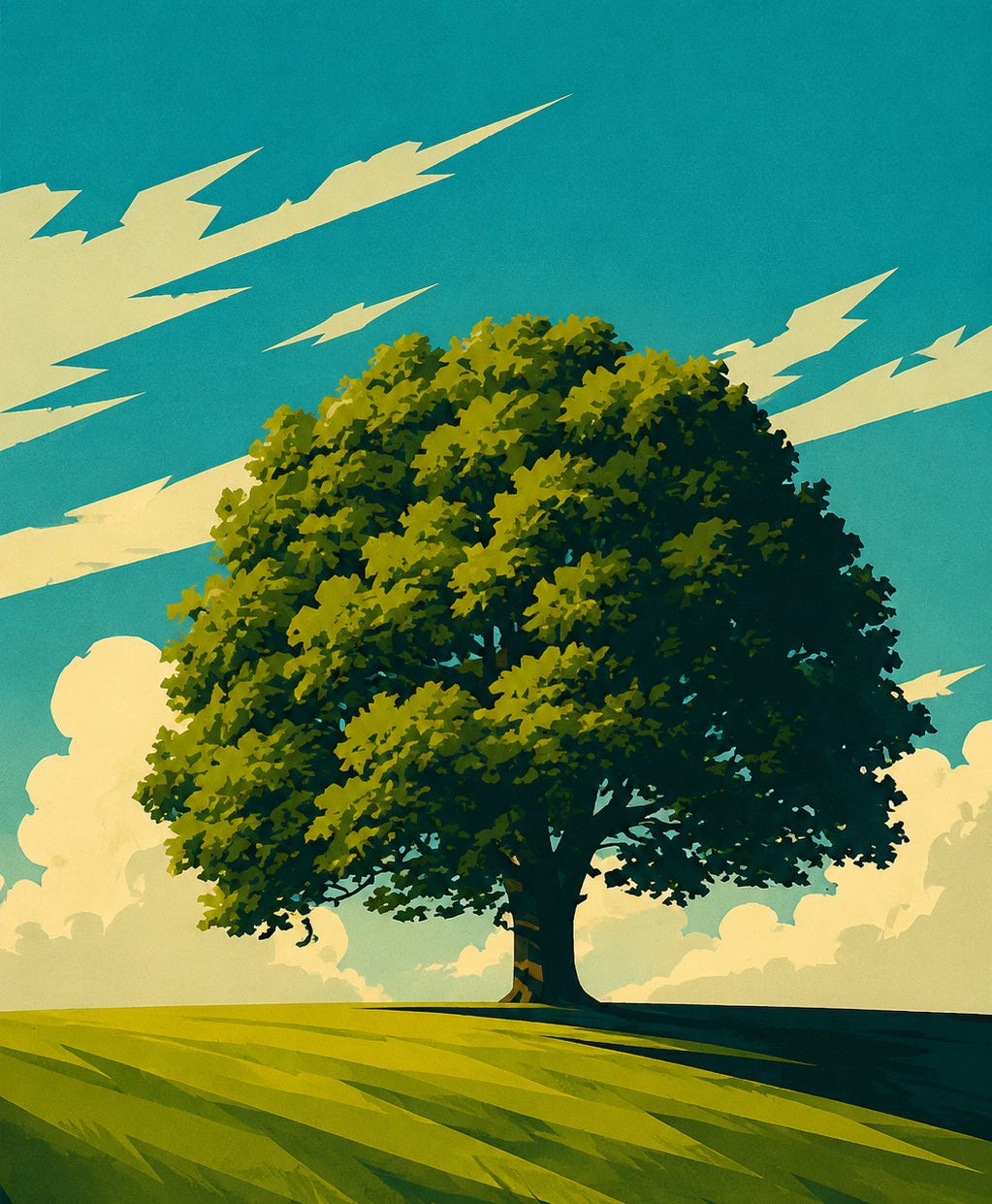
“I will no longer compare my journey to that of others; I refuse to do that harm to my own life.” — Rupi Kaur, The Sun and Her Flowers.
— Álvaro
Want to know more? Here are 3 related ideas to explore:
Digital minimalism: 4 steps to reclaim time in an accelerated world
Why are we increasingly alone? The online world; the empty parks
P.S. I also offer 1:1 consulting to help you grow on Substack.
If you’re just starting out and don’t know how it works, or if you’ve been at it for a while but are stuck, this will help you. I’ll help you find your direction, position yourself as a leader in your niche, and build a system tailored to your needs for sustainable growth.
My credentials? Over 100,000 global readers in 2 years, 100% organic growth, with 300,000 monthly visits. All from scratch, writing all by myself in my spare time.
If you’re interested, email me at: jardinmental@proton.me
References
Adler, A. (1927). Understanding human nature (W. B. Wolfe, Trad.). Greenberg.
Bauman, Z. (2000). Liquid modernity. Polity Press.
Brickman, P., & Campbell, D. T. (1971). Hedonic relativism and planning the good society. En M. H. Appley (Ed.), Adaptation-level theory: A symposium (pp. 287–302). Academic Press.
Iyengar, S. S., & Lepper, M. R. (2000). When choice is demotivating: Can one desire too much of a good thing? Journal Of Personality And Social Psychology, 79(6), 995-1006. URL
Schwartz, B. (2004). The paradox of choice: Why more is less.
Thoreau, H. D. (1854). Walden; or, life in the woods.
Tversky, A., & Kahneman, D. (1973). Availability: A heuristic for judging frequency and probability. Cognitive Psychology, 5(2), 207–232. URL
thank you soo much for this. Much need it