

Inside Neil Gaiman's routine: The routine of the most prolific writer of the 21st century
Notes on gigants - Number 63

Welcome to Mental Garden, a newsletter about creativity, focus, and systems for writing and building projects on the internet. To explore the full library, go here.
The following letter is part of our “Notes on Giants” collection, in which we explore the thoughts and lives of humanity’s greatest minds.
🏷️ Categories: Attention, Time management, Writing.
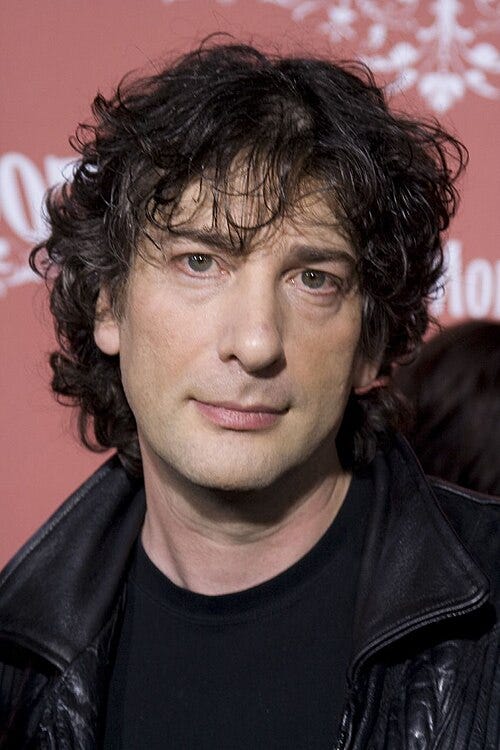
Neil Gaiman is one of the most prolific authors of the 21st century.
He is the author of landmark works such as The Sandman, Coraline, and American Gods. He has received more than 40 awards, including several in horror, fantasy, and science fiction. All of this comes from building complex worlds that have captivated millions of readers across the globe, along with relentless consistency. It’s impressive.
His consistency intrigued me, and that’s when I asked myself: “How does he manage to maintain such a level without burning out?” I dug deep into his routine and found the key.
Here is the answer to becoming a prolific author.
.jpg)

Focus or rest — don’t stay in between
Fundamental rule for writers: you don’t have to write. You can choose not to write if you’re tired, but you are not allowed to do anything else. — Neil Gaiman, The Tim Ferriss Show (2019).
It’s a rule that makes sense. This boundary allowed him to take advantage of the calm of his workspace, a place with comfortable chairs under a canopy in his garden where the breeze flows. There, he sits and allows himself only two options…
Write
Do nothing.
“I can sit at my desk, I can look at the world, I can do whatever I want as long as it is nothing. What I cannot do is crossword puzzles, I cannot read a book, I cannot call a friend… The only thing I can do is absolutely nothing, or write.” — Neil Gaiman, The Tim Ferriss Show.
This is the key to being productive in anything in life.
Attention has two modes: focused attention and diffuse attention.
Focused attention is the ability to concentrate and check off to-do lists. It’s the mental state where you direct all your attention to a single stimulus in a flow state, but it consumes a lot of energy, and if you don’t rest, you start making mistakes and performing worse. To fix that, you need to move to the opposite extreme: diffuse attention. This is the mode where the mind wanders and you let yourself drift—like walking without direction or staring at clouds.
Both modes are necessary for productivity and creativity.
If you notice, Neil Gaiman moves from one extreme to the other: either he is 100% focused, or he completely disconnects. He doesn’t look for a middle ground, which is precisely the mistake. Social media is not rest; diffuse creative thinking does not emerge from endless scrolling. The optimal state is either 100% focused attention or 100% diffuse attention.
It’s about moving intelligently between the two extremes.
Always have alternative tasks
This is one of the most surprising aspects.
When people struggle to move forward, they often blame the famous “writer’s block.” Neil doesn’t believe it exists. He said: “It sounds like it has nothing to do with you: ‘I’d love to write today, but I’m blocked.’ And that’s not true. Cellists don’t have cello block. Gardeners don’t have gardener’s block… But writers have claimed all the blocks and believe it’s real” (Buxton, 2015).
Brutal honesty.
Blocks are inevitable; what matters is knowing how to deal with them.
When the words don’t flow and he is working on a novel, Gaiman takes a break from screens to write the first draft by hand with a fountain pen (his favorite is the Pilot 823). And if the block persists, he moves on to other writing tasks. Like Isaac Asimov, he recommends having multiple projects at once so you can always keep progressing (Writers and Artists, 2012).
Always have several projects or secondary tasks so you never get stuck.
Track your performance
To avoid fooling himself about his productivity, he created a visual method.
“When I’m doing something long, like working on a novel, I always have two fountain pens in use, with two different ink colors, so I can tell at a glance how much work I did that day: ‘Look at that! Five pages in brown. Not bad. Half a page in black. That wasn’t a great day. Nine pages in blue—great, what a day!’” — Neil Gaiman, The Tim Ferriss Show (2019).
I have to admit I relate to this visual trick. For a while I did something similar: I used Hemingway’s method of counting words written, and it worked for me, because when I started building the writing habit it was hard to maintain.
Once the handwritten manuscript is finished, he rewrites and edits it on the computer.
Find your fertile hour
Not all hours of the day are equal.
I first saw this idea in the writer Derek Walcott, and it boosted my performance dramatically. Most of us think in terms of “time,” but almost never in terms of “energy.” Walcott would start working at 4:30 AM and continue for four hours (Hirsch, 1986). By the time people could bother him, he had already done the most important work of the day.
Neil Gaiman does the same, in his own way.
“I love writing, and Sundays are a joy. It’s a gift that no one else is working. It’s the day I have to really write, to do my best work. Most of my time is spent on administration and emails. We have three TV series in progress, there’s a lot going on, but on Sundays I can just create without distraction.” — Neil Gaiman, The Tim Ferriss Show (2019).
Understand your energy throughout the day and the week.
Reorganize tasks that can be moved and adjust your rest so that your energy peaks align with the hours when you can dedicate yourself to your most important work. I call this your “fertile hour.” You only need one hour of real focus per day. If you do it, your performance will skyrocket instantly.
I’m off to rest for a bit.
— Álvaro
Want to learn more? Here are 3 related ideas to go deeper:
✍️ Your turn: Are you training your ability to focus, or are you conditioning your mind to constantly seek stimulation? You’ve seen the importance of switching between maximum focus and maximum relaxation.
💭 Quote of the day: “Your ability to generate energy is directly proportional to your ability to relax.” — David Allen, Getting Things Done
P.S. I also offer 1:1 consulting to help you grow on Substack.
If you’re just starting out and don’t know how it works, or if you’ve been at it for a while but are stuck, this will help you. I’ll help you find your direction, position yourself as a leader in your niche, and build a system tailored to your needs for sustainable growth.
My credentials? Over 93,000 global readers in 2 years, 100% organic growth, with 250,000 monthly visits. All from scratch, writing all by myself in my spare time.
If you’re interested, email me at: jardinmental@proton.me
See you next time! 👋