

I watched a potter create a vessel and understood something important about life
Life, like pottery, is molded little by little

Welcome to Mental Garden, a newsletter about creativity, focus, and systems for writing and building projects on the internet. To explore the full library, go here.
🏷️ Categories: Life lessons, Continuous improvement.
Until recently, I had never stepped foot in a pottery workshop.
Yet one day, without really looking for it, I was invited to a class. I learned by watching the potter at work, he guided us as we shaped our own vessels, and I felt deeply connected to the task. Life sometimes places you exactly where you didn’t even know you needed to be. I thought I would see beautiful ceramic pieces—perhaps some bowls, mugs, maybe a vase...
I never imagined I would walk away with a lesson about life.
As I listened to the master potter explain how to work clay on the wheel, I almost immediately felt that internal click: the way we shape clay also says something about us. We are malleable, yet we are shaped by our habits and our environment. And like clay spinning on a wheel, each day is another turn. In the same way that a work of art emerges from clay, we emerge too.
This is what he explained to me.

Lessons learned from pottery
Potters create pieces by shaping clay as it spins on the wheel.
From the outside, the process looks beautiful. It’s as if a vessel is born from a block of clay that gradually transforms into a mug, a bowl, or a vase.
The reality is much more complex than it appears.
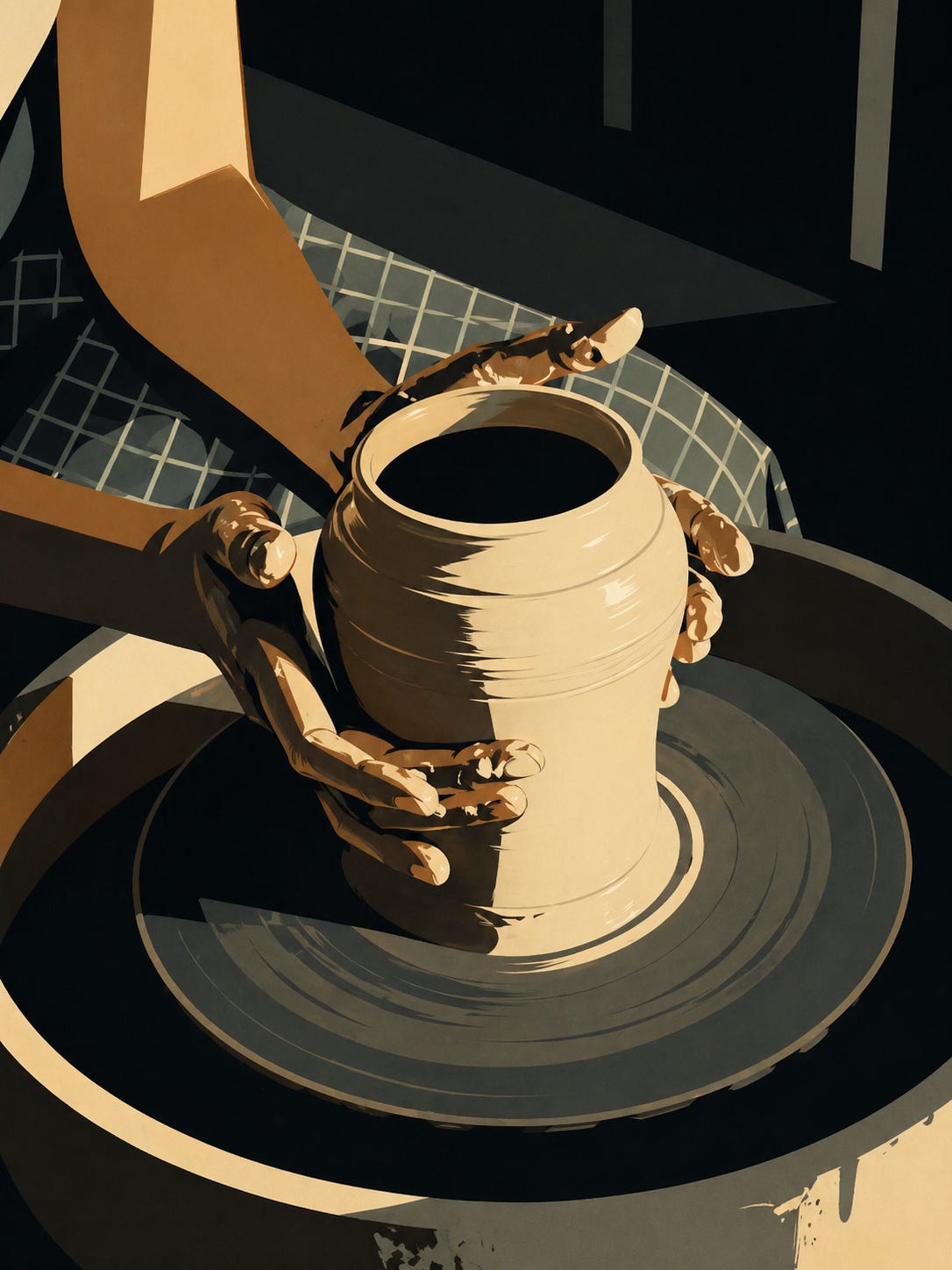
One of the most important moments in the entire process is pulling up the walls of the piece. The potter places their hands around the clay and begins to raise it, giving it height. But this is also where the risk appears: if they try to pull up too much clay at once, the piece loses stability. The walls become distorted, bend, or worse yet—they collapse.
While explaining this to us, he said something that stayed with me.
“If you try to pull up too much clay at once, the piece will collapse. The best way to do it is to raise the wall gradually, with gentle and consistent pressure.”
That is the key to clay—and to life in general.
First, you center the clay. Then you make a small opening. Then you raise the wall a little. Then a little more. Then a little more after that. And so, slowly, until the piece begins to resemble what you imagined from the start.
You must never rush the shaping process.
The goal is to guide it.
When you work with small movements, the piece becomes stable and well-formed.
And life works the same way.
Pottery in everyday life
Changing your behavior, building new habits, or learning a new skill is much more like raising a vessel on a pottery wheel than most of us realize.
Yes, you can try to change everything at once.
We can do it—at least in theory. It’s what many people promise themselves year after year with New Year’s resolutions. We decide to completely change our diet overnight, or we get carried away and think we can transform our physique in just a few months. If our life were that piece of clay, we often try to reshape the whole thing in a single pass.
And that’s the mistake.
It’s very easy to become obsessed with the perfect final result and forget about the daily process—the turn after turn on the wheel—that supports it. We are fascinated by achievements, yet we ignore the system behind them. We think about the goal, but not about how to reach it without burning out along the way. I don’t know about you, but I’ve fallen into that trap many times.
I get excited very quickly.
I’m an intense person.
And then I dive in with all the energy I have. But shortly afterward, I begin to lose momentum. The piece becomes distorted, and I end up having to start over from scratch because I quit.
Again.
Approach change like a potter
The alternative is to look at life the way a potter would.
Move slowly, with care and patience.
Start with a small movement—so manageable that it doesn’t destabilize anything—and do it well, day after day. Then repeat with a slightly bigger step, without forcing the process, but introducing a small improvement with each new turn.
That’s how a life truly changes.
This approach is the essence of homeostasis. You need to make changes so subtle that you can barely feel the friction. That’s exactly how pottery is shaped: with minimal resistance, turn after turn. Then you improve again or raise the bar slightly. Then you repeat. It’s not particularly impressive, but it works.
The potter works slowly because they want to do it right.
They know exactly where they want the piece to go, and they know they cannot force it to get there all at once without destroying it in the process.
You and I can do the same.
We can continue shaping our lives through small changes and steady improvements. With patience, a day will come when we have something beautiful in our hands—not a crooked piece defeated by haste.
A piece raised little by little, strong enough to stand on its own and worthy of pride.
Want to learn more? Here are 3 related ideas to go deeper:
Why 90% of New Year’s resolutions fail (and how to actually achieve yours)
Everything in its own time: Are you patient enough to see results?
✍️ Your turn: In what area of your life are you trying to pull up too much clay at once instead of progressing little by little? Sometimes I wonder if I write too much; so far, the clay hasn't collapsed.
💭 Quote of the day: “You must learn to take things more lightly in life, dear. The world is always changing. Learn to allow it.” — Elizabeth Gilbert, City of Girls
See you next time! 👋
