

How I stopped treating rest as a reward
and I began to see it as the foundation of everything else

Welcome to Mental Garden, a newsletter about creativity, focus, and systems for writing and building projects on the internet. To explore the full library, go here.
🏷️ Categories: Time management, Minimalism.
You are trapped in an invisible cage.
A cage built with your own hands under a premise that society has repeated to you until it has been engraved into you: you have a perpetual obligation to perform.
The philosopher Byung-Chul Han calls it “the burnout society.” In the past, you were exploited by an obvious external authority, such as the feudal lord or the slave owner. In modern life, the game is much more perverse. You have become “the torturer and the tortured.” You voluntarily exploit yourself, chasing metrics you can compare in order to prove that you performed well, while aspiring to the success narratives that everyone being exploited applauds on social media.
Being famous.
Making your first million.
Building a fortune by investing before 30.
Being ultra-productive and not wasting a single minute of the day.
To withstand the pressure of this matrix, doping has become the norm. You dope yourself with caffeine, “rest” through algorithmic stimulation to trigger dopamine release, and take melatonin pills to ease the anxiety that keeps you from sleeping. This is the routine of a large part of the population. People who treat their bodies like a phone battery, only charging them at night and when they are about to collapse with the red indicator at 1%.
Rest does not work like that.
Rest is the refuge that makes everything possible. It is not optional. Every area of your life depends on it, from your physical health to your mental health. If you do not respect your energy and protect your time, your environment will keep draining you until there is nothing left.
Here are the 3 keys I learned and use to put the brakes on and recover every day.

1. Your calendar as a trench
We were taught to see the calendar as a workspace.
We look at our schedule and, if we see a blank space, we feel an irresistible urge to fill it with a task. That is the first black hole that pulls everyone straight toward burnout.
If all your time is available to be productive, you will always fill it.
You need to start treating your blocks of disconnection as a non-negotiable appointment with yourself, not as “free time” (that diluted concept you give away to anyone who asks). If you scheduled a meeting with an important client, you would not cancel it because “something else came up.” So why do you constantly cancel the moments meant to organize your own mind?
You need to take rest seriously, and you can do it with this simple rule.
Implement a physical constraint in your system. For every 2 or 3 hours of deep work, block 30 minutes of scheduled inactivity in your calendar. By blocking it visually, you remind yourself: this space is not for sale. Then, when external noise tries to assign you more workload, you will look at your calendar and see that it is full.
Full of yourself.
That is how you recover so you can be present when it actually matters.
2. Deliberate emptiness versus dopamine consumption
An underrated skill: being able to get bored.
At the slightest hint of fatigue or emptiness, your hand slides toward your phone to receive a dose of stimulation; society has already been trained for this. Just observe what happens at a public transport stop or while waiting in line at a store. Everyone scrolls passively, from tab to tab, from video to video, and the funniest part is that they say they are “resting for a while.”
A lie.
You are subjecting your nervous system to a bombardment of scattered information.
The modern person’s inability to tolerate boredom is precisely what destroys original thinking. If you cannot hold the emptiness, you will never be able to silently connect the dots or focus on creating anything meaningful.
The solution is simple: disappear.
Absolute silence terrifies a mind used to processing 35 GB of daily noise, but crossing that barrier is the price you pay for clarity.
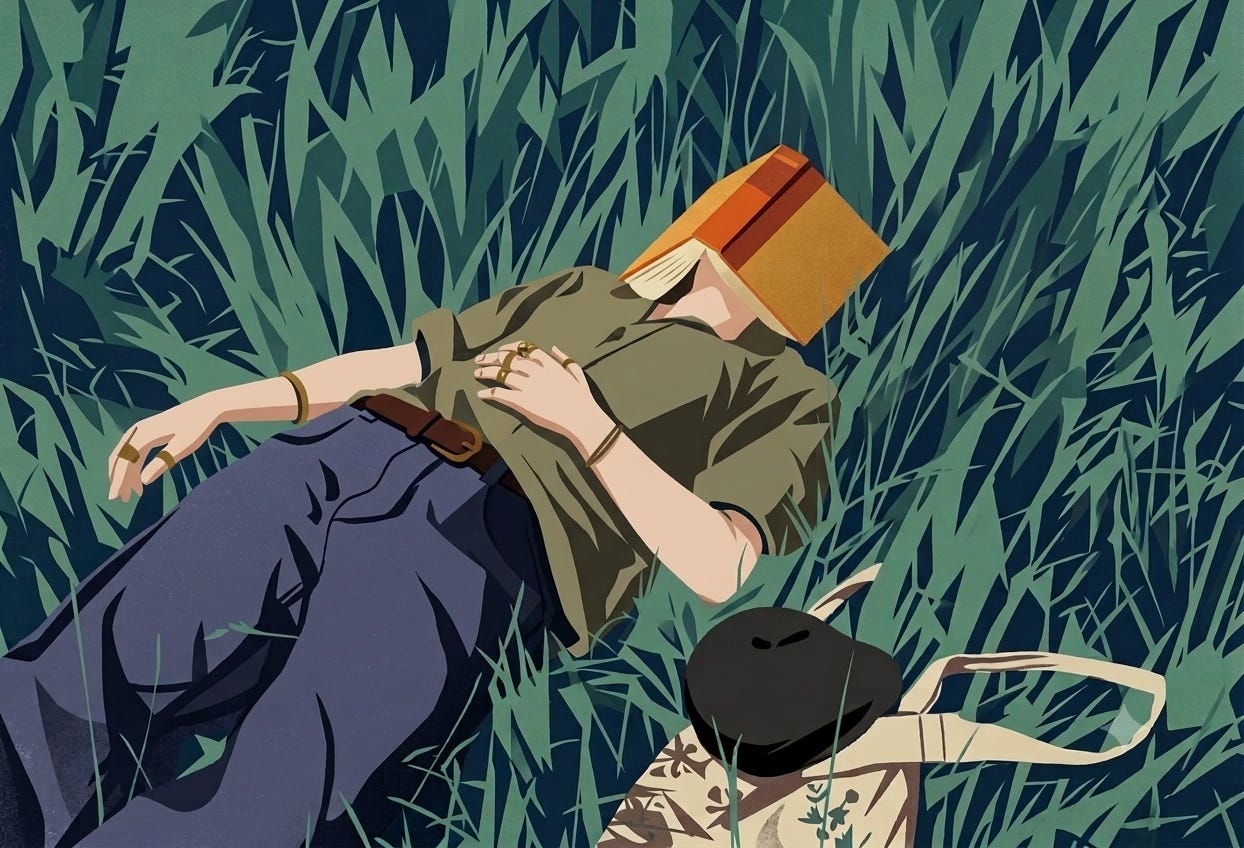
Lie on the floor for ten minutes without screens or music.
Observe a landscape, your plants, or look out the window for a while.
Wait in a line without taking out your phone, just watching what happens around you.
Drink a coffee without screens or distractions, focusing only on the taste and the moment.
Go for a walk without your phone and without a destination, and get lost in streets you never usually take.
The goal is to free your thoughts from the tyranny of results.
3. Cultivate obsessions for pleasure
Social conditioning is so influential that when you find something that sparks your curiosity, your mind immediately jumps into the trap of turning it into work:
How can I make this profitable?
How can I build a personal brand around this?
How can I package this into a business model?
If you write for pleasure, you think about creating a paid Substack. If you cook, you think about starting a recipe YouTube channel. That is the ultimate obsession with performance: making you turn your own existence and your time for exploration into work. And although this can be beautiful, allowing work to spread into your hobbies eventually creates responsibilities and pressures that weigh down the relaxed experience — the one without goals to achieve, where you could simply flow and rest.
There are things that are better kept for yourself as pure passion and nothing else.
It is necessary
Rest is not optional. Nor is it a reward you have to earn after proving yourself.
Disappear from the noise. Recover your focus and energy for things that cannot be monetized. Feeling guilty for doing nothing is not normal.
Lie down for a while.
— Álvaro
Want to learn more? Here are 3 related ideas to go deeper:
✍️ Your turn: What activity would you keep in your life even if it could never become money, recognition, or a professional opportunity? In my case, creating art through painting, writing, photography, and learning languages.
💭 Quote of the day: “Learning to rest is an ongoing process.” — Rachel Hollis, Girl, Wash Your Face: Stop Believing the Lies About Who You Are So You Can Become Who You Were Meant to Be
P.S. I also offer 1:1 consulting to help you grow on Substack.
If you’re just starting out and don’t know how it works, or if you’ve been at it for a while but are stuck, this will help you. I’ll help you find your direction, position yourself as a leader in your niche, and build a system tailored to your needs for sustainable growth.
My credentials? Over 93,000 global readers in 2 years, 100% organic growth, with 250,000 monthly visits. All from scratch, writing all by myself in my spare time.
If you’re interested, email me at: jardinmental@proton.me
See you next time! 👋
Bravo! Many of your ideas here have helped me maintain sanity. I love watching people when I'm waiting for something. And afternoon "naps" when I sometimes just look out the window instead really clears away the cobwebs. I especially liked the second section of suggestions that take the place of formal meditation, which is yet another thing to do to become "productive." Holy crap. Just sit and stare at the wall, whether you listen to your breath or not. Loved this post, Alvaro. I hope many more of your readers will to and take it to heart.