

The science of the perfect nap
How sleeping for 20 minutes improves your creativity, memory, and mental clarity

Welcome to Mental Garden, a newsletter about creativity, focus, and systems for writing and building projects on the internet. To explore the full library, go here.
🏷️ Categories: Creativity.
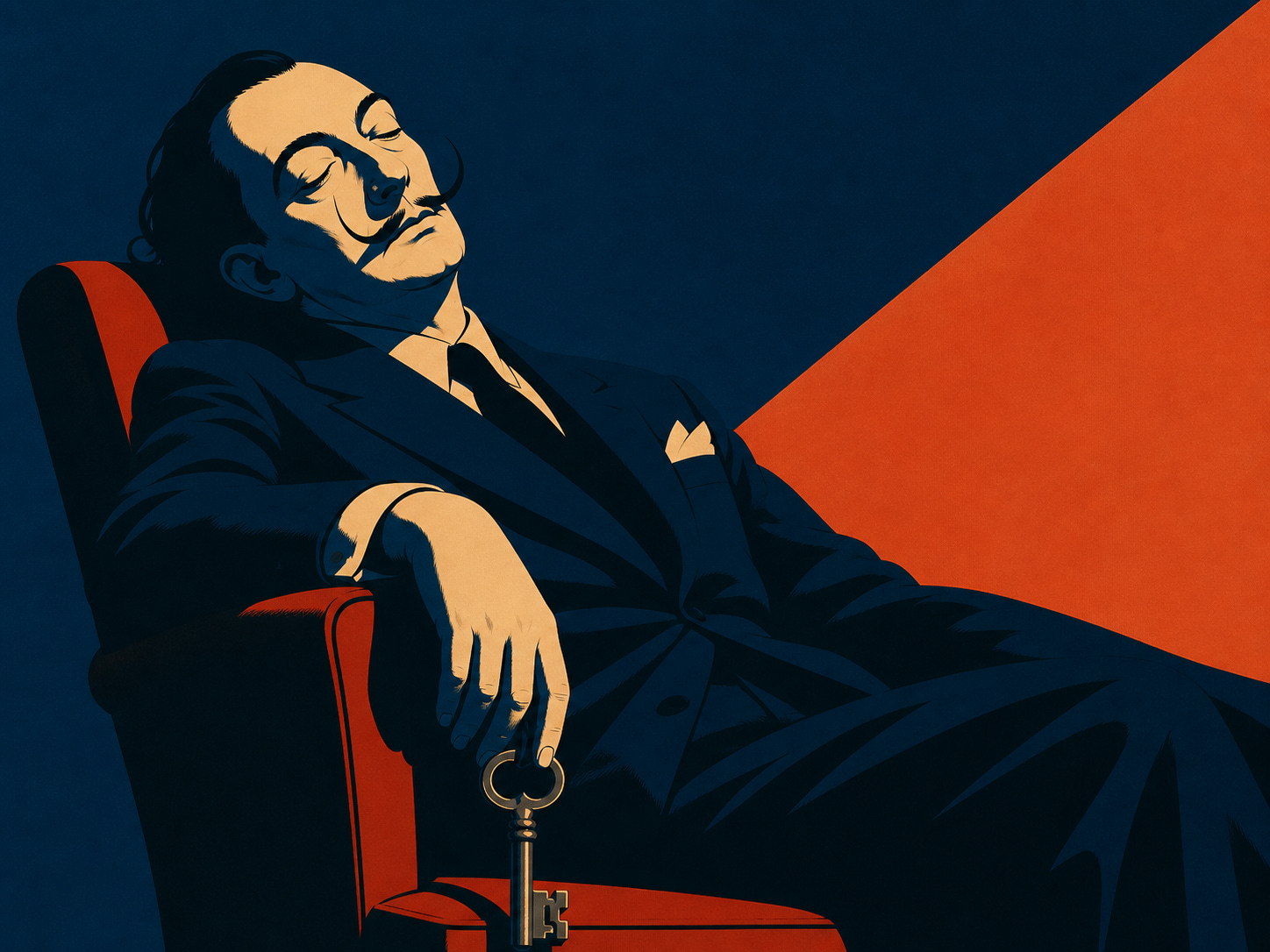
The painter Salvador Dalí developed a mysterious technique to become more creative.
Dalí said he would sit in a chair, with one arm supported and his wrist relaxed over the armrest, holding a heavy metal key above an upside-down plate. As soon as he began to fall asleep, the key would drop, strike the plate, and wake him with a loud crash (Dalí, 1948). He said it worked because he woke up right at the moment of falling asleep—he always stayed at the threshold—and that made him feel more creative afterward.
And he was right.
Science has shown that the onset of sleep can be a creative space, since people who reach it and then wake up solve creative problems better than those who didn’t sleep or who took long naps (Lacaux et al., 2021).
Dalí’s intuition, therefore, was correct: the onset of sleep makes you more creative.
Let’s look at the science behind the perfect nap and how to use it in everyday life.

Why we need sleep
Sleeping is not being inactive.
While we sleep, an active process of metabolic, emotional, immune, and cognitive regulation takes place. Science recommends sleeping 7 or more hours per night regularly (Watson et al., 2015). In fact, in the United States, 30% of adults slept less than 7 hours per night, confirming that chronic sleep restriction remains common and harmful.
Naps can help daily sleep for two reasons:
They reduce homeostatic sleep pressure: This sounds technical, but essentially it means that the longer we stay awake, the stronger our need to sleep becomes. This is due to the principle of homeostasis.
They coincide with a natural drop in energy after lunch, known as the “post-lunch dip” (Monk, 2005). It’s that midday or early afternoon sluggishness we’ve all felt.
Naps and cognitive performance
A scientific study analyzed results from 54 experiments and found a pattern.
Napping improved overall performance, especially in memory, attention, and processing speed (Leong et al., 2022). So no—taking a nap is not laziness. A well-timed nap can be one of the most effective ways to boost performance. But as mentioned: it has to be well planned.
Duration and timing are crucial.
Duration matters
The simple rule is: if you want quick energy, sleep for 10 to 20 minutes.
Naps of 30 minutes can increase the risk of waking during deeper sleep stages (Hilditch et al., 2017), making it harder to regain mental clarity due to sleep inertia. In fact, sleeping 60 to 90 minutes is only recommended if you’re extremely tired, allowing you to complete a full sleep cycle. This can be useful, but it may affect nighttime sleep and is less practical than a short nap.
Best timing: early afternoon
The ideal time is usually between 1:00 p.m. and 4:00 p.m.
This aligns with the natural energy dip and minimizes interference with nighttime sleep. One analysis found that cognitive and physical performance benefits peak around 2:00 p.m. (Saddoud, 2026). That’s why a short nap right after lunch is a great option.
Naps and coffee
It may seem contradictory to drink coffee and then go to sleep, but there’s a trick.
Caffeine takes time to reach its peak effect, so it can start working just as you wake up. Experiments show that 200 mg of caffeine + a nap is more effective at reducing sleepiness and improving performance than napping alone (Hayashi et al., 2003).
Still, use this with caution.
Caffeine can impair nighttime sleep if consumed late and shouldn’t become a chronic substitute for proper rest. In fact, naps are a tool—not a replacement for nighttime sleep. Naps longer than 60 minutes can worsen sleep quality and disrupt physical and mental health by altering biological rhythms (Yamada et al., 2015; 2016).
The perfect nap would be…
For daily productivity/creativity: 10–20 minutes
For deep recovery: 60 minutes (on exceptionally exhausting days)
For overall health: prioritize 7+ hours of regular nighttime sleep
And now, sweet dreams.
Rest well.
Want to learn more? Here are 3 related ideas to go deeper:
✍️ Your turn: How could you incorporate a 10–20 minute nap into your daily routine?
💭 Quote of the day: “Rest is not idleness, and to lie sometimes on the grass under the trees… is by no means a waste of time.” — John Lubbock, The Use of Life
See you next time! 👋

References 📚
Dali, S. (1948). 50 Secrets of Magic Craftsmanship.
Hayashi, M., Masuda, A., & Hori, T. (2003). The alerting effects of caffeine, bright light and face washing after a short daytime nap. Clinical Neurophysiology, 114(12), 2268-2278. URL
Hilditch, C. J., Dorrian, J., & Banks, S. (2017). A review of short naps and sleep inertia: do naps of 30 min or less really avoid sleep inertia and slow-wave sleep?. Sleep medicine, 32, 176–190. URL
Lacaux, C., Andrillon, T., Bastoul, C., Idir, Y., Fonteix-Galet, A., Arnulf, I., & Oudiette, D. (2021). Sleep onset is a creative sweet spot. Science Advances, 7(50). URL
Leong, R. L. F., Lo, J. C., & Chee, M. W. L. (2022). Systematic review and meta-analyses on the effects of afternoon napping on cognition. Sleep medicine reviews, 65, 101666. URL
Monk, T. H. (2005). The Post-Lunch Dip in Performance. Clinics In Sports Medicine, 24(2), URL
Ng, A. E., Black, L. I., & Adjaye-Gbewonyo, D. (2026, abril). Short sleep duration and sleep difficulties among adults: United States, 2024 (NCHS Data Brief No. 559). National Center for Health Statistics. URL
Saddoud, A., Frikha, M., Chlif, M., Bursais, A. K., & Al-Nuaim, A. (2026). Effects of Napping on Cognitive and Physical Performance in Sleep-Deprived Elite Kung-Fu Athletes. Life (Basel, Switzerland), 16(2), 253. URL
The Dick Cavett Show. (2020, agosto 23). Salvador Dali on the meaning behind his art. YouTube. URL
Watson, N. F., Badr, M. S., Belenky, G., Bliwise, D. L., Buxton, O. M., Buysse, D., Dinges, D. F., Gangwisch, J., Grandner, M. A., Kushida, C., Malhotra, R. K., Martin, J. L., Patel, S. R., Quan, S., & Tasali, E. (2015). Recommended Amount of Sleep for a Healthy Adult: A Joint Consensus Statement of the American Academy of Sleep Medicine and Sleep Research Society. SLEEP, 38(6), 843-844. URL
Yamada, T., Hara, K., Shojima, N., Yamauchi, T., & Kadowaki, T. (2015). Daytime Napping and the Risk of Cardiovascular Disease and All-Cause Mortality: A Prospective Study and Dose-Response Meta-Analysis. Sleep, 38(12), 1945–1953. URL
Yamada, T., Shojima, N., Yamauchi, T., & Kadowaki, T. (2016). J-curve relation between daytime nap duration and type 2 diabetes or metabolic syndrome: A dose-response meta-analysis. Scientific Reports, 6(1), 38075. URL
This explains a lot, Alvaro. At about 2 (14:00) my brain powers down. The ensuing nap happens whether I want to or not. The brain is done! You're right about the 60-minute naps, too. I wake up like a zombie. The information about coffee and its timing during nap was a surprise. No wonder that happens. You've solved several mysteries today, Alvaro.