

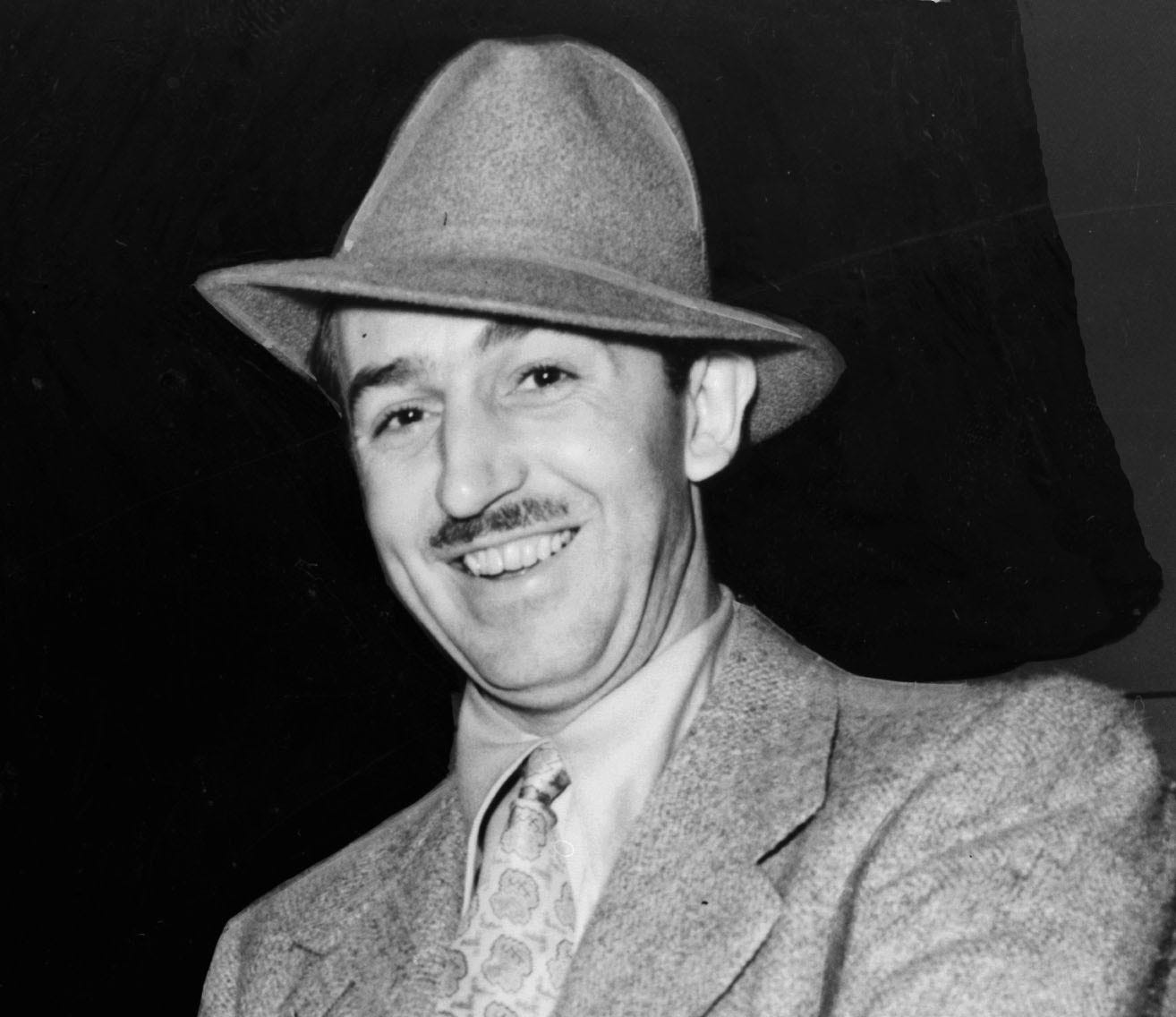
Walt Disney: The child without a childhood who marked the childhood of millions
Notes on gigants - Number 59

Welcome to Mental Garden, a newsletter about creativity, focus, and systems for writing and building projects on the internet. To explore the full library, go here.
The following letter is part of our “Notes on Giants” collection, in which we explore the thoughts and lives of humanity’s greatest minds.
🏷️ Categories: Life lessons, Motivation, Learning.
In 1964, during the premiere of Mary Poppins, Walt Disney seemed to have reached the summit of a mountain that very few people ever manage to climb in their lifetime.
He had revolutionized the animation industry, built Disneyland, brought cinema to television, and created a company that transformed the way people consumed entertainment. A year after his death, more than 240 million people had watched one of his films, millions read his books, and bought his products. He won 22 Academy Awards, more than any other person in history. However, his true legacy was not the awards—it was the characters that shaped the childhoods of millions: Mickey Mouse, Snow White, Pinocchio, Dumbo, Cinderella, and Bambi.
From the outside, it seems as if the story was always brilliant.
But people begin in the shadows long before they shine…



A harsh childhood
Long before he became the famous Walt Disney, he was just an exhausted child.
At nine years old, he worked seven days a week delivering newspapers for his father’s business. While other children played, he would wake up before sunrise, complete his delivery route, attend school, and return to work before the day ended. During winter, the cold was so intense that he sometimes curled up inside bundles of newspapers to stay warm. The hardest part was that he received no compensation for his effort. All the money went to his father, who managed the business (Gabler, 2007).
He repeated that routine without rest for six years.
Decades later, Walt would recall that period saying he was working all the time and never truly had a childhood (Gabler, 2007). His relationship with his father offered little refuge. Elias Disney was an authoritarian man who cared only about work, so Walt grew up without a childhood beyond his father’s business.
The wounds did not disappear when childhood ended.
The relationship between them became so strained that when Elias died, Walt chose not to interrupt a business trip to attend the funeral. Despite everything, after a childhood marked by labor and deprivation, he had an idea: he dreamed of building an animation company. He wanted to tell stories and create worlds, perhaps to compensate for everything he had missed as a child (Gabler, 2007).
That dream would be tested more times than he could imagine.
In 1921, he founded his first company, Laugh-O-Gram Studio. He managed to secure contracts to produce several animations, but the business did not generate enough income to stay afloat. Desperate to save it, Disney bet on a new project called Alice’s Wonderland, a short film combining live action and animation, but it was unsuccessful and the company went bankrupt (Gabler, 2007).
Walt was devastated.
He had failed the investors who trusted him and the friends who supported him. He then decided to move to Hollywood with the intention of becoming a film director, but after months of searching for work, he had to admit another defeat—he could not break into the industry (Gabler, 2007; Schickel, 2019).
For many, this would have already been the end of a dream.
But he kept going.
Walt got back up once more and began showing Alice’s Wonderland to film distributors. Most did not respond, but eventually, a woman named Margaret Winkler, a distributor in New York, gave him a chance. She offered him $1,500 for six Alice shorts. The audience responded well, and more orders followed. Soon after, Walt and his brother Roy founded Disney Brothers Studio, the company that would later become The Walt Disney Company, eventually achieving worldwide fame (Gabler, 2007; Schickel, 2019).
The story changed completely.
When we look at Walt’s life, the only constant was his ability to keep moving forward despite obstacles. That is why his journey contains some of the most valuable lessons on learning and resilience.
Let’s go through the key ideas one by one.
1. Follow what matters to you
The path toward any goal is already difficult on its own.
It becomes even harder if we pursue something that does not truly fit us…
Many people try to find motivation for goals that, deep down, never felt like their own, and pursue them only due to external expectations. This can be one of the worst kinds of suffering: struggling for something you don’t even believe in.
Walt did the opposite.
He rejected a more conventional life and chose to pursue animation when it was still a small and unprofitable industry. His father constantly criticized that decision, but instead of being discouraged, he pushed forward.
All obstacles weigh less when the destination is truly yours.
2. Fail more in order to succeed
We live in a culture obsessed with success.
However, behind every shining story there is often an invisible mountain of mistakes. Walt understood this through repeated failure. Rather than avoiding it, he learned from his errors and kept moving forward with his project.
“All the adversity I’ve had in my life, all my troubles and obstacles, have strengthened me… You may not realize it when it happens, but a hard hit can be the best thing in the world for you.” — Walt Disney (cited by Disney Official Account)
To succeed more, you must be willing to fail even more.
3. Commit for the long term
In poker there is a move called all in, where a player bets everything on one hand.
Walt lived much of his life this way. He invested his time, energy, and resources into a vision that no one could guarantee would succeed. The idea is that the more priorities and plans you have to manage, the fewer resources you can dedicate to each one. So if you commit everything to one, you are more likely to develop the skills, knowledge, and opportunities needed to surpass others.
It is pure mathematics.
The risk is higher, but it maximizes your impact on your single priority.
4. Never stop learning
Invest in knowledge; stay curious.
Walt was a tireless learner who spent hours studying animation, always willing to experiment and learn new techniques, and eager to travel and connect with people from all walks of life to take the best from each of them. It is simple: the more you know about something, the better you become at it. The better you become, the more opportunities come your way and the more confidence you gain.
That is why he considered books one of life’s greatest treasures.
“There are more treasures in books than in all the pirate loot on Treasure Island and at the bottom of the Caribbean… and best of all, you can enjoy these riches every day of your life.” — Walt Disney (Walt Disney Archives)
Knowledge puts you ahead of the rest.
Because of all this, his story continues to inspire decades later.
He was an ordinary man who experienced failure and hard work, but he chose not to make it the end of his story. He was stubborn and passionate, he did not give up, and he kept going until he turned the vision he had as a young man into reality.
A child without a childhood who wanted to give children a better childhood.

Want to learn more? Here are 3 related ideas to go deeper:
First they will mock you, then they will admire you: The life of the greatest high jumper
Before the world believes in you, you have to believe in yourself
Practice matters more than standing out: Stephen King’s lesson on success
✍️ Your turn: What knowledge or skill could change your life in five years if you started developing it today?
💭 Quote of the day: “But a man is not made for defeat. A man can be destroyed but not defeated.” — Ernest Hemingway, The Old Man and the Sea
See you next time! 👋
References 📚
Gabler, N. (2007). Walt Disney: The Triumph of the American Imagination.
Schickel, R. (2019). The Disney version: The Life, Times, Art and Commerce of Walt Disney.
When Disney Studios were under his care and direction, the animated features, films, and short movie, even the Mickey Mouse Club serial, were not only fun to watch but deeply rooted in the literature, the morality lessons of the time, and even as satires on daily dife. Goody was Everyman who struggled with his boss, his son, and so on. After he died and especially after Michael Eisner took over the company, something was lost. There was a cynicism to is that didn't quite gel. And it became more about the money than the children.
I am a retired Disney executive. This is all so true. Each Cast Member lives Walt’s mission to bring joy to everyone we meet.
Ben May
Orlando, Florida