

You're never alone, and that's the problem
Notes on gigants - Number 52

Welcome to Mental Garden, a newsletter about creativity, focus, and systems for writing and building projects on the internet. To explore the full library, go here.
The following letter is part of our “Notes on Giants” collection, in which we explore the thoughts and lives of humanity’s greatest minds.
🏷️ Categories: Solitude, Creativity, Attention.
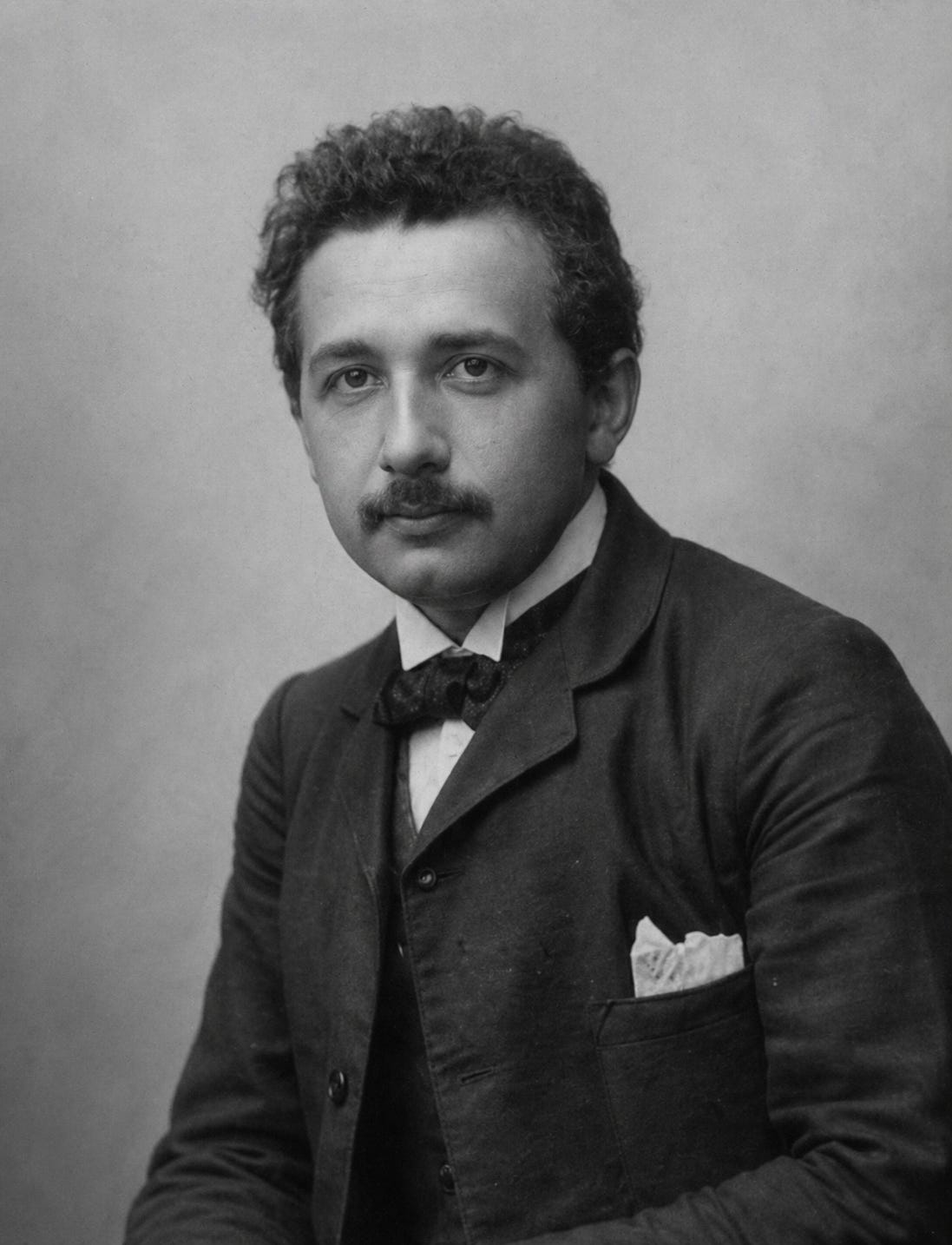
In 1902, a young Albert Einstein, just 21 years old, was about to give up on his dream.
Six years earlier, he had enrolled in Mathematics and Physics at the Federal Polytechnic School in Zurich, but his time there was far from exemplary. He often skipped classes and spent much of his free time courting girls, while playing the violin at ladies’ luncheons and cocktail parties.
It didn’t take long for negative opinions about him to form.
To his professors, Einstein was nothing more than a distracted, lazy student—someone informal, at best destined for a mediocre career in physics. And after graduating, reality was no kinder.
Einstein couldn’t find a job.
He was rejected for a position as a laboratory assistant and even considered the possibility of selling insurance (Kaku, 2008). After two frustrating years searching unsuccessfully for employment, he moved to Bern to work as a clerk in the patent office, where he lived trapped in a routine of six workdays a week. He had no time for anything and was exhausted. Everything seemed to indicate that he would eventually give up on a career in physics forever…
Or would he?
In March 1905, Einstein submitted a paper that challenged one of the most widely accepted beliefs of his time: the idea that light was a wave. Instead, he proposed something groundbreaking—that light was a particle.
In May 1905, he presented a second paper. This time, he questioned another widespread conviction: that atoms did not exist. He provided evidence that they did.
In June 1905, he published a third paper, the most important of all. In it, he proposed that time and space were a single reality, shaping that intuition into what we now know as the theory of relativity.
In September 1905, he published a fourth paper as a continuation of the previous one, where he suggested that mass and energy were equivalent, deriving from it the most famous equation in human history: E = mc².
Those four papers would transform how we understand the world.
This year is known as Einstein’s “Annus Mirabilis” (Miracle Year).
By the end of his career, Einstein had published more than 300 scientific papers, received a Nobel Prize in Physics, and established himself as one of the most important physicists of all time.
This raises a question: How is it possible that a chaotic scientist, a 26-year-old employee perhaps destined for a mediocre life, could suddenly produce four revolutionary papers in the span of a single year?
What is the most important lesson we can learn from Einstein?
Here is the answer.


Hyperactivity
We live in an age of constant action.
Being busy has become a virtue. “Doing things” is a sign that you are moving forward. We measure the value of our days by the number of tasks we manage to check off. The ideal seems to be this: fill every gap and produce non-stop, running endlessly like a desperate hamster on its wheel.
That’s where the great loss begins.
People cannot stand themselves. A study from the University of Virginia found that participants in an experiment preferred to give themselves electric shocks rather than remain alone with their thoughts (Wilson et al., 2014).
We are incapable of spending time alone with our thoughts.
This is why 24/7 mass entertainment thrives—anything to avoid thinking alone.
The reality is the opposite.
It is precisely in moments of solitude and boredom that the clearest ideas tend to appear. It is also there that the mind calms down enough to think clearly and make precise decisions.
Those who cannot spend time alone simply cannot stand themselves.
Time Alone
“I am a solitary traveler and have never fully belonged to my country, my home, my friends, or even my immediate family. In the face of all these ties, I have never lost a sense of distance and a need for solitude.” — Albert Einstein (Isaacson, 2017)
Einstein had to spend a lot of time away from his friends, family, and work, but he didn’t feel bad about it. Being alone didn’t hurt him. In fact, he often spoke about his need for solitude in order to think and move forward.
In a letter to Queen Elisabeth of Belgium, he wrote:
“Princeton is a small and wonderful place, a picturesque village. However, by ignoring certain social conventions, I have managed to create an environment conducive to study and free from distractions.” — Albert Einstein (Letter to Queen Elisabeth of Belgium, November 20, 1933) (Einstein, 2019)
If Einstein lived today, he would likely be labeled a “bitter loner with no social life.”
The reality that no one wants to admit is that without his solitude, he would never have produced the great advances in physics that changed human history. Einstein is not an isolated case—there is a clear pattern. Throughout history, scientists and artists across disciplines have sought solitude to refine their thinking.
How much time do you spend alone with your mind?
In the same way, solitude can help improve our attention, creativity, and decision-making ability. I usually take daily walks out of necessity—it’s impossible to sit down and write without having spent time alone in reflection. I go out without headphones, and if I can, I walk in the countryside. That gives me the clarity I need.
Simply set aside a few minutes each day to be alone and do nothing.
By doing so, you will connect with your inner self and discover ideas and concerns.
Let yourself be bored—do yourself that favor, I beg you.
Want to learn more? Here are 3 related ideas to go deeper:
Amusing Ourselves to Death: The Modern Addiction to Entertainment
Why I Chose to Live a Boring Life: Are You Living Fully or Just Filling Time?
✍️ Your turn: Do you feel uncomfortable being alone?
💭 Quote of the day: “Nowadays, we have a great variety of stimuli—books, videos, social media. We never have to be alone, without anyone to talk to or anything to do. Being alone with one’s own thoughts seems to be an unpleasant experience for many of the participants studied, who preferred to administer a mild electric shock to themselves rather than be deprived of external stimuli.” (Wilson et al., 2014)
See you next time! 👋

References 📚
Einstein, A. (2019). The ultimate quotable Einstein.
Kaku, M. (2008). Physics of the Impossible.
Isaacson, W. (2017). Einstein: His Life and Universe.
Wilson, T. D., Reinhard, D. A., Westgate, E. C., Gilbert, D. T., Ellerbeck, N., Hahn, C., Brown, C. L., & Shaked, A. (2014). Just think: The challenges of the disengaged mind. Science, 345(6192), 75-77. URL
Today, I read an article from Sean Dietrich who is walking the Camino with his wife. He marvels at the social aspect of the Spanish culture. Now I read this, and your bring out the necessity and wonder of alone time and how it can allow our minds to create and to learn our deepest personal thoughts and ideas. What a contradictory day, and how delightful it is to have these opposing ideas circulating the planet. Thank you, Alvaro