

You weren't born to watch life from the sidelines
Living requires getting involved, helping, creating, and being part of the real world

Welcome to Mental Garden, a newsletter about creativity, focus, and systems for writing and building projects on the internet. To explore the full library, go here.
🏷️ Categories: Social relationships, Life lessons, Happiness, Solitude.
JoCleta Wilson’s alarm goes off at 4 in the morning. She jumps out of bed, makes her coffee, gets ready, and then drives to Home Depot to go to work (Page, 2025). It could be an ordinary routine, except for one detail.
JoCleta is 100 years old.
As she told The Washington Post, going to work, talking to people, and feeling useful gives her a sense of purpose and keeps her physically and mentally active. Her story is striking, but it is not a coincidence. Science has shown that taking part in social activities in old age helps delay aging (Kim et al., 2024). In addition, greater social integration is also linked to lower mortality (Pérez et al., 2025).
In other words, you live longer and you live those years better.
Contributing to the world around you benefits both you and others.
Based on this, I had a reflection: the direction of society, generation after generation, is toward people who are more isolated in the digital world, more sedentary, and more disconnected from tangible life. Shared, in-person, and creative activities are declining because of individualistic consumption at home.
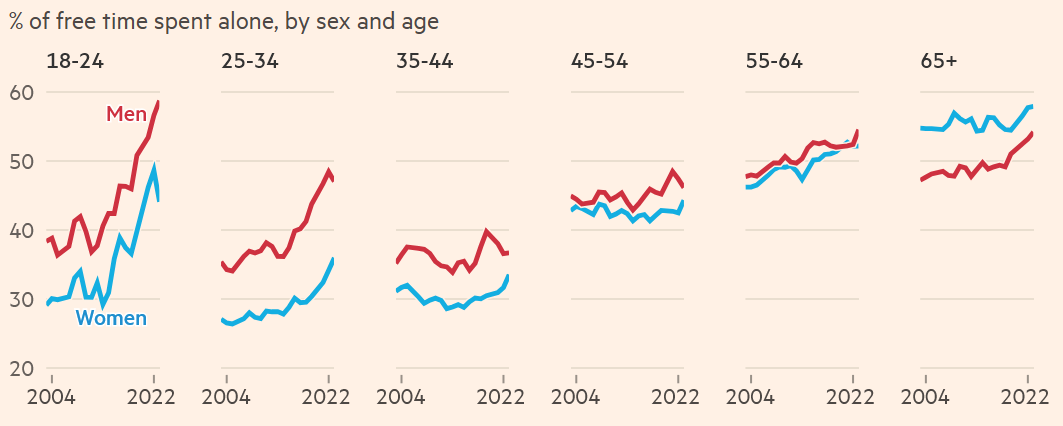
If we do not correct course, the destination is a passive, lonely, and empty life.
Put bluntly: the easiest way to live worse, live fewer years, and feel empty inside is to spend your life without social connections, consuming endlessly, and contributing nothing to anyone or anything. Meanwhile, those who continue contributing to society and who have a strong social network live longer and better.
The idea is clear: we are social beings, and we need to be part of a community.
And that brings the inevitable question: How can you apply this to your own life?
Let’s take a look.

The importance of community
When I was a child, my parents used to say that in the past everyone in the neighborhood knew each other.
Everyone knew their neighbors’ names, what they did for work, their problems, and the lives of their families. It was not unusual to go play at a friend’s house or to exchange what you had for what your neighbor had. You gave them eggs from your hens, and they gave you vegetables from their garden. That was the life my parents knew.
Notice what this implies, because it matters.
In a culture where talking with and helping your neighbor is common, you have to contribute something, because sitting silently in a corner is just too strange. The act of contributing in some way is so natural and obvious that, however small it may seem, it gives you a small sense of personal worth within the community.
Being part of the conversation with your neighbor makes you feel valued.
Helping your neighbor when they need it makes you feel valuable to the group.
Being helped by your neighbor when you need it reminds you that you matter to them.
When you add up all these interactions over the years, it is easy to see how you can develop a strong sense of community. You see yourself as someone useful to the group, someone who is taken into account, and someone whose well-being others also care about.
That matters, and modern life and the internet have lost it.
It is increasingly common to come home from work and spend time passively consuming at home instead of contributing to a greater cause or community you are part of. Much of the time we spend on the internet is devoted to consuming what others have created instead of contributing our own ideas or value to the world.
The result, I believe, is that our sense of personal worth gradually weakens.
Our life becomes less active and less meaningful. More disconnected from reality.
In short: less healthy.
To stop contributing is to stop living
“To live is the rarest thing in the world. Most people exist, that is all.” — Oscar Wilde
As you know, Jardín Mental is about how to live a healthy and intentional life, but also about a human need: to create, to contribute something of our own, and perhaps to turn that impulse into a craft. That is why this news and the scientific findings that accompany it only confirm an important intuition: creating and helping others allows us to live a healthier, happier, and more meaningful life.
We cannot know how many years we are going to live.
But we can decide what to do with the time we are given.
Helping and contributing value within our means is enough. There is no need for great heroic acts; it is enough simply to step in, even in modest ways. Help a stranger on the street. Go play sports with friends instead of just scrolling on social media. Write a paragraph and share it online instead of limiting yourself to reading what others write. Great contributions are not necessary; small everyday ones are enough.
Just yesterday I went to the park to do calisthenics with friends, and I will tell you what happened.
While we were training, we saw a bottle lying on the ground. I picked it up and threw it in the trash.
On the way home, I came across a sign that the wind had knocked over. I stopped, picked it up, and set it back properly so it would not fall again.
When I got home, I felt that satisfaction that small things leave behind. In fact, I wrote it down in my journal and wrote about it happily; I felt fulfilled. I had done nothing extraordinary, but I knew that, in some way, I had contributed to making my city a little cleaner and a little more orderly. It surprised me to see how nobody passing by picked up the bottle or fixed the sign.
There is too much passivity. It harms them, and it harms the rest of us too.
Too often, we live as spectators, not as actors.
Living well requires participation. Being part of something. Leaving a mark, however small, on the place we inhabit. Be bold, start something, or create. Help the people around you and care about them doing well. When the people around you do better, your life improves too. Put forward your own ideas. Listen carefully in conversations. Make art. Get involved. Take part in your community. Contribute to the world in front of you.
Being alive is not the same as living. Remember that.
Want to learn more? Here are 3 related ideas to go deeper:
The Omniscreen: Digital childhood, hyperconnection, and loneliness
Why are we becoming more and more lonely? Everyone online, the parks empty
✍️ Your turn: When was the last time you did something for someone else or for your community without expecting anything in return? A few days ago, a neighbor gave me vegetables from his garden. I am eager to have the chance to help him back.
💭 Quote of the day: “Alone we can do so little; together we can do so much.” — Helen Keller, The Story of My Life
See you next time! 👋

References 📚
Page, S. (2025). Centenarians share their longevity formula: ‘Staying busy gives you purpose’. The Washington Post. URL
Kim, S., Halvorsen, C., Potter, C., & Faul, J. (2024). Does volunteering reduce epigenetic age acceleration among retired and working older adults? Results from the Health and Retirement Study. Social Science & Medicine, 364, 117501. URL
Pérez, A. U., Rashidi, N. E., Farbu, E. H., Castagné, R., Grimsgaard, S., Wilsgaard, T., Vuckovic, D., Tang, D., Chadeau-Hyam, M., Sandanger, T. M., Delpierre, C., Kelly-Irving, M., & Neufcourt, L. (2025). Social integration and mortality across the life course: findings from the Tromsø study. BMC Public Health, 25(1), 4186. URL
Great piece. Do you think connecting with others as we are doing now through writing and response provides the same benefit as in- person contact?